
The strongest GEO agencies in the UK do three things well: build brand authority at the entity level, engineer consistent citations across multiple AI platforms, and help senior leadership teams rethink how digital visibility works when AI delivers the answer before users ever reach a search result.
Businesses investing in GEO now are capturing intent at the moment of maximum influence, before prospects ever reach a traditional search results page.
Around 60% of Google searches in 2025 and 2026 end without a click to any website, as users receive complete answers directly from AI Overviews, ChatGPT, and Perplexity.
When AI Overviews appear, paid search click-through rates have declined by approximately 68%, dropping from 19.7% to 6.34% between June 2024 and September 2025, according to Seer Interactive research tracking 3,119 queries across 42 organisations. Social advertising costs are rising too, with Meta CPMs up approximately 20% year-over-year in 2025.
Your customers aren't clicking links the way they used to. They're getting answers directly from AI engines. It is the most significant restructuring of customer discovery since Google displaced directory search and most UK businesses haven't adjusted their strategy to account for it.
This isn't a generic agency list. It's a guide for senior decision-makers who need to understand what genuinely strong GEO execution looks like, how to evaluate a provider, and what realistic results look like across a 12-month investment.
Why UK businesses are moving to GEO in 2026
Three things are pushing UK marketing leadership toward GEO partnerships right now.
Performance Max has plateaued.
When every competitor deploys the same automation on the same platforms, differentiation disappears. As auction dynamics reset to a higher baseline cost structure, advertisers across nearly all verticals are paying more for less efficient results. The efficiency gains that made Performance Max compelling in 2023 and 2024 are now widely adopted, which means they are a competitive advantage for no one.
Traditional SEO assumptions no longer hold
For a decade, the goal was ranking position one to capture clicks. That model assumed users clicked links to find answers. When AI Overviews are present, organic click-through rates fall by approximately 61% according to Seer Interactive's research. The question has shifted from "how do we rank higher?" to "how do we become the answer AI models provide?" These are fundamentally different problems requiring fundamentally different disciplines.
Most marketing teams weren't built for this
The average UK marketing department has deep expertise in keywords, ad copy testing, and conversion rate optimisation. Very few have anyone with genuine capability in entity architecture, structured data implementation, or LLM citation engineering. GoodFirms' 2026 survey found that 43% of marketers are now actively implementing GEO strategies, up from near zero in 2025. The market is moving, and most internal teams don't yet have the skills to keep pace without external strategic support.
What to look for in a GEO agency
The UK GEO agency market has grown quickly through 2025 and into 2026. Capability gaps between providers are significant, many agencies are repackaging existing SEO services with new terminology rather than delivering genuinely different work. These four questions separate strategic partners from tactical vendors.
1. Can they demonstrate real citation growth across multiple AI platforms?
Most cannot yet. The agencies worth hiring have moved past recycled SEO frameworks and can show actual citation frequency improvements across ChatGPT, Perplexity, Claude, and Google AI Overviews, not just featured snippet rankings rebranded as GEO results. Ask for before-and-after citation data for specific industry queries, across multiple platforms, not a conceptual presentation about how GEO works in theory.
2. What services does a GEO agency need to offer?
At minimum: entity architecture, schema markup implementation, citation-optimised content, digital PR for LLM authority, llms.txt deployment, and citation tracking across AI platforms. If their GEO service looks suspiciously like their existing SEO service with different terminology, it probably is. The disciplines overlap but are not the same, and agencies that haven't made the investment to understand the difference will deliver SEO results, not GEO results.
3. Why does GEO-specific experience matter?
Because the failure modes are different from SEO. Content can rank well in traditional search while being completely ignored by AI models or worse, miscited. AI models weight entity clarity, source authority, and semantic context differently from search ranking algorithms. SEO experience provides a useful foundation but doesn't automatically transfer. The technical and strategic skills required for GEO have to be built separately, and that takes time and investment that most agencies haven't yet made.
4. How should a GEO agency approach measurement?
GEO measurement is genuinely harder than paid media attribution. Citation tracking is still imperfect, many AI engines don't pass referral data that allows precise conversion tracking. Any agency promising clean, linear GEO-to-conversion attribution is overselling the current state of measurement technology.
What good looks like: directional measurement of citation frequency, brand mention tracking across AI platforms, entity authority scoring, and correlation analysis connecting AI visibility improvements to downstream commercial trends.
Top 9 GEO Agencies in the UK
The UK GEO market is still maturing. Fewer than a dozen agencies can genuinely deliver across entity optimisation, structured data architecture, digital PR for LLM authority, and strategic AI transformation.
The table below assesses each agency across three dimensions: technical depth, strategic consultancy capability, and evidence of citation performance.
Agency Comparison Table
1. Push
Founded: 2007
Push operates at the strategic end of the UK GEO market, treating generative engine optimisation as part of broader AI-driven marketing transformation rather than a standalone technical service.
Founded in 2007, Push has built its GEO capability on the back of deep multi-channel performance marketing expertise, which means GEO strategy is always developed in the context of how it integrates with paid search, paid social, and content investment, rather than planned in isolation from the rest of the marketing mix.
The credentials
- Google Premier Partner - top 3% in EMEA
- Microsoft Elite Partner - one of only four in the UK
- Meta and TikTok Premium and Gold Partner
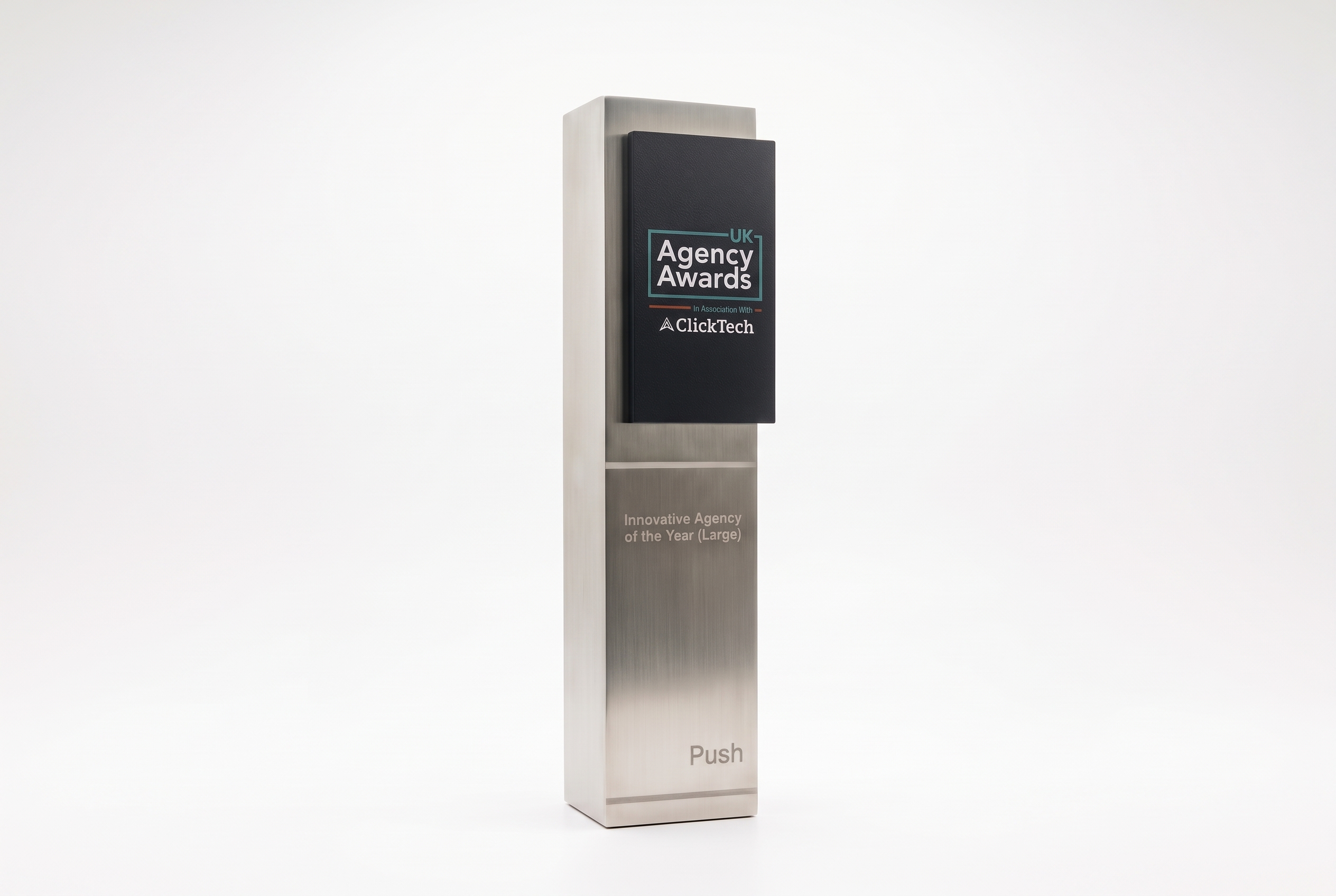
- Best Use of AI in Client Campaign (Global Agency Awards 2026) for AI-powered UGC
- Best Use of Video, UK Paid Media Awards 2026
- 7 major awards in 2025, including Best Use of AI (UK Agency Awards) and Best Use of AI in Search (UK Search Awards)
- Only agency in the world to win awards directly from Google and Microsoft six years running
Clients include
Clarks, Natural History Museum, Golfbreaks.com, Stagecoach, Hilti, Finisterre, Sole Supplier, Truefitt & Hill
What they do
- GEO: entity architecture, multi-LLM citation engineering, llms.txt, schema markup
- Performance marketing: Paid Search, Paid Social, Pay Per Lead
- Organic: SEO, GEO, CRO, AEO
- Proprietary AI tools across the full campaign lifecycle
Best for
Enterprise businesses that want GEO treated as a board-level priority, not a technical add-on.
2. Propellernet
Founded: 2013
Brighton-based Propellernet is a B-Corp certified digital marketing agency with over two decades of search expertise and a B-Corp impact score of 99.4, nearly double the industry median.
Their history of building tools ahead of market need, AnswerThePublic (2014), CoverageBook (2014), and Sandbox, their internal AI tool for stress-testing PR campaigns against AI journalists, reflects the same instinct that makes them a credible GEO partner.
What they do
- GEO strategy integrating structured data, entity mapping, and digital PR for LLM citation authority
- Technical SEO including site architecture and crawl optimisation
- Award-winning digital PR securing high-authority coverage that feeds AI model citation
- Content strategy and creation aligned to AI-driven discovery
- Paid media across search, social, shopping, and programmatic
- AI workshops and LLM visibility measurement for client teams
Best for
Ambitious B2C brands across travel, retail, sport, and lifestyle that want GEO built on strong digital PR and technical search foundations. Clients include AutoTrader, CV Villas, Pour Moi, SportsShoes.com, Gymshark, Waitrose, and Panasonic.
3. Builtvisible
Founded: 2010
Founded by Richard Baxter in 2010 and acquired by CEO Geoff Griffiths in 2019, Builtvisible has spent over 14 years building a reputation as one of the UK's most technically rigorous organic digital marketing agencies.
Their client list includes ASOS, Trainline, and Guardian Media Grouplarge, technically complex websites where the depth of technical execution determines whether GEO strategy is ever realised in practice.
What they do
- Technical entity architecture and schema implementation across complex, large-scale websites
- Semantic content strategy mapping brand entities to natural language AI queries
- Digital PR and content promotion building citation authority in high-trust publications
- AI citation research and entity visibility analysis
- SEO and GEO integrated strategy for enterprise and mid-market B2B clients
- Data and analytics underpinning all organic performance work
Best for
Enterprise and mid-market B2B brands, particularly those in SaaS, technology, travel, e-commerce, and media, with complex technical website architectures where GEO strategy requires genuine technical depth to implement at scale.
4. Charle Agency
Founded: 2018
London-based Charle Agency has positioned itself as the GEO specialist for ecommerce and DTC brands navigating the shift from traditional product search to AI-driven product discovery. Founded in 2018 by Nicholas Dunn, their focus is on the specific challenge facing consumer brands: as more shoppers use AI tools to research and compare products, visibility in those AI-generated responses matters as much as and increasingly more than visibility in Google Shopping results.
What they do
- Product entity optimisation, structured data at the product, category, and offer level
- AI-optimised comparison content and decision-framework articles targeting retail queries
- Digital PR securing product mentions in authoritative consumer and retail publications
- Schema implementation across product, offer, and review entity types
- GEO strategy audits for ecommerce brands transitioning from traditional SEO programmes
Best for
Consumer brands and ecommerce businesses focused on AI-driven product discovery. Particularly well-suited to DTC brands in competitive categories where AI shopping recommendations are becoming a significant influence on early-stage purchase decisions.
5. Blue Array
Founded: 2015
Reading-based Blue Array differentiates on two dimensions that matter to a specific type of client: depth of specialist focus and ethical business credentials.
As a B-Corp certified agency with a B Impact score of 91.9 well above the 50.9 median for ordinary businesses they operate under independently verified standards for social and environmental performance.
What they do
- Entity-first GEO strategy with comprehensive knowledge graph auditing
- Large-scale schema implementation across enterprise website architectures
- Content cluster development for topical authority at scale
- B-Corp compliant agency processes and ESG-aligned reporting
- GEO training programmes for in-house marketing and content teams
- Digital PR building citation authority in authoritative publications
Best for
Organisations that require enterprise-scale GEO delivery, a proven track record as a first-mover in the discipline, and ethical partner credentials as part of their procurement process. Key clients include RAC, Yell, Mail Online, and Crew Clothing.
6. Passion Digital
Founded: 2012
London-based Passion Digital takes a more experimental approach to GEO than most UK agencies. Incorporated in January 2012 and built into a full-service digital marketing agency under CEO Tim Greatrex and founder Mike Grindy, they are early adopters of emerging AI platforms and have built proprietary research tooling for AI visibility analysis that goes beyond standard citation tracking.
What they do
- AI-first acquisition strategy integrating GEO with performance channels
- Proprietary deep research tools for competitive citation analysis across AI platforms
- Cross-platform optimisation across Google AI Overviews, ChatGPT, Perplexity, and emerging AI search tools
- Entity optimisation with a strong content production component
- GEO testing and experimentation frameworks for brands willing to move ahead of established best practice
Best for
Tech-forward brands comfortable with an experimental approach, companies that want to be early movers on emerging AI platforms and are willing to test less-established tactics alongside proven GEO fundamentals.
7. Found
Founded: 2005
Found began its digital life in 2005 as Artemis Eight, specialising in long-tail PPC for major UK companies. In 2010, the agency transformed into Found, expanding its expertise into SEO, content, CRO, and socialthe iteration that defines the agency as it operates today.
Headquartered in London's Hatton Garden, Found is now part of the Tomorrow agency network alongside data company Braidr, influencer agency Disrupt, and proprietary platform Luminr.
What they do
- Integrated GEO and SEO strategy through the proprietary Everysearch™ framework
- Entity optimisation and structured data implementation
- Digital PR securing high-authority citations for LLM visibility
- Luminr platform, real-time visibility tracking across AI and traditional search
- Internal team workshops and GEO training for client marketing departments
Best for
Brands that need a combined traditional SEO and emerging GEO strategy particularly those with existing SEO programmes looking to evolve their approach to AI-driven search rather than replace established investment wholesale. Clients include PUMA, Fender, Unilever, and Wowcher.
8. Impression
Founded: 2012
Founded in November 2012 by Aaron Dicks and Tom Craig, Nottingham-based Impression has grown from a team of two to a multi-award-winning B Corp certified agency with offices in Nottingham, London, Manchester, and New York. Their B Corp certification reflects the same commitment to verified social and environmental standards that distinguishes Blue Array within the list.
What they do
- Integrated campaign planning where GEO strategy informs paid media creative and targeting
- Cross-channel content production designed for both AI citation and direct commercial conversion
- GEO coordinated with PPC and paid social for unified attribution modelling
- Unified reporting connecting AI visibility improvements to wider marketing performance metrics
- AEO and GEO positioned within annual integrated marketing roadmaps
Best for
Companies that want fewer agency relationships to manage and already run performance marketing campaigns through a single provider. Impression is well placed to demonstrate how GEO investment can reduce dependency on rising paid media costs over time.
9. Distinctly
Founded: 2009
Distinctly is an independent digital marketing agency with over 15 years of experience, founded in 2009 and operating from offices in London and Hertfordshire.
Far from the SME-only boutique positioning the agency is sometimes given, Distinctly's actual client roster, which includes Arsenal FC, BoConcept, Zalando, and Watford Football Clubflects a mid-market to established brand focus across ambitious B2C sectors.
What they do
- Integrated GEO, SEO, and digital PR strategy for ambitious B2C brands
- Entity optimisation and structured data advisory
- Digital PR campaigns building citation authority in authoritative publications
- Content strategy and creation aligned to GEO objectives
- Paid media coordinated with organic and PR strategy for unified performance
Best for
Ambitious mid-market and established B2C brands, across retail, sport, lifestyle, and consumer, seeking integrated search, PR, and GEO strategy from an independent agency with a strong competitive track record. Well-suited to businesses where GEO needs to be coordinated across SEO, PR, and content rather than executed as a standalone discipline.
How to choose the right GEO agency
Start with an honest internal capability audit
Before evaluating any agency, assess your team's current capabilities across entity architecture, semantic content strategy, schema implementation, LLM citation engineering, and AI-driven attribution. Most UK marketing teams will find genuine gaps, which is entirely expected, since these disciplines barely existed three years ago.
The more useful question is not "what can this agency do?" but "what do we need externally, and what should we build internally?" Large organisations often have technical teams capable of implementing schema markup and llms.txt files but lacking the strategic expertise to prioritise correctly.
They need consultancy, not execution. Smaller businesses typically need full-service delivery without enterprise-level strategic fees. Knowing your specific gaps prevents the common mistake of hiring strategists when you need implementers, or execution-only agencies when you need strategic direction.
Watch how they run discovery
The clearest signal separating strong GEO agencies from average ones shows up in how they begin a new client relationship. Strong agencies invest time understanding your business model, competitive positioning, customer decision journey, and internal capabilities before proposing anything. They ask questions before offering solutions.
Does the agency begin with questions or answers? Do they want to understand your business objectives, competitive context, and internal constraints, or do they immediately pitch standard GEO packages? Do they acknowledge measurement limitations honestly, or promise universal results regardless of category or competition level?
The strongest GEO agencies operate more like management consultancies than marketing vendors. Expect discovery sessions, stakeholder interviews, and strategic alignment before any implementation proposals.
Ask for citation evidence, not SEO case studies
Many agencies repackage traditional SEO results, featured snippet rankings, Knowledge Panel appearances, organic traffic growth, as GEO success stories. These metrics correlate with good GEO practice but do not prove citation engineering capability.
What to ask for instead: evidence of LLM citation growth across multiple AI platforms, ChatGPT, Claude, Perplexity, and Google AI Overviews. Before-and-after comparisons of citation frequency for specific industry queries. Attribution analysis connecting AI-driven visibility to downstream commercial outcomes.
The strongest agencies maintain proprietary citation tracking tools and can show measurable citation growth for real clients, not just conceptual frameworks for how GEO works.
Be realistic about timescales and what good looks like
GEO delivers compounding long-term competitive advantage, not short-term wins. Agencies promising rapid citation growth or dramatic visibility improvements within weeks are either targeting low-competition, commercially irrelevant queries or overselling a discipline that takes time to build.
If you need short-term performance, paid search remains the right tool. GEO is the investment that reduces your long-term dependency on it.
Choosing the right GEO agency is a strategic decision
Choosing the right GEO agency in the UK determines whether your brand navigates the shift to AI-driven search strategically or reactively. The gap between early movers and laggards will widen as AI citation patterns self-reinforce, brands that appear consistently in AI-generated responses build entity authority that makes future citation more likely, creating a compounding dynamic that late movers will find increasingly difficult to displace.
GoodFirms' 2026 survey found that 43% of marketers are now actively implementing GEO strategies, up from near zero in 2025. The window for establishing clear AI visibility advantages is real, but realising it requires the right strategic partner, not just a technical vendor.
Push offers several ways to begin:
- Strategic Assessment - a half-day workshop with your senior leadership team to evaluate current AI visibility, identify competitive gaps, and map a clear transformation roadmap
- Comprehensive GEO Audit - full entity presence and AI visibility benchmarking across platforms, with a prioritised implementation roadmap for either internal execution or agency partnership
- Transformation Partnership - full-service GEO implementation with embedded team training, ongoing optimisation, and proprietary AI visibility measurement
If you're ready to move from uncertainty to strategic clarity, talk to our team today.
Generative Engine Optimisation FAQs
What is generative engine optimisation (GEO) and how is it different from SEO?
GEO improves how often your content is selected and cited in AI-generated answers, recommendations, and overviews. Traditional SEO focuses on ranking in search results, while GEO focuses on being used as a trusted source inside conversational AI responses.
How do you optimise a website to show up in ChatGPT, Gemini, and Perplexity answers?
It typically combines clear, conversational content with strong page structure (headings, lists, Q&A) and supportive schema markup. It also includes technical improvements like crawlability, performance, and multimodal signals (images, alt text, captions) so AI systems can interpret the page accurately.
What does a GEO audit include?
A GEO audit reviews AI visibility, content structure, technical setup (including schema and indexing signals), and authority indicators that influence whether AI cites your pages. It outputs a prioritised roadmap of fixes and opportunities to increase citations and AI-driven discovery.
How long does it take to see results from GEO?
Many sites see early movement in AI citations within a few weeks, with more consistent gains often appearing over 2–3 months. Timelines vary based on your starting authority, content depth, and how competitive your topics are.
How do you measure GEO performance and AI visibility?
Performance is measured by tracking AI citations, how prominently your site is referenced, and changes in discovery-driven traffic and engagement. Reporting typically combines citation monitoring with keyword/topic coverage and technical health improvements linked to AI-readable content.