
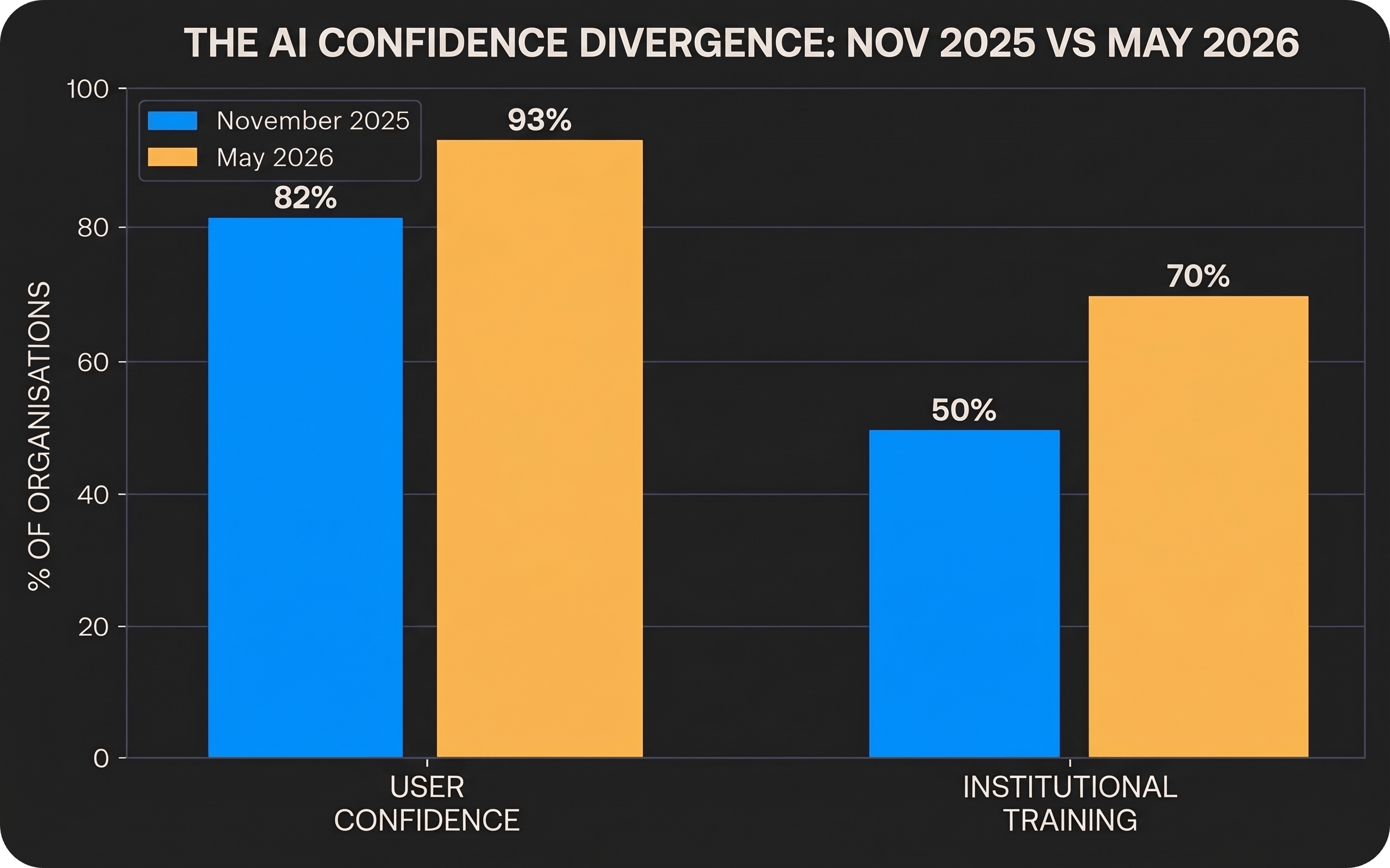
The ARF's figure describes confidence among teams already running AI day to day, not marketers as a whole, so treat it as one data point rather than an industry verdict. Still, an 11-point jump in six months among practitioners tells you something is moving fast.
The ARF tracked this shift from November 2025 to May 2026, and the data tells two stories. One is about speed. The other is about risk. I've spent 12 years watching technology waves hit marketing departments, from Harrods.com in the early e-commerce years through to building a resident portal from scratch at a housing association. Every wave follows the same pattern: adoption outruns governance. AI is doing it faster than anything I've seen before.
Key takeaways
- Practitioner confidence in AI-generated marketing outputs rose from 82% to 93% in six months, per the ARF, while structured testing protocols reached only 64% of organisations.
- 70% of marketing teams say they lack the governance and data structures to scale AI safely, even as 15.3% of marketing budgets now go toward AI tooling (Gartner's CMO Spend Survey).
- AI-generated "digital twin" consumer personas smooth out the contradictions and emotional friction that actually drive purchasing decisions, which makes synthetic research a risky substitute for real fieldwork.
- Consumers penalise brands the moment they spot AI in an ad. Under Armour's positive brand sentiment nearly halved after backlash over its AI-assisted production.
- 39% of CMOs are cutting agency budgets as generative AI compresses production work, but agencies that shift to strategic, causally-validated work stand to capture the value that's left on the table.
What does the ARF's 2026 research actually show?
The ARF's tracking study found AI has moved out of pilot projects and into daily operational infrastructure: creative production, media buying, measurement, consumer research, all of it. Confidence in AI outputs rose from 82% to 93%. Formal upskilling programmes grew from 50% to 70% of organisations. Structured testing protocols reached 64%.
Scott McDonald, President and CEO of the ARF, put it plainly: AI has embedded itself across the whole marketing stack, from creative to econometric measurement, so governance and validation now need the same investment as the tools themselves. Marketing hasn't standardised on one system, either.
Platform-native tools like Google Performance Max and Meta Advantage+ dominate media buying inside their own closed loops, while creative, research and analysis run on a scattered mix of foundation models and specialist vendors. That split creates its own headache: nobody owns the whole picture.

Why is confidence rising faster than the ability to govern it?
Confidence is climbing because AI genuinely speeds up production. Governance is lagging because most organisations built their AI stack before they wrote the rules for using it. Gartner's CMO Spend Survey found marketing teams now put 15.3% of their budget into AI tooling, yet 70% admit they don't have the processes to scale it safely.
Marketing budgets, meanwhile, have sat flat at 7.7% to 7.8% of company revenue through 2025 and 2026. Teams are reallocating existing spend toward AI rather than growing overall investment, so governance has to be built inside a budget that isn't expanding.
MIT's Project NANDA found that 95% of AI production pilots showed no measurable impact on the P&L. Worth flagging: that figure comes from a report published in mid-2025, so by the time you're reading this it may already be dated. Treat it as directional rather than gospel. Even so, the underlying point holds up: heavy tactical throughput on its own doesn't move the business. That's the gap between confidence and commercial return, and it's why PUSH treats AI adoption as a strategy problem first, not a tooling problem. Our AI marketing services are built around that distinction.
Can AI-generated personas replace real consumer research?
No. Joint research from the ARF and the Marketing Science Institute found that AI-generated "digital twins" consistently regress toward the mean, stripping out the contradictions and emotional friction that actually drive buying decisions.
Columbia University's Twin-2K-500 benchmark compared real respondents against their synthetic equivalents and found the AI versions came back hyper-rational, hyper-knowledgeable, and skewed toward optimistic, progressive attitudes that don't match how real people behave. Researchers at the Technical University of Munich found the same pattern testing personality traits like neuroticism and extraversion: AI smooths away exactly the volatility that reveals genuine consumer insight. Worse, these models are unstable. Small changes to a prompt reshuffle which brand benefits an AI surfaces, so two researchers asking slightly different questions get two different truths from the same tool.
Here's the trap: a researcher's own assumptions shape the prompt, the model reflects those assumptions back as a polished consensus, and the business reads that consensus as market validation. You end up optimising a campaign for a customer who doesn't exist. I've built research and insight functions from the ground up before, at a housing association and inside a national media brand, and the lesson holds every time: you cannot skip the mess of real human behaviour and still expect a reliable answer.

What happens to brand trust when people spot AI in your ads?
Trust drops immediately, and it drops hardest in premium and legacy categories where craft and effort justify the price. Research on what's been called "AI Salience" suggests the moment a consumer recognises AI in an ad, they unconsciously discount the effort and investment behind it, which drags down perceived quality and sincerity.
Under Armour's "Forever Is Made Now" campaign shows how fast that can happen. The hybrid production mixed 3D CGI, AI cutaways and repurposed live-action footage of Anthony Joshua, and it drew backlash after a director's uncredited cinematography turned up reused in the mix. Positive brand sentiment dropped from 31.7% to 16.1%, while negative sentiment rose from 1.0% to 7.3%.
Toys "R" Us hit similar turbulence with an early commercial built using OpenAI's Sora, among the first big-brand ads to use the model. It generated polarised reactions over its uncanny visuals and stirred up union debate about bypassing human crews. Dove took the opposite route: its pledge to never use generative AI to depict women reinforced two decades of brand equity built on authenticity, and it earned praise rather than backlash. The pattern holds up: AI used to cut cost gets punished, AI used to serve a genuine brand position barely registers, because the brand led with a human commitment instead.
Is AI killing the agency billable hour?
It's compressing it hard, and agencies still charging by the hour for production volume are exposed. Generative tools now let internal teams churn out hundreds of creative variants in seconds. Gartner reports 39% of CMOs are cutting agency budgets, while 22% say internal AI tools have already reduced how much they lean on external partners for day-to-day execution.
The agencies who survive this shift aren't the ones automating faster. They're the ones who stop selling hours and start selling outcomes: causal proof of what actually moved revenue, strategic problem framing, and the governance internal teams don't have the bandwidth to build themselves. That's the model PUSH has built around, which is why our AI training and workshops focus on giving in-house teams the governance skills the ARF data shows 70% of them are missing, not just the tools.
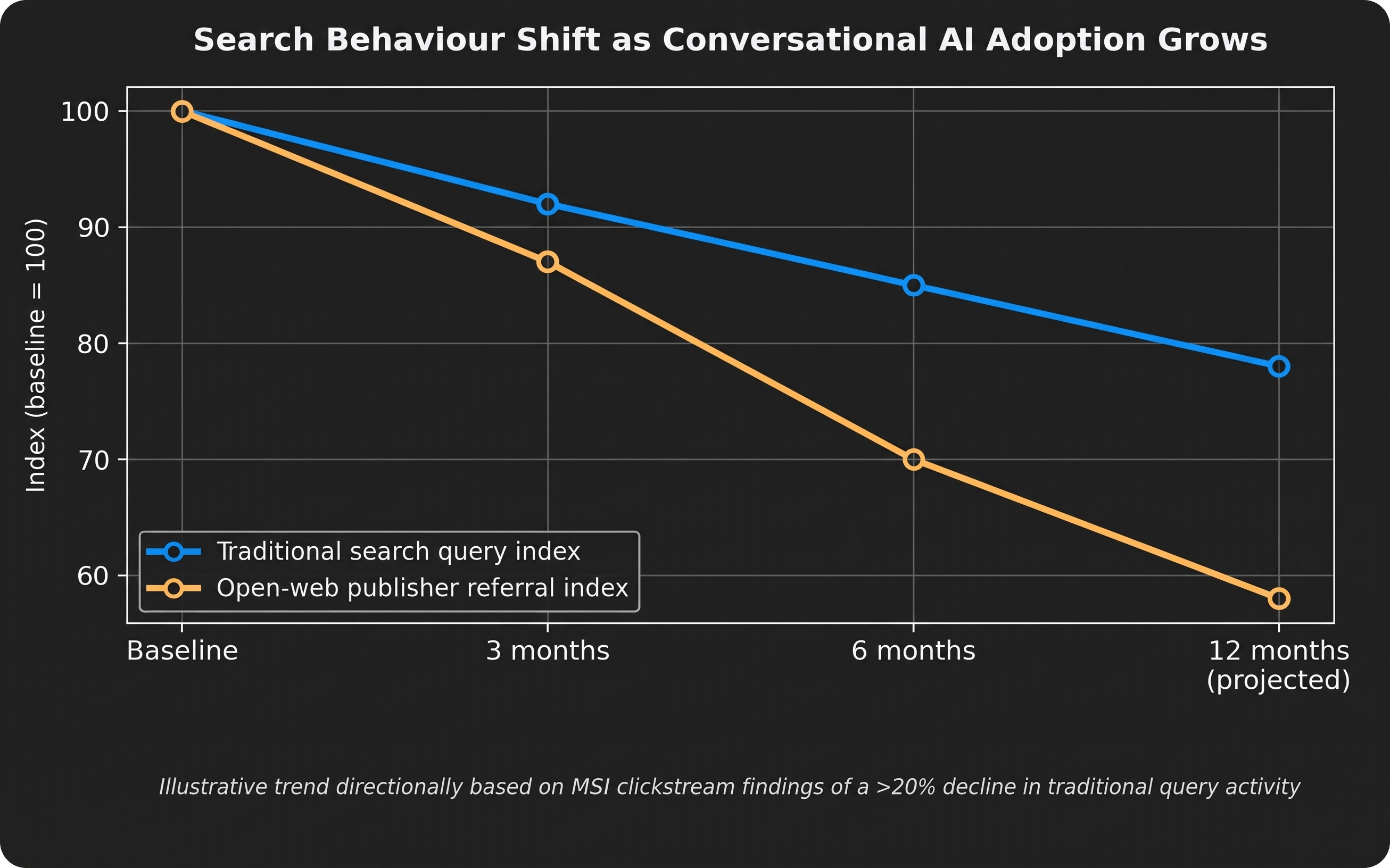
How is AI reshaping search, and where does GEO come in?
Consumers are moving discovery away from search engines and into conversational AI, and that's collapsing the traffic model most brands still lean on. Clickstream research from the Marketing Science Institute found traditional search query activity drops more than 20% among people who actively use conversational AI platforms, and referrals to independent publishers fall even faster.
This is why Generative Engine Optimisation (GEO) matters now, not eventually. GEO is the discipline of making sure your brand gets accurately represented and positively cited when an AI model answers a question, instead of returning ten blue links. Standard SEO and display playbooks don't cover this on their own. It's also why the ARF's Cross-Platform Measurement Council is building "Delegated Identity" frameworks, designed to track commercial intent as AI agents start comparing products and completing checkouts on a person's behalf. We've built our own GEO approach around this exact shift, which is what won PUSH Best Use of AI in Search at the UK Search Awards 2025. You can see how that thinking plays out across the wider market in our
What should marketing leaders actually do about this?
Fix where human judgement sits in the workflow. Most organisations use humans as a late-stage sign-off gate on content that's already been generated. The ARF's Psychology of GenAI research found that a check at that stage catches far less than teams assume. That doesn't mean human oversight doesn't matter, it means where you place it matters more than whether you have it at all. Human expertise earns its keep at the start: framing the problem, spotting bias in the prompt, stress-testing whether a synthetic assumption actually holds up in the real market. Put your best people at the front of the process, not the back of it.
Measure causal lift, not platform-reported ROAS. Closed-loop platforms like Performance Max and Advantage+ are mathematically incentivised to claim credit for conversions that would have happened anyway. Frameworks such as Predicted Incrementality by Experimentation (PIE), developed through MSI research, use live holdout tests to isolate what your media spend actually caused, rather than what the platform says it caused.
Reinvest efficiency gains in brand, not just speed. PwC and the ANA found that when every competitor runs the same foundation models to cut costs, creative variance collapses and brands start looking alike. The organisations pulling ahead do the opposite: they use AI's productivity gains to fund distinctive creative, better first-party data and rigorous measurement, and post markedly higher shareholder value as a result. AI should fund your brand equity, not replace it.
Related frameworks worth knowing
- PIE (Predicted Incrementality by Experimentation) - MSI's holdout-testing framework for isolating true causal ad lift from platform-reported conversions.
- Delegated Identity - The ARF Cross-Platform Measurement Council's emerging standard for tracking commercial intent as AI agents transact on a consumer's behalf.
- Generative Engine Optimisation (GEO) - Structuring brand content so it's accurately cited inside AI-generated answers, not just ranked in search results.
The real work starts now
The ARF's data points to one thing: the industry has solved for speed. It hasn't been solved for judgement.
Every business we work with is asking some version of the same question right now: are we using AI to move faster, or are we using it to make better decisions? Those aren't the same thing, and the 2026 numbers suggest most organisations are still only answering the first one.
If you want to build AI into your marketing with the governance to back it up, talk to PUSH about your AI marketing strategy.
FAQ
Is AI confidence in marketing actually justified by the ARF's data?
Partly. Confidence in output quality is justified for speed and volume, but the same data shows 70% of teams lack the governance and testing maturity to scale AI safely. Confidence is running ahead of readiness, and it's worth remembering that other surveys put marketer trust in AI well below the ARF's figure, so read the 93% as a snapshot of practitioners already deep in the tooling, not the whole industry.
Why do AI-generated consumer personas produce misleading research?
Because foundation models regress toward the mean, flattening real human contradictions and emotional friction into a smooth, hyper-rational consensus that doesn't reflect actual buying behaviour.
Do consumers really notice when an ad is AI-generated?
Yes, at least based on the AI Salience research cited above. Consumers appear to unconsciously discount perceived effort and investment the moment they detect AI involvement, which lowers trust and perceived quality, especially in premium categories.
Are agencies becoming obsolete because of generative AI?
Agencies built around billable production hours are exposed, since AI has compressed that work close to zero cost. Agencies shifting to strategic problem-framing, governance and causally-proven results are gaining value, not losing it.
What is Generative Engine Optimisation (GEO) and why does it matter now?
GEO is the practice of structuring content so AI platforms like ChatGPT, Gemini and AI Overviews accurately represent and cite a brand. It matters because traditional search query volume is already dropping over 20% among conversational AI users.