
Key Takeaways
- AEO (Answer Engine Optimisation) is the practice of structuring content so AI tools like ChatGPT, Perplexity and Google AI Overviews can extract, trust and cite it directly.
- AI-sourced visitors convert at significantly higher rates than standard organic traffic, making AEO the highest-intent channel available to most brands right now.
- AEO and SEO are not competing strategies. AEO builds on the domain authority SEO creates.
- The brands establishing AI citation dominance now are making it exponentially harder for competitors to catch up later.
- Measurement shifts from keyword rankings to share of AI citations, branded search lift, and source diversity score.
Unlike traditional SEO, which optimises for link placement in search results, AEO optimises for direct citations within AI-generated responses. Research from Semrush shows AI visitors convert at 4.4x the rate of standard organic traffic, while Forbes data indicates LLM-sourced leads convert 9x better than conventional search traffic.
If your brand isn't machine-readable, you're invisible in the conversations that matter most.
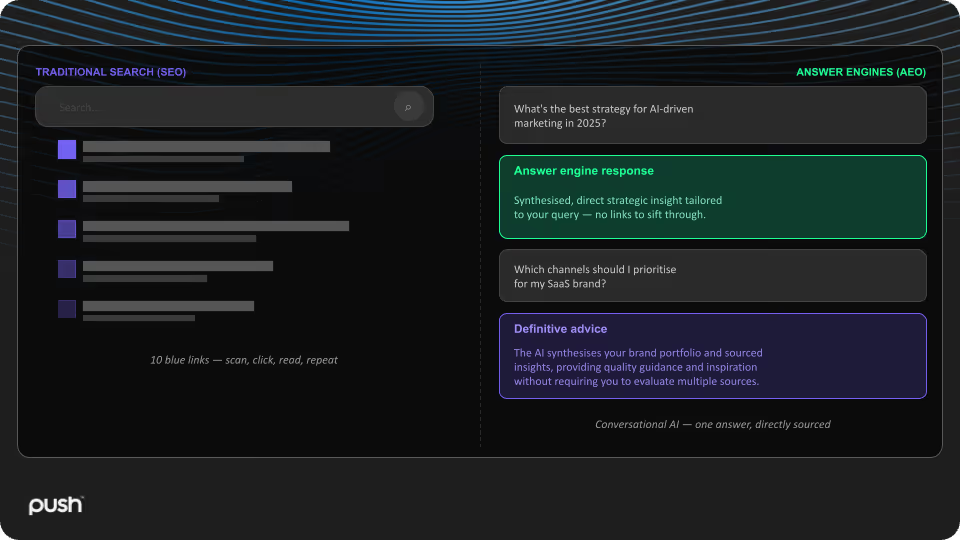
The evolution of search: moving from a directory of links to a direct advisor model that synthesises information for the end user.
The search landscape just experienced its most violent restructuring since featured snippets arrived a decade ago. Gartner predicts a 25% drop in traditional search engine volume by 2026. The cause? Answer engines don't send users to your website, they extract your expertise, synthesise it with competitor data, and present a single "best answer" without requiring a click.
The numbers are brutal. Zero-click searches now account for over 58% of all Google queries. Paid search costs have increased 23% year-over-year, while organic click-through rates continue their freefall. Yet some brands are thriving. NerdWallet reported 35% revenue growth despite a 20% traffic decline by focusing on AI citations rather than raw visitor counts.
The brands appearing in AI-generated answers right now are not there by accident. They engineered it. This guide covers exactly how.
What is Answer Engine Optimisation, technically?
Answer Engine Optimisation is the strategic practice of making your content retrievable, trustworthy, and synthesisable for Large Language Models (LLMs).
Where traditional SEO focused on keyword density and backlink profiles to rank in the top 10 blue links, AEO focuses on Natural Language Processing (NLP) compatibility, semantic clarity, and authority signals that AI systems use to determine citation-worthiness.
The technical difference comes down to extraction versus indexing. Google's traditional algorithm indexes pages based on relevance signals, title tags, meta descriptions, internal links. Answer engines extract specific facts, then cross-reference those facts across dozens of sources to build a consensus answer.
Three core components define AEO optimisation:
1. Machine Readability
Your content must be structured in a way that AI can parse without ambiguity. This means:
- Direct answers placed in the first 40-60 words of each section
- Schema markup (FAQ, HowTo, Speakable) that explicitly labels content types
- No critical information hidden behind JavaScript rendering or gated content
- Clean HTML hierarchy with semantic H2/H3 structure
2. Authority Consensus
AI models don't trust a single source. They aggregate information from news outlets, Reddit threads, G2 reviews, industry publications, and Schema-enhanced websites to determine which brands are credible. If five authoritative sources cite your statistic, you become the source of truth.
3. Atomic Content Architecture
Each section of your content should function as a self-contained "knowledge unit." AI systems extract these units independently, so vague introductions or narrative storytelling that delays the answer hurts citation probability. The inverse pyramid writing style, answer first, context second, dominates AEO performance.
How does AEO work alongside traditional SEO?
The most dangerous misconception about answer engine optimisation is that it replaces SEO. It doesn't. AEO builds on the authority foundations that traditional SEO established.
At Push, we've been tracking AI citation share across client accounts since the major answer engines scaled in 2023. Push won Best Use of AI in Search at the UK Search Awards 2025, not for a one-off campaign, but for a documented, repeatable approach to AI search visibility. The dual-track strategy described above is what we run for clients every day.
The connection is direct: you still need backlinks to build domain authority, but those backlinks must come from diverse, AI-trusted sources, not just SEO-focused link farms. You still need on-page optimisation, but the focus shifts from keyword density to answer clarity.
The brands winning in 2025 are running dual-track strategies: maintaining SEO fundamentals while engineering content specifically for LLM extraction. This approach protects existing traffic while capturing the higher-intent, higher-conversion audience arriving via AI citations.
For businesses uncertain where to start, an AI marketing audit can benchmark your current visibility across both traditional search and answer engines, revealing exactly where your content is losing citation opportunities.
What’s the Difference Between AEO and GEO?
Answer Engine Optimisation (AEO) and Generative Engine Optimisation (GEO) are often used together, but they solve slightly different problems. AEO is primarily about making your content easy for AI systems to extract, trust, and cite when answering a question directly.
GEO is broader: it focuses on how your brand appears across AI-generated experiences more generally, including recommendations, comparisons, summaries, and brand positioning inside conversational interfaces.
What is the ROI case for AEO in a zero-click world?
Let's not sugarcoat it, AI is transforming the marketing landscape, and the old playbooks are dying. Paid search (Performance Max) and paid social are becoming more expensive and harder to differentiate. When every competitor can access the same targeting and automation tools, cost per acquisition becomes a race to the bottom.
AEO offers a strategic counter-position: become the brand AI systems recommend before the paid auction even begins.
The Conversion Premium
Why do AI-sourced visitors convert at 4.4x–9x higher rates? Because AI engines act as trusted advisors rather than neutral directories. When ChatGPT or Perplexity cites your brand in response to "What's the best [solution] for [problem]?", that citation functions as a third-party endorsement. The user didn't choose you from a list, an intelligent system vetted you on their behalf.
This shifts the user's mental frame from "I need to evaluate options" to "I've already been guided to the right choice." The decision-making friction drops dramatically.
The Consensus Opportunity
HubSpot's research into "consensus building" reveals that AI models prioritise Reddit threads, G2 reviews, and niche forums when synthesising brand recommendations. Why? Because these platforms represent authentic user opinion, which LLMs weight heavily when determining trustworthiness.
This creates a strategic imperative: your brand must have a validated presence across the digital ecosystem, not just your owned website. If 12 Reddit threads mention your competitor as "the best tool for X" and zero mention you, the AI will cite your competitor, regardless of your superior backlink profile.
Practical implication: community engagement, review generation, and strategic PR placements now directly impact AI citation rates. Brands that treated Reddit as "just social media" are now scrambling to build retroactive credibility.
The Defensive Necessity
Here's the uncomfortable truth: if you're not optimising for answer engines, your competitors are. And once they establish citation dominance, displacing them becomes exponentially harder. AI models exhibit "source preference", once a brand is cited consistently for a topic, the model reinforces that association in future responses.
Across client accounts, we've seen competitors capture over 70% of AI citations in a category within six months of a brand delaying implementation. Recovering that ground took over a year of sustained content and authority work.
The window for "easy" AEO positioning is closing fast. Brands that establish authority now will defend it for years. Brands that wait will pay acquisition premiums to compete.
How do you implement AEO? A phase-by-phase roadmap

Moving from "uncertain" to "unbeatable" in AEO requires a structured, phased approach. Most brands fail because they treat AEO as a one-time technical fix rather than a strategic transformation. Here's the roadmap that works:
Phase 1: Build Brand Authority Across the Ecosystem (Months 1-3)
AI models can't cite what they haven't ingested. Your first priority is ensuring your brand exists in the datasets LLMs were trained on and continue to reference.
Immediate Actions:
- Audit your current citation presence - Use tools like ChatGPT, Perplexity, and Google AI Overviews to search for questions your brand should answer. Document which competitors appear and which sources are cited.
- Accelerate PR and earned media - Target niche industry publications, podcasts, and news outlets. Each mention becomes training data for future AI responses.
- Activate community engagement - Reddit, Quora, and industry-specific forums aren't optional anymore. Authentic, helpful contributions build the "consensus" AI models rely on.
- Systematise review generation - G2, Trustpilot, Capterra, and Google Reviews all feed into LLM trust calculations. Review platforms make up just 8.5% of links in AI-generated answers, yet three of the five most cited domains are review sites, Gartner Peer Insights, G2, and Capterra. Research from Profound and G2 shows a 10% increase in reviews correlates with a 2% increase in AI citations, and the threshold for meaningful AI visibility starts at around 50–75 verified reviews.
The goal isn't to game the system, it's to create a legitimate, multi-source proof that your brand is the authoritative choice in your category.
Working with a team experienced in AI-driven marketing transformation compresses what typically takes six months into 90 days through strategic media placements and community activation.
Phase 2: Engineer Atomic Content (Months 2-6)
Once your brand authority is established, you need to give AI systems extractable, citation-ready content.
Content Architecture Principles:
- Answer-first structure - Every H2 section should begin with a direct, 40-60 word answer. No preamble, no narrative buildup, just the answer.
- Semantic keyword integration - Use NLP-friendly phrasing: "What is [topic]?" "How to [action]?" "Why does [problem] occur?" These question formats align with how users prompt AI systems.
- Example-driven explanations - AI loves concrete examples because they're easier to extract and verify. "For example, NerdWallet achieved..." performs better than vague claims.
- Statistic citation with sources - Every data point should link to the original research. AI models verify claims by checking whether your sources are trustworthy.
Technical Implementation:
- Schema markup - Implement FAQ and HowTo schema on every relevant page. Speakable schema tells voice assistants which sections to prioritise.
- Internal linking strategy - Guide AI crawlers through your site's knowledge architecture. Each article should link to 3-5 related deep-dive pieces.
- No JavaScript content hiding - If your answer requires JavaScript to render, it doesn't exist to most AI crawlers.
This phase typically involves re-engineering 15-30 cornerstone content pieces and creating 10-15 new atomic guides that directly answer high-volume queries in your space.
Phase 3: Technical Integrity and Distribution (Months 4-12)
The final phase focuses on making your content irresistibly citation-worthy through technical excellence and strategic distribution.
Technical Checklist:
- Page speed under 2.5 seconds - AI systems prioritise fast-loading sources because they assume faster sites are better maintained.
- Mobile-first rendering - Most AI training datasets are mobile-heavy. If your mobile experience is broken, you're not getting cited.
- HTTPS and security signals - Trustworthiness matters. Sites with security warnings are penalised in LLM citation logic.
- Structured data validation - Use Google's Rich Results Test and Schema.org validator to ensure your markup is error-free.
Distribution Strategy:
- Syndication partnerships - License your content to industry publications, always with canonical tags pointing back to your site. This builds "source of origin" authority.
- Social amplification - Every piece of content should be distributed across LinkedIn, Twitter/X, and relevant subreddits (where rules allow). Social signals contribute to recency scoring in AI models.
- Email and newsletter inclusion - Keep your existing audience engaged while signaling to AI systems that your content has recurring value.
An experienced AI strategy partner keeps you continuously adapting to algorithm updates and new citation opportunities as answer engines evolve.
How do you measure AEO success when users don't click through?
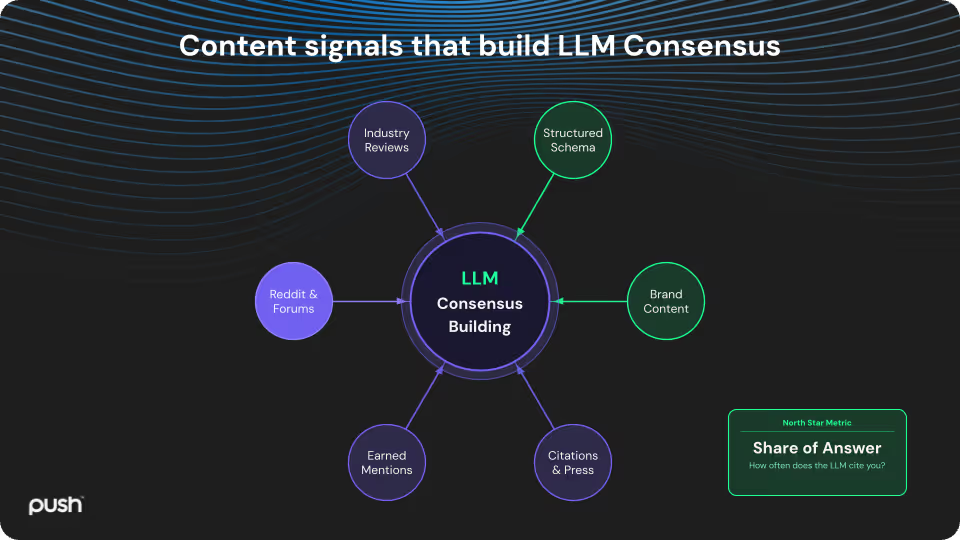
Traditional SEO metrics, keyword rankings, organic sessions, click-through rates, no longer tell the complete story. In a zero-click world, the business wins even when the user never visits your website.
Here are the metrics that matter for what is answer engine optimisation:
1. Share of AI Citations
What percentage of AI-generated answers in your category mention your brand versus competitors? Track this across ChatGPT, Perplexity, Google AI Overviews, and Gemini.
Measurement Method: Monthly, query 50-100 core questions in your space across all major answer engines. Document which brands appear, in what order, and how often. Calculate your share percentage.
Target benchmark: 30%+ citation share in your primary category within six months of AEO implementation.
2. Branded Search Lift
When users see your brand cited by an AI system, they often perform a follow-up branded search to learn more. Track branded search volume in Google Search Console as a proxy for AI-driven awareness.
What to look for: Branded search queries containing modifiers like "review," "vs [competitor]," "pricing," or "demo" indicate high purchase intent triggered by an AI citation.
Target benchmark: 15-25% increase in branded search volume quarter-over-quarter during active AEO campaigns.
3. Source Diversity Score
How many different domains, platforms, and content types cite or mention your brand? AI models prioritise brands with "consensus", the more varied your source types, the higher your trust score.
Measurement Method: Use tools like Brand24, Mention, or Semrush Brand Monitoring to track:
- News articles
- Reddit threads
- Review sites (G2, Trustpilot, Capterra)
- Forum discussions
- Podcast mentions
- YouTube videos
- Industry blogs
Target benchmark: 8+ distinct source types mentioning your brand monthly.
4. Citation Accuracy and Sentiment
It's not enough to be cited, you need to be cited correctly and positively. Track whether AI systems are associating your brand with accurate information and positive sentiment.
Measurement Method: When you discover a citation, evaluate:
- Is the fact stated about your brand accurate?
- Is the tone positive, neutral, or negative?
- Is your brand positioned as a leader or an alternative?
Target benchmark: 90%+ accuracy rate, 70%+ positive sentiment across citations.
Tools like Semrush's AI Toolkit and emerging AEO-specific platforms provide automated citation tracking, but manual monthly audits remain essential for catching nuance and strategic positioning.
For businesses serious about measurement, implementing a custom dashboard that tracks all four metrics provides the executive visibility needed to justify AEO investment and guide strategic pivots.
Why does AEO require cross-functional integration?
The most common failure pattern we observe: treating AEO as a standalone initiative owned by the SEO team. In reality, effective answer engine optimisation requires coordination across content, PR, product, customer success, and paid media.
Why cross-functional integration matters:
- Product teams determine what features can be highlighted in comparison content
- Customer success generates the case studies and testimonials that build consensus
- PR secures the earned media placements that AI models cite as authoritative
- Paid media provides the testing ground for messaging that should also appear in organic AEO content
- Content engineers the atomic guides and structures the answer architecture
Companies that approach AEO as a marketing transformation, rather than an SEO tactic, see 3-5x faster results because every department understands its role in building citation-worthy authority.
This is where working with an agency experienced in AI marketing adoption accelerates progress. External partners bring the cross-functional frameworks and change management expertise to align internal teams around AEO goals without creating territorial conflicts.
How do you stand out when AI summarises everyone's content the same way?
Here's the strategic tension: AI systems synthesise generic facts from multiple sources, making differentiation through information alone nearly impossible. If everyone is citing the same statistic, the same definition, the same best practices, how does your brand stand out?
Answer: Performance-led creative.
AI can summarise facts, but it can't replicate unique insight, provocative perspective, or human-led strategic narrative. The brands winning AEO combine:
- Data-backed substance (which gets cited)
- Opinionated perspective (which gets remembered and shared)
- Visual storytelling (which drives engagement and social amplification)
Example: Instead of writing "10 SEO best practices," a performance-led creative approach writes "Why 7 of the Top 10 SEO Tactics Are Now Obsolete (And What Replaces Them)." The provocative angle drives social shares and inbound links, while the factual core still provides citation-worthy information.
This blend of substance and story is the only sustainable moat in an AI-summarised world. Generic content gets extracted and forgotten. Distinctive content gets extracted and attributed.
For businesses struggling to develop this creative edge internally, partnering with teams specialising in AI-driven campaign delivery provides the strategic narrative frameworks and creative firepower needed to differentiate in a commoditised information landscape.
Why does delaying AEO cost more the longer you wait?
If you're still uncertain whether AEO deserves strategic attention, consider this: every month you delay, your competitors are capturing citations, building consensus, and training AI models to associate their brand with your category.
Reversing that association isn't impossible, but it requires 3-5x the effort of establishing first-mover authority.
The brands that moved early on AEO are now enjoying:
- 35-50% lower customer acquisition costs because AI citations pre-qualify and pre-educate prospects
- Higher average order values because cited brands are perceived as premium category leaders
- Shorter sales cycles because prospects arrive with third-party validation already established
The brands that waited are now fighting for visibility in a citation landscape their competitors have already colonised.
The transition from traditional search to answer engines isn't a future prediction, it's happening now. The question isn't whether to optimise for AEO. The question is whether you'll lead or follow.
How do you start implementing AEO for your business?
Understanding what is AEO is the first step. Implementing answer engine optimisation successfully requires strategic planning, cross-functional coordination, and continuous adaptation as AI systems evolve.
The three non-negotiables for AEO success:
- Executive sponsorship. This is a transformation initiative, not a tactical project. Leadership must prioritise citation-building across all departments.
- Measurement discipline. Track citation share, branded search lift, and source diversity monthly. What gets measured gets managed.
- Best-in-class partnership. Navigating this transition requires expertise in AI systems, content engineering, technical SEO, and strategic positioning, a rare combination to build in-house.
For businesses ready to move from understanding AEO to implementing it, the fastest path forward is a structured discovery process that audits your current AI visibility, identifies immediate citation opportunities, and builds a 90-day roadmap tailored to your competitive landscape.
Book an AI strategy call to benchmark where your brand currently appears (or doesn't) in AI-generated answers, and discover the specific gaps preventing citation dominance in your category.
The death of the link isn't the death of organic growth, it's the birth of a new competitive advantage. The brands that master answer engine optimisation will own the most valuable real estate in digital marketing: direct recommendation by trusted AI advisors.
The brands cited in AI answers six months from now are building that authority today. The only question is whether yours is one of them.
Frequently Asked Questions
Q1: What is answer engine optimisation (AEO) and why does it matter?
A: Answer engine optimisation is the practice of structuring content so AI systems can accurately extract, trust, and cite it in generated answers. It matters because many searches are now zero-click, and visibility increasingly comes from being cited directly inside AI responses.
Q2: How is AEO different from traditional SEO?
A: Traditional SEO aims to rank pages in search results to earn clicks, while AEO aims to earn citations and brand mentions inside AI-generated answers. AEO prioritises answer-first writing, semantic clarity, and machine-readable structure alongside authority signals across the wider web.
Q3: What’s the difference between AEO and generative engine optimisation (GEO)?
A: AEO focuses on being extracted and cited as the direct answer to a question. GEO is broader and focuses on how AI systems describe, compare, recommend, and position a brand across conversational and generative experiences.
Q4: How do AI systems decide which sources and brands to cite?
A: They look for consistent, verifiable information across multiple trusted sources and platforms, not just a single webpage. Clear “atomic” sections, strong authority signals, and consensus mentions in reviews, forums, and publications all increase citation likelihood.
Q5: How do you measure AEO success if users don’t click through?
A: Track share of AI citations for priority queries, branded search lift, and source diversity across platforms and domains. Also monitor citation accuracy and sentiment to ensure the information being surfaced is correct and positively framed.