
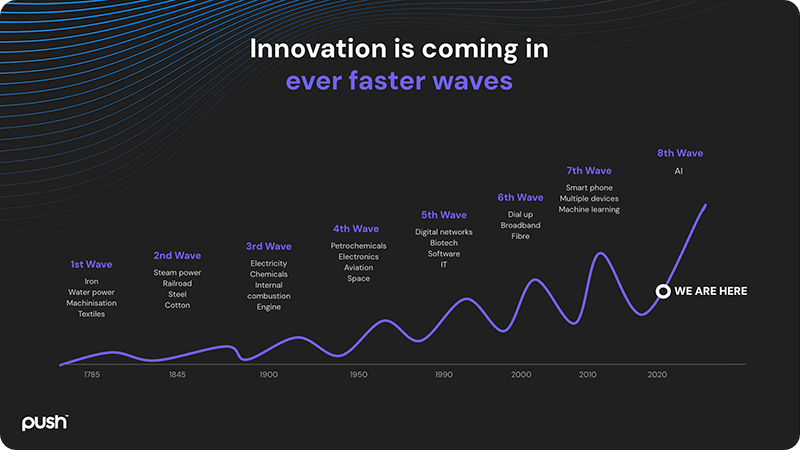
The pace of change IS accelerating and it can be explained. The Kondratieff Cycle, those sweeping 40- to 60-year waves of boom and bust tied to major technological shifts, feels like it's accelerating.
Smartphones reached mass adoption in under a decade. Generative AI tools hit 100 million users in months. Compare that to electricity or the automobile, which took decades to rewire economies.
So are innovation waves genuinely compressing? And if they are, does that mean the current AI wave will transform business and society faster, and more profoundly, than the internet or even electricity?
Here's what the evidence shows.
Are Innovation Cycles Actually Getting Shorter?
Yes, but with important caveats.
Diffusion timelines are compressing
Time-to-50% household adoption has fallen sharply over a century. Electricity and automobiles took several decades; smartphones and social platforms did it in under a decade. ChatGPT-style tools crossed 100 million monthly users within months in 2023–2024, a speed record among consumer applications.
Platform scaling is faster with digital distribution and network effects. Facebook, Android, and TikTok each reached hundreds of millions of users in a few years. The commercialisation phase is compressing even if foundational R&D remains long.
But foundational science hasn't sped up
Semiconductor process nodes, fusion energy, and biotech (with its regulatory gateways) still illustrate persistent long timelines. And diffusion in healthcare, education, and government lags behind consumer tech by years or decades. I have mentioned before on how worried I am that the education sector is falling behind. It is particularly concerning as my son starts his journey into Higher Education this September.
The "wave" feels shorter largely because digital layers can scale near-instantly once the enabling infrastructure exists. Physical-economy innovations, energy grids, transport systems, manufacturing, still follow long arcs.
Bottom line: commercialisation and adoption of digital innovations are clearly faster. The aggregate "wave" might feel shorter, but deep-science and capital-intensive innovations still follow multi-decade cycles.
Will AI Have the Biggest Impact in the Shortest Time?
Framed against General Purpose Technologies (GPTs) like electricity and the internet, AI has distinctive features that could yield faster and possibly broader initial impact.
Speed of deployment
AI is software-delivered. Model access via APIs and SaaS allows immediate diffusion to organisations and consumers without physical buildouts. Early adoption rates have been record-setting for consumer apps. "Drop-in" productivity tools, AI copilots and assistants, integrate into existing workflows (email, IDEs, productivity suites), reducing friction versus past platform shifts.
Breadth across tasks and sectors
AI automates and augments horizontal tasks across knowledge work: coding, design, marketing, analytics, customer support. It's not industry-specific automation; it's a general intelligence layer.
Early randomised and quasi-experimental studies show sizable productivity uplifts. Customer support agents using generative AI saw significant increases in resolved tickets per hour, with the largest gains for less-experienced workers. Software development copilots show double-digit speed improvements in coding tasks.
Writing and content tasks see large time savings and quality improvements for lower-skilled users, narrowing performance dispersion.
These studies collectively suggest faster, more inclusive productivity gains than many prior IT tools, because the "intelligence layer" generalises across tasks.
Complementarities and capital intensity
Unlike electricity's heavy physical capital, AI's core complements are organisational change, workforce upskilling, data readiness, and governance, costly, but largely intangible and faster to adapt than building grids and retooling factories.
But there are constraints. Model accuracy and reliability, data privacy and IP concerns, regulation, and compute/power constraints could temper the speed and breadth of impact. Safety and alignment concerns may slow high-stakes deployments.
AI vs. the Internet: Speed and Scope
Speed: Initial user adoption and incorporation into daily workflows is even faster for AI, due to API-first delivery and integration into existing tools. The internet created new channels; AI enhances cognition within those channels.
Scope: The internet primarily transformed communication, distribution, and information access. AI directly augments creation, reasoning, and decision support across functions, potentially touching a greater share of tasks in the short run.
The internet took roughly 10–15 years for broad economic impact; large productivity debates persisted until the mid-2000s. AI's early micro-evidence is stronger, faster, and more generalizable.
AI vs. Electricity: Can Digital Match Physical Transformation?
Electricity is the archetypal GPT. It impacted nearly every sector but required massive capital, grid buildout, and factory reorganisation, a multi-decade transformation with a well-known productivity "J-curve" (slow early gains, rapid later gains).
Speed: AI requires fewer physical complements at the edge than electrification; thus early productivity impacts can arrive faster in knowledge-intensive sectors.
Depth and durability: Electricity redefined production across the physical economy and enabled a century of follow-on innovations. AI's ultimate depth may match or surpass this if it reliably augments or automates cognition and coordinates physical systems, robotics, autonomy, industrial processes.
To match electricity's foundational status, AI must diffuse into and transform capital-heavy sectors: manufacturing, construction, energy, healthcare. That will take longer.
Practical expectation:
- Short-term (1–3 years): AI likely delivers larger and faster productivity uplifts in white-collar workflows than the internet did in its first few years.
- Medium-term (3–10 years): Impacts broaden as firms reengineer processes, data pipelines, and governance. Gains may concentrate in organisations that invest in complements.
- Long-term (10–20+ years): To rival electricity's economy-wide transformation, AI must extend beyond digital tasks, through robotics, autonomous systems, and AI-enabled industrial processes.
What This Means for Leaders and Marketers
Innovation "waves" feel shorter mainly because digital technologies scale faster. Commercialisation and diffusion are compressing even if foundational R&D remains long.
AI's delivery model (APIs, SaaS), horizontal applicability, and strong early micro-evidence of productivity gains suggest larger near-term impact than the early internet era.
Electricity remains the benchmark for depth and breadth across the physical economy. AI could ultimately match or exceed it if cognitive automation permeates physical systems, but that phase will unfold over a longer horizon.
Organisations can realise tangible gains now in knowledge work via copilots and workflow automation, while planning for deeper process redesign and data governance to unlock step-change benefits.
The clients who win aren't just adopting AI tools, they're rethinking workflows, training teams, and embedding AI into decision-making. You can't just bolt AI onto existing processes. You have to reengineer, starting with AI.
The transformation is happening. The question is whether you'll lead it or follow it.
What's your view? Is AI moving faster than any prior General Purpose Technology, and will it reshape the economy more profoundly than electricity did?
Frequently Asked Questions
Are innovation cycles really getting shorter, or does it just feel that way?
Adoption and commercialisation cycles for digital products are clearly compressing because distribution is instant and network effects scale fast. However, foundational science and capital-heavy rollouts (energy, manufacturing, healthcare) still move on multi-decade timelines.
Why is AI being adopted faster than the internet was?
AI can be deployed through software (APIs and SaaS) and embedded directly into tools people already use, which lowers friction. Instead of creating a new channel like the internet did, AI boosts productivity inside existing workflows, accelerating uptake.
Will AI impact the economy more than the internet?
AI is likely to have broader near-term impact because it augments and automates tasks across many functions like marketing, analytics, coding, and customer support. The internet mainly transformed communication and distribution, while AI directly affects creation and decision-making.
Can AI transform society as deeply as electricity did?
Early gains can arrive faster in knowledge work because AI doesn’t require large physical infrastructure to start delivering value. Matching electricity’s depth depends on AI spreading into physical and regulated sectors via robotics, autonomy, and industrial process change, which will take longer.
What should leaders and marketers do now to benefit from AI without wasting time and budget?
Start with high-volume, measurable workflows (content production, customer support, reporting, research, sales enablement) and redesign processes rather than bolting tools onto existing habits. Prioritise governance, data readiness, and team training so pilots can scale into reliable, repeatable performance gains.