
That was the ceiling of the conversation. AI as a shortcut, a time-saver. A slightly clever tool that sat alongside everything else. That conversation feels like a different era now.
What actually changed
The shift that's happened in UK marketing over the last two years isn't about tools. It's about architecture.
A new category of agency has emerged, one that didn't bolt AI onto an existing model. They built the whole thing around it from day one. Different structure. Different team shape. Different relationship with data. Different ways of thinking about what a campaign even is.
At Push, we've been building toward this since 2007. What started with Google scripts in the early 2010s became a proprietary technology stack, then a dedicated research lab, then a complete repositioning of how we work with clients. Not because it was fashionable. Because we could see where things were heading.
The traditional agency model runs on billable hours. Large teams. Separate departments for strategy, creative, media buying, reporting. Each fragment of a campaign is managed by a different person, often in a different meeting.
AI-first agencies have stripped that back. The routine work, account setup, keyword research, bid adjustments, performance reporting, is handled by automated systems. What remains is a small, senior team doing the work that actually requires human judgment.
A small, highly specialised team can now manage output volumes that used to require a cast of dozens.
For clients, that means less money going to junior execution and more direct access to people who can make fast, commercial decisions based on what's actually happening in the account.
The data problem nobody wanted to talk about
For years, a lot of digital advertising ran on borrowed data. Third-party cookies. Platform metrics. Audience segments built by someone else, on someone else's terms.
That era is ending. Privacy regulations tightened. Cookies are going. The signals that used to power targeting are disappearing.
We saw this coming at Push and built around it. The work we do now is heavily weighted toward server-side tracking, CRM integrations and attribution models that rely on first-party data, information a brand actually owns, about people who have actually engaged with them.
That's also what DIAL360 was built for. Our proprietary platform consolidates data across Google, Meta, TikTok, Snapchat, Pinterest and Microsoft into a single dashboard, normalised, real-time, and ready for AI to work on. The goal isn't a prettier report. It's automated bidding that optimises for real business value, not vanity metrics. Not clicks. Not impressions. Actual outcomes.
According to IAB UK, the UK digital ad market reached £40.5 billion in 2025 and is forecast to grow a further 10.3% in 2026. That's a lot of money. And 56% of industry leaders cite AI and automation as their top operational challenge, specifically around transparency and algorithmic accountability.
The agencies that solve the data problem cleanly are the ones that will earn the trust that comes with that spend.

What the job actually looks like now
The role of a paid media manager has changed more in the last two years than in the previous ten.
The platforms, Google's Performance Max, Meta's Advantage+, programmatic systems, now handle much of what used to be manual. Campaign setup. Creative iteration. Cross-channel bidding. The machine does the optimisation.
What the machine cannot do is decide what matters. It cannot set commercial priorities. It cannot protect brand voice. It cannot ask whether a campaign is actually solving the right problem.
Inside Push, we call this the shift from operator to architect. The team's job is no longer to press buttons. It's to design the system, train the model, and interrogate the output. DIAL, our Digital Innovation Acceleration Lab, exists specifically for this. It's where we test emerging AI technologies before they go mainstream, working in collaboration with Google, Meta and TikTok, so that by the time a new capability reaches clients it's already been stress-tested in real conditions.
The best agencies aren't replacing strategists with AI. They're freeing strategists from work that was never really a strategy.
That's a harder job in some ways. It requires a different kind of thinking. But it's also a more valuable one.
Personalisation at a scale that wasn't possible before
For most of the history of digital advertising, targeting meant demographics. Women, 25 to 34, London. Men, 40 to 55, interested in finance. Broad buckets. Educated guesses. The best available option at the time.
AI-first agencies work differently. Their systems evaluate hundreds of data signals in real time, browsing behaviour, purchase history, time of day, even local weather, and serve a message calibrated to that specific moment of intent.
No human team could manage that at scale. Millions of individual touch-points, across multiple platforms, updated continuously. It's precisely the kind of problem machine learning was built for.
The commercial impact is straightforward: higher conversion rates, better margin protection, less wasted spend. Not because the creative is necessarily better, but because it's reaching the right person at the right moment.
Search isn't what it was
There's another shift happening that most brands are still catching up with. Search used to mean typing a few words into a box and clicking a link. That model is being replaced by something more conversational. People are asking questions of AI systems, ChatGPT, Gemini, Perplexity, and expecting direct answers, not a list of pages to visit.
IAB UK research published in June 2026 found that 74% of its members believe AI-generated summaries are already reducing traffic to brand websites. That number will only grow.
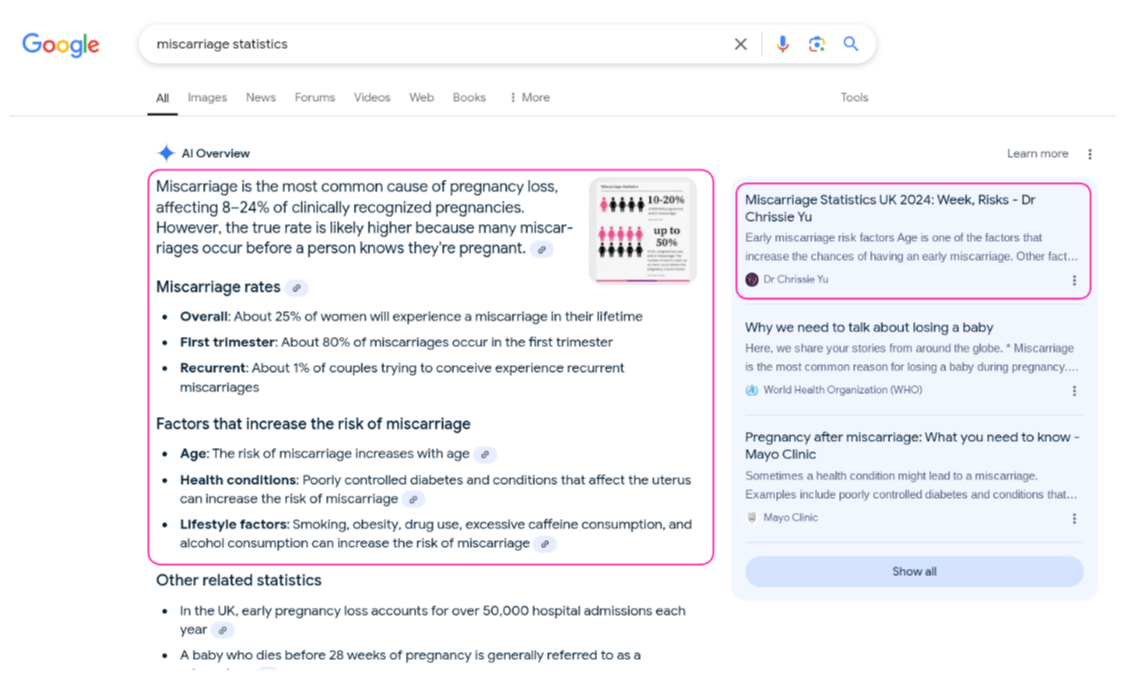
We've been working in this space directly. For a client campaign earlier this year, we structured content so precisely for AI retrieval that it ranked number one in Google AI Overviews, outperforming the NHS on its own subject matter. The content wasn't just well-written. It was built to be read, trusted and cited by an AI system. That's a different discipline from traditional SEO, and most brands haven't started thinking about it yet.
For Clarks during Back to School season, one of the most competitive retail periods of the year, we used AI to analyse and clean over 3,000 keywords in hours rather than weeks, automated competitor gap analysis, and let the team focus entirely on strategy. The result was double-digit organic growth during peak season.
The goal in both cases wasn't to rank on page one. It was to be the answer.
What this means in practice
None of this means traditional agencies are finished. Good strategy, good creative, good relationships, those things still matter enormously.
But the infrastructure underneath marketing is changing. The agencies that built around AI from the start have a structural advantage that is getting harder to close. They're faster. They're more precise. They can offer mid-market businesses the kind of data capability that used to be reserved for enterprise budgets.
We've spent nearly two decades building toward this. Not because we predicted every detail of where AI would go. But because we understood early that the agencies which would matter in the long run were the ones that treated technology as infrastructure, not decoration.
The question for any brand right now isn't whether AI matters in marketing. That conversation is over.
The question is whether the people managing your marketing are architects or operators.
There's a meaningful difference.
FAQ
Q: What is an AI-first marketing agency?
A: An AI-first marketing agency is one that treats machine learning and automation as the core infrastructure of its business model, rather than an optional tool layered on top of traditional processes. These agencies build their team structures, data systems and campaign delivery around automated intelligence from the outset.
Q: What is Push Group's DIAL and DIAL360?
A: DIAL (Digital Innovation Acceleration Lab) is Push Group's dedicated research and development hub, where emerging AI technologies are tested and refined before being deployed in client campaigns. DIAL360 is Push's proprietary AI platform that consolidates marketing data across Google, Meta, TikTok, Snapchat, Pinterest and Microsoft into a single real-time dashboard, enabling automated campaign management and AI-powered creative optimisation.
Q: How are AI-first agencies different from traditional marketing agencies?
A: Traditional agencies rely on large teams and billable hours, with different departments managing separate fragments of a campaign. AI-first agencies use automated systems to handle routine tasks, bidding, reporting, campaign setup, and deploy a smaller, more senior team focused on strategy, commercial judgment and model oversight.
Q: Why is first-party data so important for AI-driven marketing?
A: As third-party cookies are phased out and privacy regulations tighten, brands can no longer rely on externally sourced audience data. First-party data, collected directly from a brand's own customers through its own channels, provides the clean, accurate signals that AI systems need to optimise campaigns for real business outcomes rather than vanity metrics.
Q: How is AI changing search and content discovery in the UK?
A: UK consumers are increasingly using conversational AI tools, such as ChatGPT, Google AI Overviews, Gemini and Perplexity, to find information, rather than clicking through lists of search results. IAB UK research from June 2026 found that 74% of its members believe AI-generated summaries are already reducing traffic to brand websites.
Q: What is Generative Engine Optimisation (GEO)?
A: Generative Engine Optimisation (GEO) is the practice of structuring digital content so that AI-powered search systems can accurately read, understand and cite it in direct conversational answers. It involves semantic relevance, structured schema markup and clear information architecture, distinct from traditional SEO, which focused on ranking in link-based search results.
Q: Has Push achieved results with AI search optimisation?
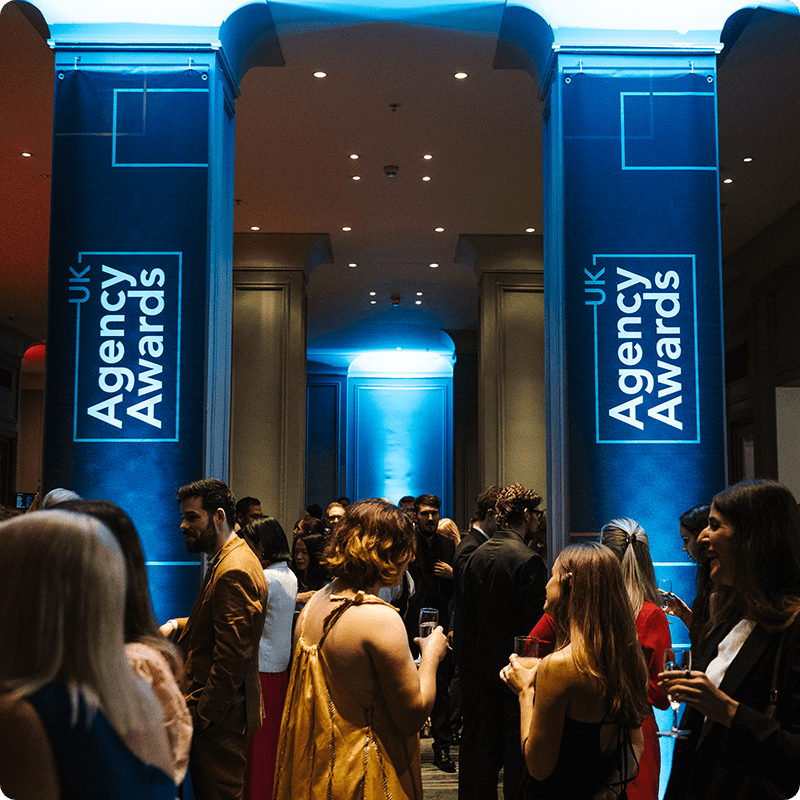
A: Yes. Push's AI-driven content strategy for Dr Chrissie Yu, a London-based consultant obstetrician, achieved the number one position in Google AI Overviews for miscarriage-related queries, outranking established health authorities including the NHS. The campaign won Best Use of AI in a Client Campaign at the UK Agency Awards 2025.
Q: How large is the UK digital advertising market in 2026?
A: According to IAB UK's Digital Adspend 2025 report, the UK digital advertising market reached £40.5 billion in 2025 and is forecast to grow 10.3% to £44.7 billion in 2026. AI is projected to drive approximately £18 billion of that spend by 2030, representing around 32% of the total market.
Q: What awards has Push won for AI marketing?
A: In 2025, Push Group won seven major industry awards including Best Use of AI at the UK Agency Awards, Best Use of AI in Search at the UK Search Awards, and Gold for Best Use of AI/Data in Marketing at the AI & Data Awards. Push has also won awards from Google and Microsoft six years running, making it the only agency in the world to achieve this.
Q: What does the shift from operator to architect mean for marketers?
A: As AI systems take over manual campaign execution, bidding, A/B testing, keyword management, the role of a paid media professional is evolving from someone who executes tasks to someone who designs the systems, sets the strategic inputs and interrogates the outputs. This requires commercial judgment, data literacy and the ability to train and oversee AI models.