
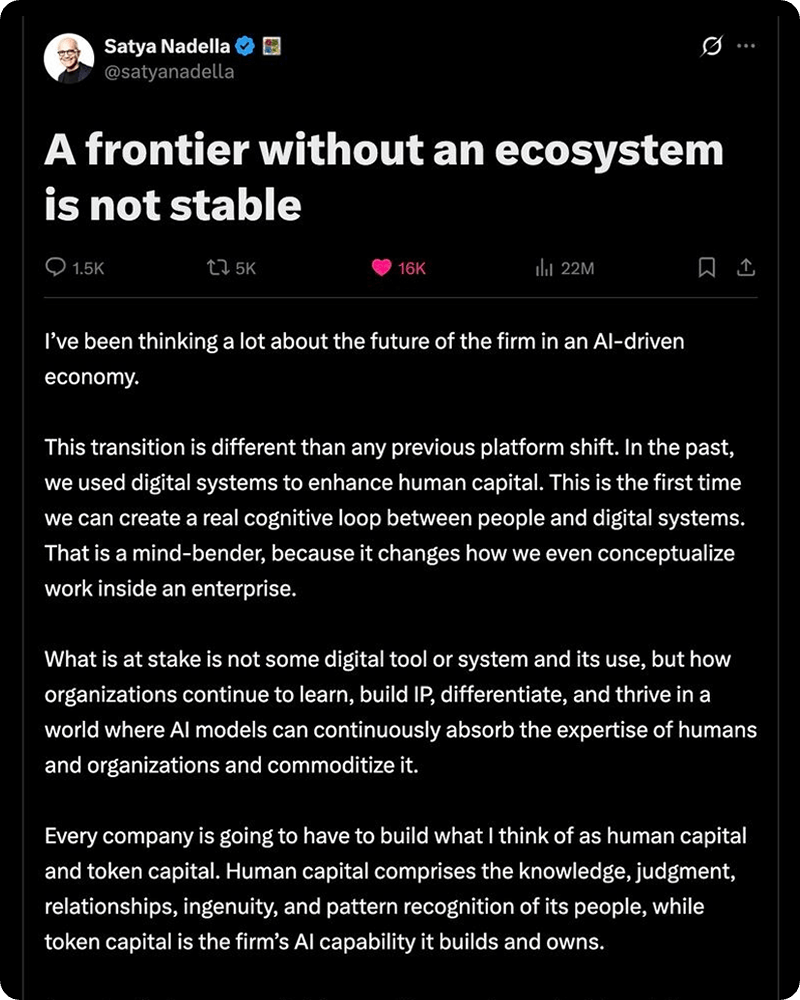
His post on X, titled "A frontier without an ecosystem is not stable," passed 65 million views. That kind of reach doesn't happen by accident. It landed because it touched something people were already sensing but hadn't named.
The AI race is producing winners. The question nobody was asking loudly enough is: winners of what, exactly, and at whose expense?
At Push, we've been working inside this problem for the better part of three years. We've written about the hidden cost of AI tokenomics and what happens when businesses scale AI usage without understanding the unit economics underneath it.
Nadella has now given the same problem a strategic frame. What he describes as the defining risk of the AI era, we've been watching play out inside marketing operations, client by client.
Key Takeaways
- The AI competitive advantage is not which model you choose. It's the learning system you build on top of it.
- Human capital and token capital compound together. As AI capability grows, human expertise becomes MORE valuable, not less.
- Concentration risk is already visible. Roughly 117,000 tech jobs were cut in 2026, with AI cited as a factor by major employers.
- Businesses that cannot switch AI models without losing their institutional knowledge are already exposed.
- Building proprietary AI capability is a cost discipline as much as a technology choice. The two are inseparable.
What does Nadella actually mean by "token capital"?
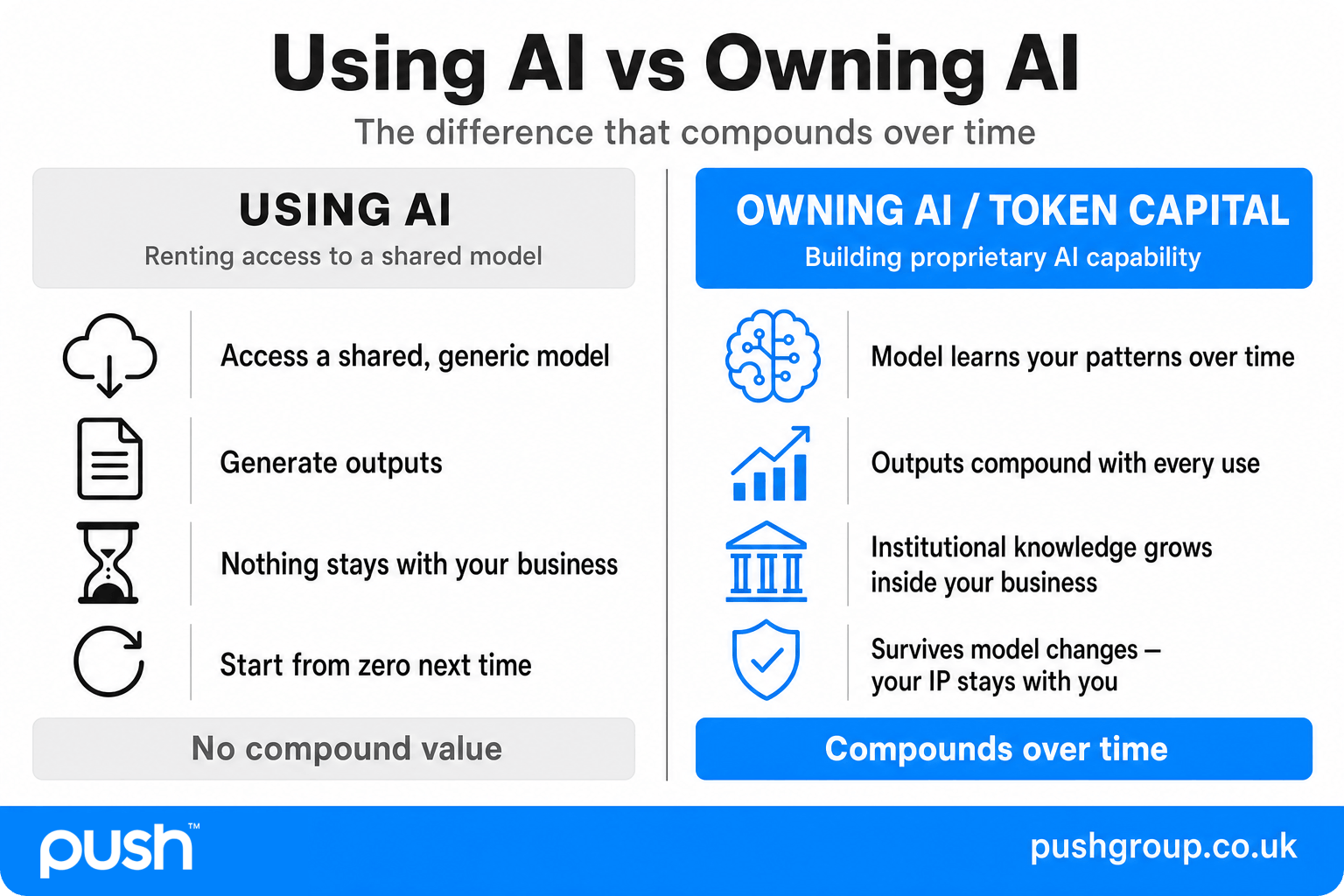
Token capital is an organisation's accumulated AI capability: the refined prompts, evaluation systems, reinforcement learning environments and institutional memory it builds and owns, distinct from the general-purpose model it runs on top of.
Human capital is the familiar side of this: the knowledge, judgment, relationships and pattern recognition of your people. Token capital is what you build when AI starts learning from your specific decisions, your specific data, your specific outcomes.
The relationship between the two is where Nadella makes his most important point. Human capital does not shrink as AI capability grows. It becomes more valuable. People set ambitious goals, make the connections across domains, and spot the patterns that matter to the business. Without that direction, Nadella writes, "you have computers running in circles."
The difference between using AI and owning AI
Most businesses are currently using AI. They have subscriptions. They prompt models. They generate outputs. That is not the same as owning AI capability. Owning it means the system learns from your business over time, and that learning stays with you when you change provider, change team, or change model.
Why context is the competitive moat
Box CEO Aaron Levie put the challenge precisely: "In a world where everyone has access to the same expert intelligence, how does a company differentiate?" That question is uncomfortable because most businesses don't have an answer yet.
A general AI model cannot replicate the specific, accumulated knowledge inside your organisation. But that advantage only holds if you actively build and retain it. Most companies are feeding their best thinking into shared models and walking away with outputs. Nothing compounds. Nothing stays.
Why should UK business leaders care about what sounds like a big-tech problem?
Nadella's concentration warning is not abstract. If a small number of frontier models absorb the expertise of entire industries, the economic returns flow to the model providers, not to the businesses that generated the knowledge in the first place. The competitive differentiation those businesses spent decades building gets commoditised from underneath them.
The historical parallel Nadella draws is pointed. He compares it directly to the first wave of globalisation, when entire industrial economies were hollowed out by outsourcing. The GDP numbers looked fine on the surface. But the displacement was real, and the consequences are still being felt across towns and sectors that never recovered.
For mid-sized UK businesses, this isn't a story about Silicon Valley. It's a story about professional services firms whose strategy work is being absorbed by models they don't own. Retailers whose customer insight is feeding platforms that will sell it back to their competitors. B2B businesses whose institutional knowledge lives in conversations with a third-party AI tool, not inside the organisation.
The political consequences are already arriving
The backlash Nadella warns about isn't hypothetical. Roughly 117,000 tech jobs were cut in 2026, with Meta, Snap, and Block among those citing AI as a factor. Antitrust regulators in the EU and UK have opened investigations into AI market concentration, particularly the relationships between the largest model providers and the platforms built on top of them.
This is no longer a strategy conversation only. It is already a policy conversation. Businesses waiting to build their own AI capability will find themselves on the wrong side of both.
What is the "hill climbing machine" and what does it look like inside a marketing operation?
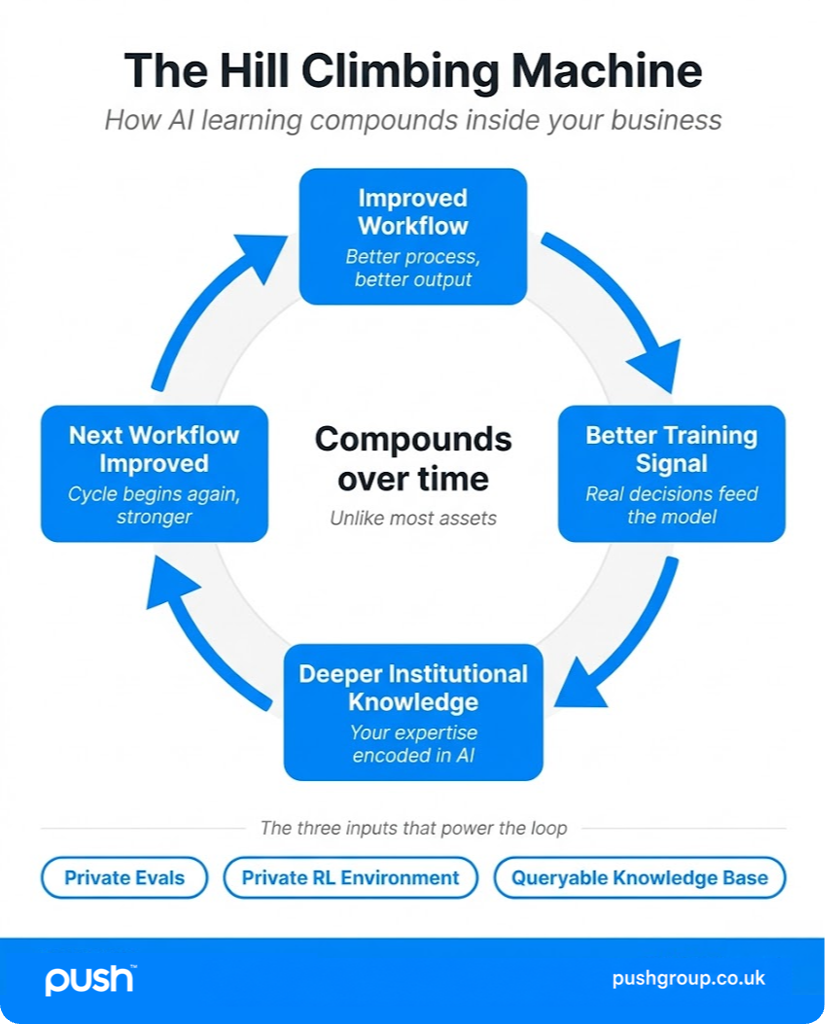
Nadella's practical framework has three components. Private evals: your own performance scorecard that measures whether AI is improving against outcomes that matter to your business, not generic external benchmarks.
Private reinforcement learning environments: systems where models are trained on your internal data, decisions and workflows. A queryable knowledge base: institutional memory made searchable, which also makes token usage more efficient. Together, these form what he calls a "hill climbing machine."
Every improved workflow produces better training signals. Better signal deepens institutional knowledge. That knowledge improves the next workflow. Unlike most assets, it compounds.
Private evals in marketing terms
Not "did the AI produce a good headline." Did it produce a headline that performed against your specific audience, on your specific channel, for your specific offer? Generic benchmark performance is a starting point. What builds competitive advantage is knowing how AI performs inside your business, against your real outcomes, tracked and iterated over time.
Training on your decisions, not generic data
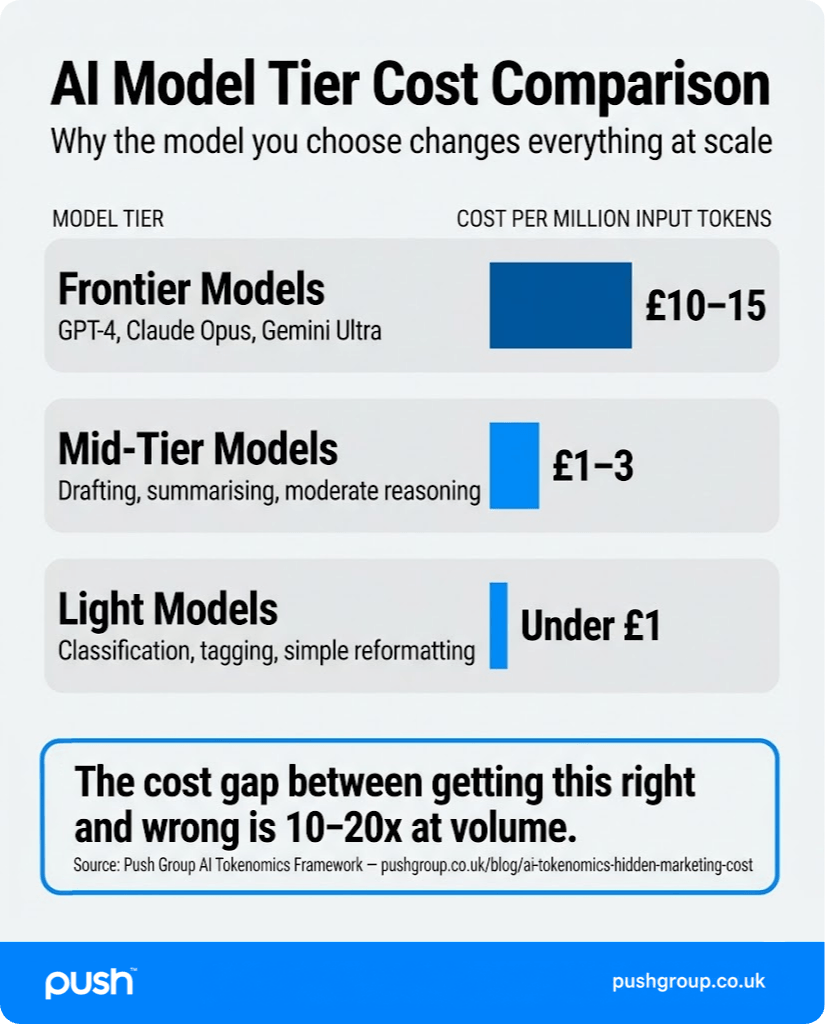
At Push, we've written about how a model trained on your own patterns produces clean outputs on the first pass. That isn't just a quality improvement. It's a direct cost saving. The difference between a model that knows your business and one that doesn't is a 10 to 20 times cost gap for equivalent output quality. That gap is the commercial argument for building your own loop, not just prompting a shared model.
Institutional memory as a portable asset
Nadella sets a single test for whether a company actually owns its AI capability: can it swap out one foundation model for a newer one without losing the "company veteran" expertise baked into its system?
If the answer is no, institutional intelligence is locked inside someone else's model. When that model changes, or the contract ends, or a better option arrives, the knowledge walks out with it.
What has Push learned from working inside this problem?
I co-founded Push in 2007 coming out of senior roles at Kraft Foods, PepsiCo and Disney. Across that career I watched businesses build real institutional advantages, in brand knowledge, customer relationships, channel expertise, and then make decisions that handed those advantages to intermediaries who extracted the value and moved on. Outsourcing. Consolidation. Platform dependency. The pattern repeats.
AI is the latest version of that pattern, and it runs faster than any previous iteration.
When Push went AI-first, we encouraged full adoption across the team. No gatekeeping, no approval gates. We wanted genuine usage, not a pilot. Adoption grew fast. Then we discovered what Ricky Solanki captured in our AI tokenomics piece: the cost curve wasn't flat. Credits ran out mid-month. Work stopped. The economics of AI at scale are usage-based and variable, not fixed subscriptions. Teams that model it as the latter eventually hit a wall.
The answer was not to restrict usage. It was to treat AI spend as a managed operational cost: renegotiate with providers, map workflows to model tiers, and audit prompts for efficiency. Cost-per-output dropped by around 40% compared to our initial unstructured period. That is what optimisation looks like once you understand where your actual value sits.
The lesson for any business on this journey: let adoption happen. Measure it properly. Build structure once you understand where the waste is and where the value compounds.
What does this mean for how you choose an AI marketing partner?
If Nadella is right, and the argument holds up on its merits, then the question for any business evaluating an AI marketing agency is not which models they use. It's whether they build your capability or their own.
There is a version of AI agency work that amounts to using frontier models on your behalf and reporting on outputs. That's a service. It doesn't compound anything inside your business.
Push's approach is different. As a Google Premier Partner (top 3% in EMEA) and Microsoft Elite Partner, one of only four agencies in the UK, we build AI systems that run inside client operations. The intent is always that the learning compounds inside the client's business, not inside ours. That means structured prompt libraries, documented workflows, and AI operations built to survive a model change.
Snowflake CEO Sridhar Ramaswamy described the risk plainly in a February 2026 podcast. The largest AI companies "want to create a world in which all of the data for all of the enterprises is easily available to them," he said, with everything else becoming "a dumb data pipe." That's the outcome Nadella warns against. It's also the outcome any business should be actively designing around.
The model portability test
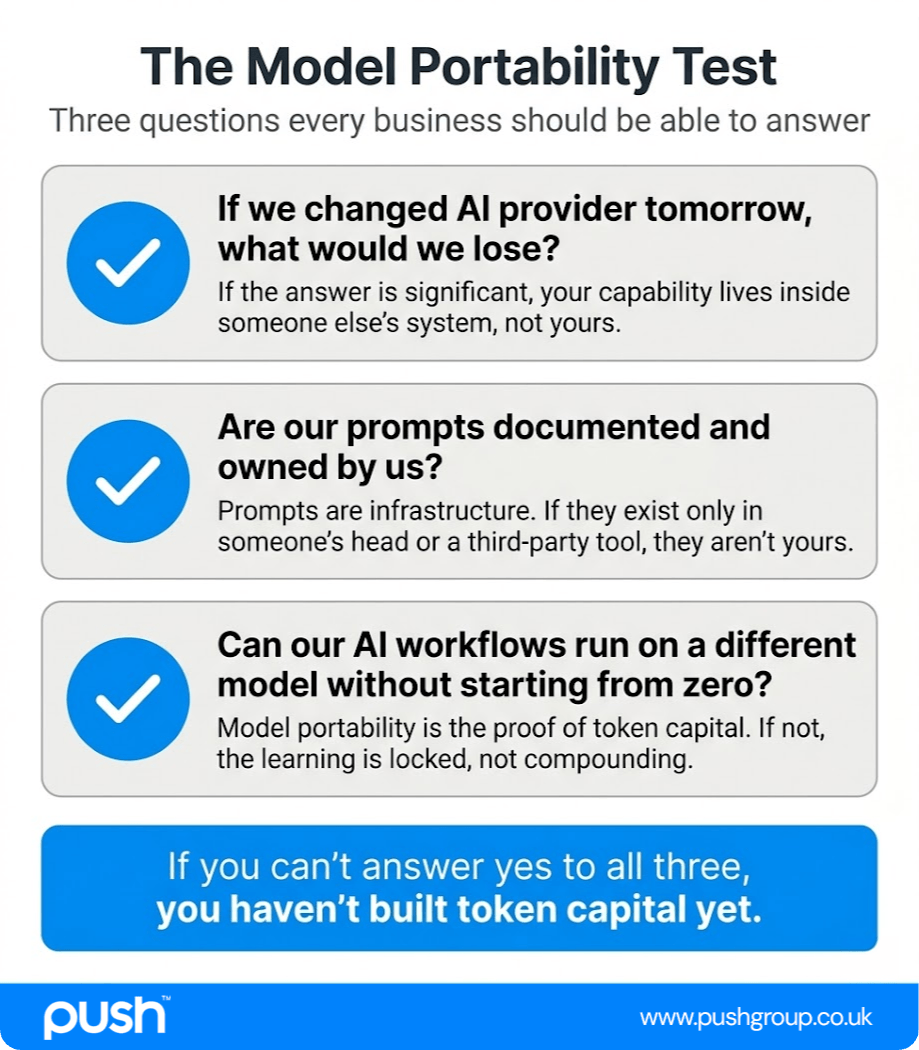
Ask this question before you sign any AI contract or agency agreement: if we changed AI provider tomorrow, what would we lose? If the answer is "everything," the capability is not yours. If the answer is "nothing material," you haven't built any yet. The right answer is "our institutional intelligence stays with us. The model is replaceable. The learning is not."
Is Nadella saying the right things for the right reasons?
There is an obvious tension in this essay and it's worth naming directly. Nadella runs a company that sits in the exact platform layer his framework would make indispensable. A world where every enterprise builds proprietary learning loops on commodity foundation models is, conveniently, a world where Microsoft sells the cloud infrastructure, the developer tools, and the AI partnerships to build all of them.
You can believe in guardrails and still compete hard inside them. That tension doesn't invalidate the argument. But it means reading it with clear eyes. The globalisation parallel is sound.
The concentration risk is real and independently corroborated by executives at Snowflake and Box who have nothing to gain from making the same point. The prescription, building proprietary learning loops on portable infrastructure, is the right strategic response regardless of who is making the case for it.
The harder question is whether any major platform provider will resist the long-term pull to capture the value flowing through the systems they host. Nadella says platforms should enable more value than they capture.
His own company's balance sheet, with capital expenditure up nearly 66% year-on-year, suggests the economics of that restraint are harder than the philosophy of it.
What should you actually do with this?
Three things, in order of priority. First, audit what you currently have. Map every AI tool in use across your business. For each one: who owns the learning that tool is generating? If it's the tool provider, not you, that's the gap.
Second, build a prompt and workflow library. Prompts are infrastructure, not disposable instructions. A documented, tested, improving library of prompts is the starting point for institutional AI knowledge. Without it, you're starting from zero every time a team member leaves or a tool changes.
Third, define your model portability standard. Before your next AI investment, ask whether you can take your capability with you. If you can't, negotiate the terms or find a partner who builds portably. For teams ready to go further, our AI training programmes are built around exactly these disciplines: prompt engineering, workflow optimisation, and building AI capability that stays inside the business.
The businesses that act on this now will compound an advantage that grows harder to replicate. The businesses that don't will find, as Nadella puts it, that their knowledge is being "commoditised right out from underneath them." That's not a 2030 problem. The timeline on this is already running.
FAQ
What is token capital and how is it different from AI tool usage?
Token capital is the AI capability an organisation builds and owns: its prompt systems, evaluation frameworks, reinforcement learning environments and institutional memory encoded into AI workflows. Using an AI tool means accessing a shared model. Token capital means the model learns from your specific business over time, and that learning stays with you.
What is a learning loop in AI and how does a business start building one?
A learning loop is an AI system that improves by learning from a company's own internal data, decisions and workflows rather than relying solely on a pre-trained general model. Building one starts with three components: private evaluation systems that score AI against your real outcomes, reinforcement learning on your internal data, and a queryable knowledge base of institutional memory.
What is AI tokenomics and why does it matter for marketing budgets?
AI tokenomics is the commercial discipline of understanding, tracking and optimising token-level costs across AI workflows. Unlike fixed software subscriptions, AI costs are variable and usage-based. A frontier model costs 10 to 20 times more per task than a mid-tier model for equivalent outputs. Teams that don't map workflows to model tiers consistently overspend.
How do I know if my business is too dependent on a single AI model or provider?
Apply the model portability test. Ask: if we changed AI providers tomorrow, what institutional intelligence would we lose? If the answer is significant, your capability is locked inside someone else's system. A well-built AI operation should survive a model change with its accumulated knowledge intact.
What should a mid-sized UK business prioritise when building an AI strategy?
Start with three steps: audit every AI tool in use and map who owns the learning it generates. Build a documented prompt and workflow library that improves over time. Define a model portability standard before signing any new AI contract. These three actions are the foundation of proprietary AI capability.