
New research surveying 1,415 marketing leaders and 3,547 consumers across seven countries puts a number on it. AI marketing has a trust problem. The tools are universal. The consumers can tell. And 70% say something is missing.
That gap, between the speed everyone has gained and the trust most brands haven't earned, is where the real work is.
Key Takeaways
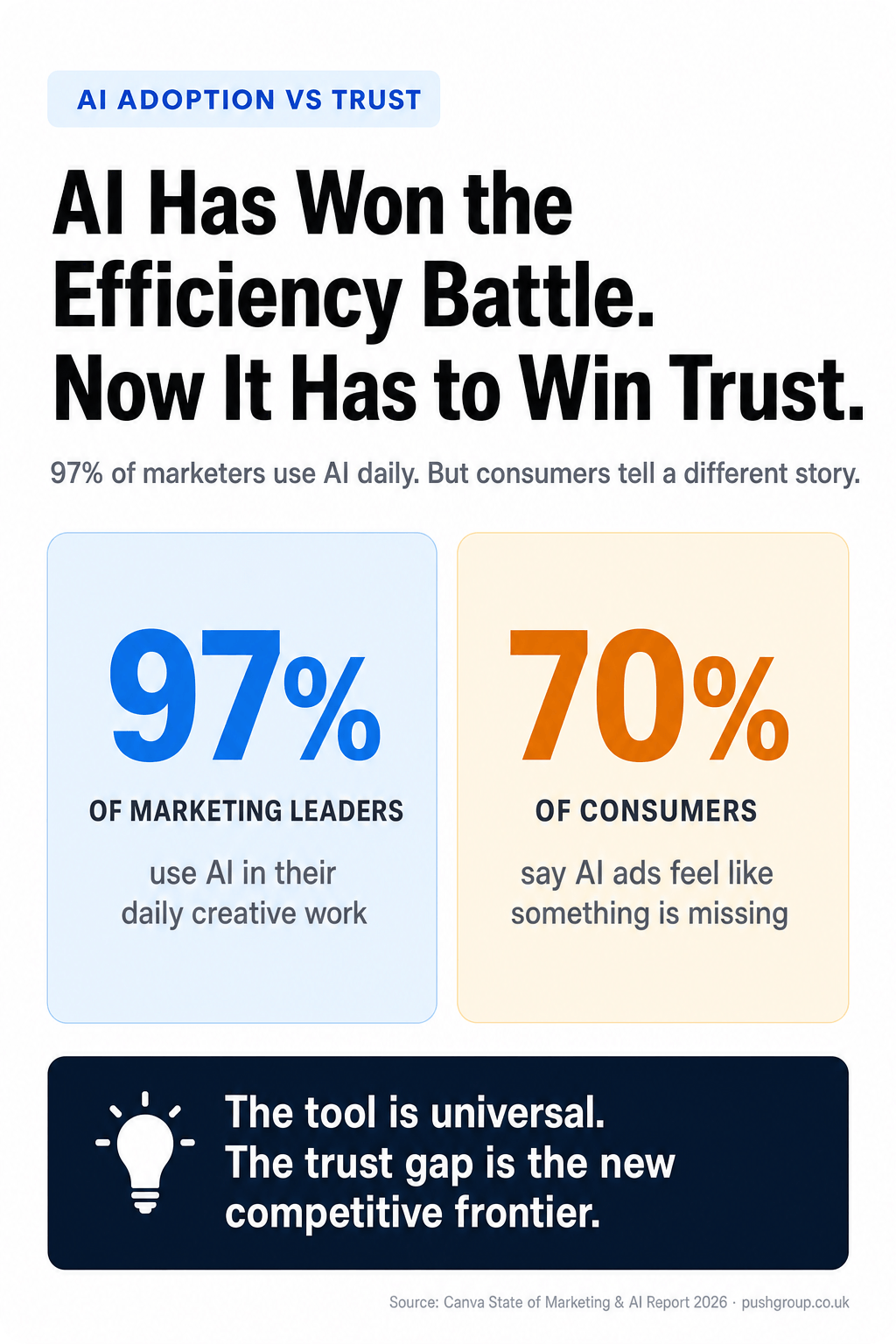
- 97% of marketing leaders now use AI in their daily creative work, and 99% plan to increase AI investment in 2026
- 70% of consumers say AI-generated ads feel like something is missing, even though 68% say they're fine with AI in advertising if it makes ads more helpful
- Consumer discomfort is not about AI itself. It's about uncanny creative quality and unwanted prediction
- 74% of consumers say formal governance policies would make them more comfortable with AI in advertising
- The skills now in demand are judgment, brand intuition, and emotional intelligence, none of which AI can replicate at scale
- Mentions of "AI slop" in media monitoring data increased ninefold, signalling that volume without quality is now a brand risk
What does 97% AI adoption actually mean for your marketing?
When nearly every marketing team on the planet uses the same tools, the tools stop being the differentiator. That's what 97% adoption actually means.
The tool is table stakes. The advantage is how you use it.
Three years ago, being an AI-first agency or an AI-forward marketing team was a positioning statement. It told the market something meaningful about your capabilities and your ambition.
That's no longer true. The positioning has been commoditised. What matters now is what you do with the tools, and that comes down to judgment. What brief do you give it? What do you accept and what do you reject? Where does the human voice come in, and at what point in the process?
Those are not AI questions. They're strategic ones.
What "director" and "collaborator" actually look like in practice.
The Canva report found that 41% of marketing leaders now describe AI as functioning like a "director" on their team, and another 39% say it operates more like a "collaborator." Between those two descriptions, 80% of marketing leaders have given AI a creative seat at the table.
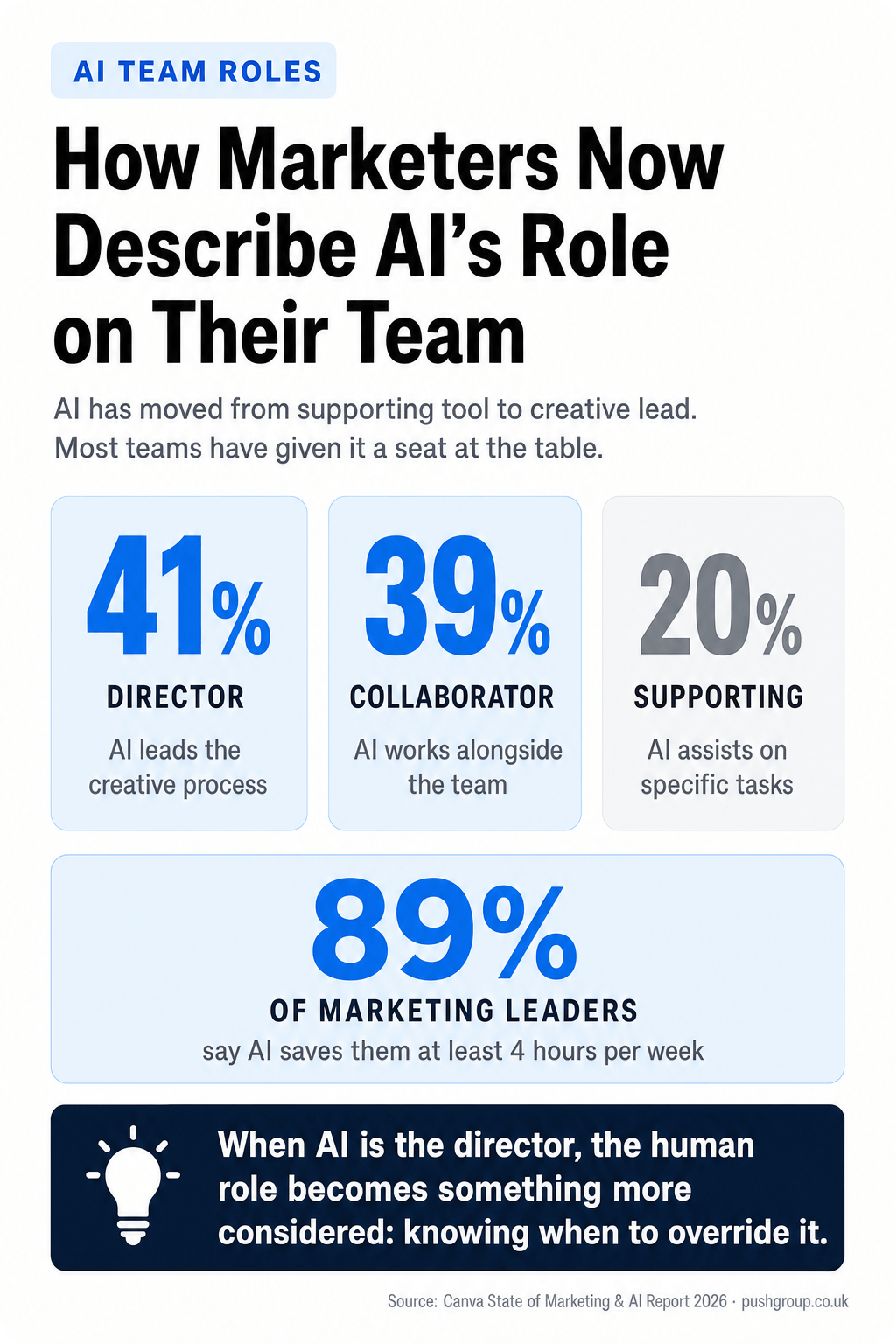
In practice, this means the human role has changed. You're no longer primarily a producer. You're a creative director making decisions about what the AI generates, what gets refined, what gets scrapped, and what the final output says about the brand.
That requires taste, experience, and sector knowledge. It's not a role AI fills. It's a role it creates the need for.
The efficiency gains are real. 89% of leaders say AI saves them at least 4 hours per week. That time doesn't disappear. It gets redirected. The question is whether it's being redirected toward judgment and quality, or just toward volume.
Why are consumers uncomfortable with AI advertising?
Consumer discomfort with AI in advertising is not a blanket rejection of the technology. The data is more specific than that, and the specificity matters if you're going to do anything useful with it.
The "something is missing" problem.
70% of consumers say they can usually spot AI-generated ads, and the tell isn't the visual quality or a technical artefact. It's the absence of a specific human point of view. Something that feels genuinely felt rather than generated.
87% of consumers say the best advertising still needs a human touch. 78% say they'd rather see ads made by people, even if AI could produce technically better ones.
That last statistic is striking. Better, by some measurable standard, isn't enough. Consumers are responding to something that quality metrics don't capture. Authenticity. Specificity. The sense that a real person understood them well enough to create something for them.
The prediction problem.
The second source of discomfort is different. It's not about creative quality. It's about surveillance.
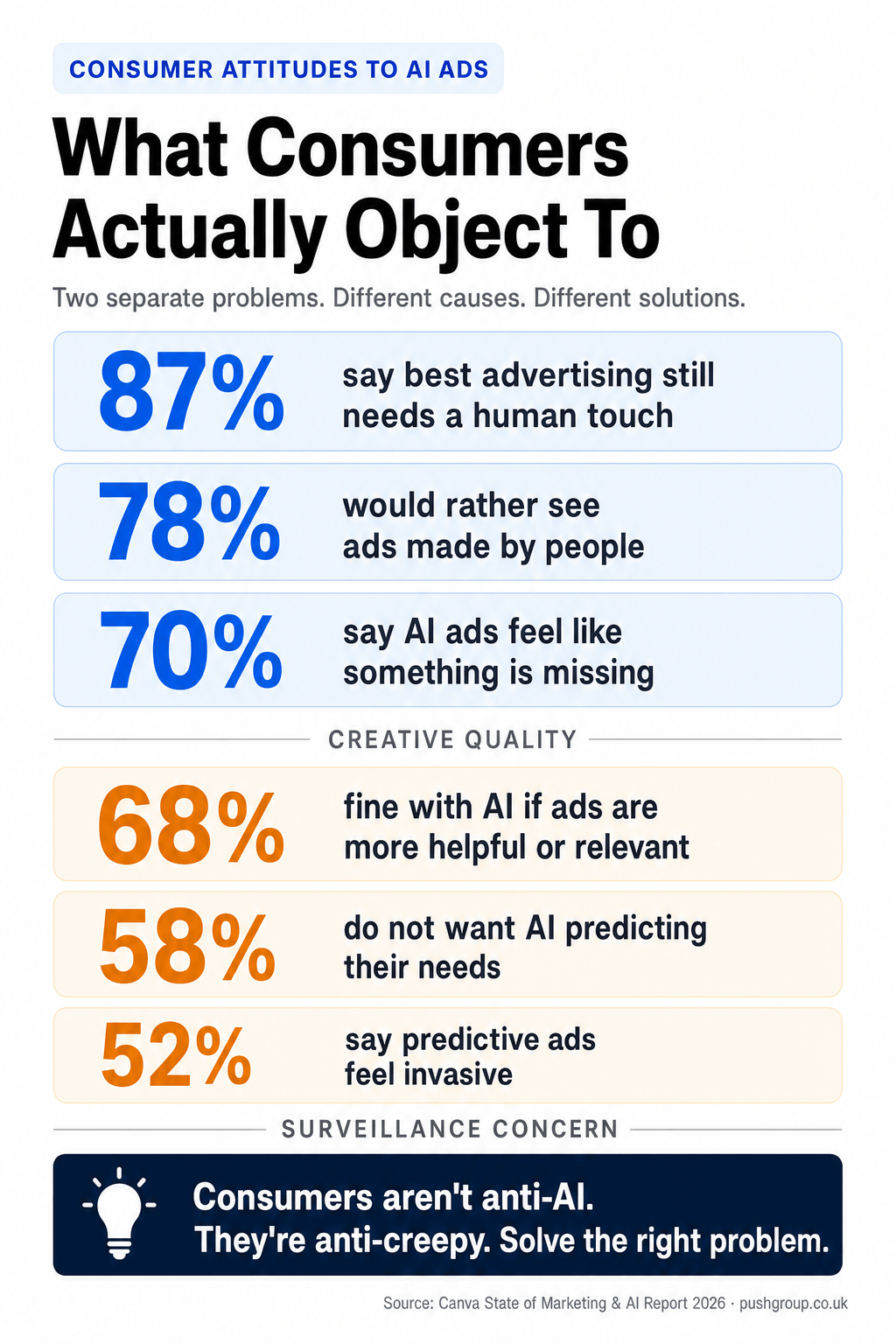
58% of consumers say they don't want brands using AI to predict what they want. 52% say it feels invasive when an ad appears to know what they're about to buy before they've searched for it.
If you run prospecting campaigns, this is a practical issue. The creative execution and message sequencing need to feel earned, not surveilled. There's a difference between an ad that's relevant because it's well targeted, and an ad that's relevant because it demonstrates exactly how much data you've collected on the person seeing it.
Consumers feel that difference. They've always felt it. AI has just made the surveillance more visible and more precise.
Where the line actually sits.
68% of consumers say they're fine with AI in advertising if it makes ads more helpful or relevant.
That's a clear signal. The problem is not AI. The problem is AI used without judgment about what "helpful" and "relevant" actually mean to a specific person in a specific context. When you get that right, most consumers don't object. When you get it wrong, 70% of them notice.
What is AI slop, and why does it matter for your brand?
"AI slop" is the term that's entered the media monitoring conversation to describe AI-generated content that is technically competent but distinctively empty. Fast. Fluent. Forgettable.M
entions of "AI slop" in media monitoring data have increased ninefold. That number tells you the market has named the problem.
When volume stops being a signal of quality.
For most of the history of content marketing, volume was a proxy for resource and ambition. A brand publishing consistently across multiple channels was signalling that it had invested in building something.
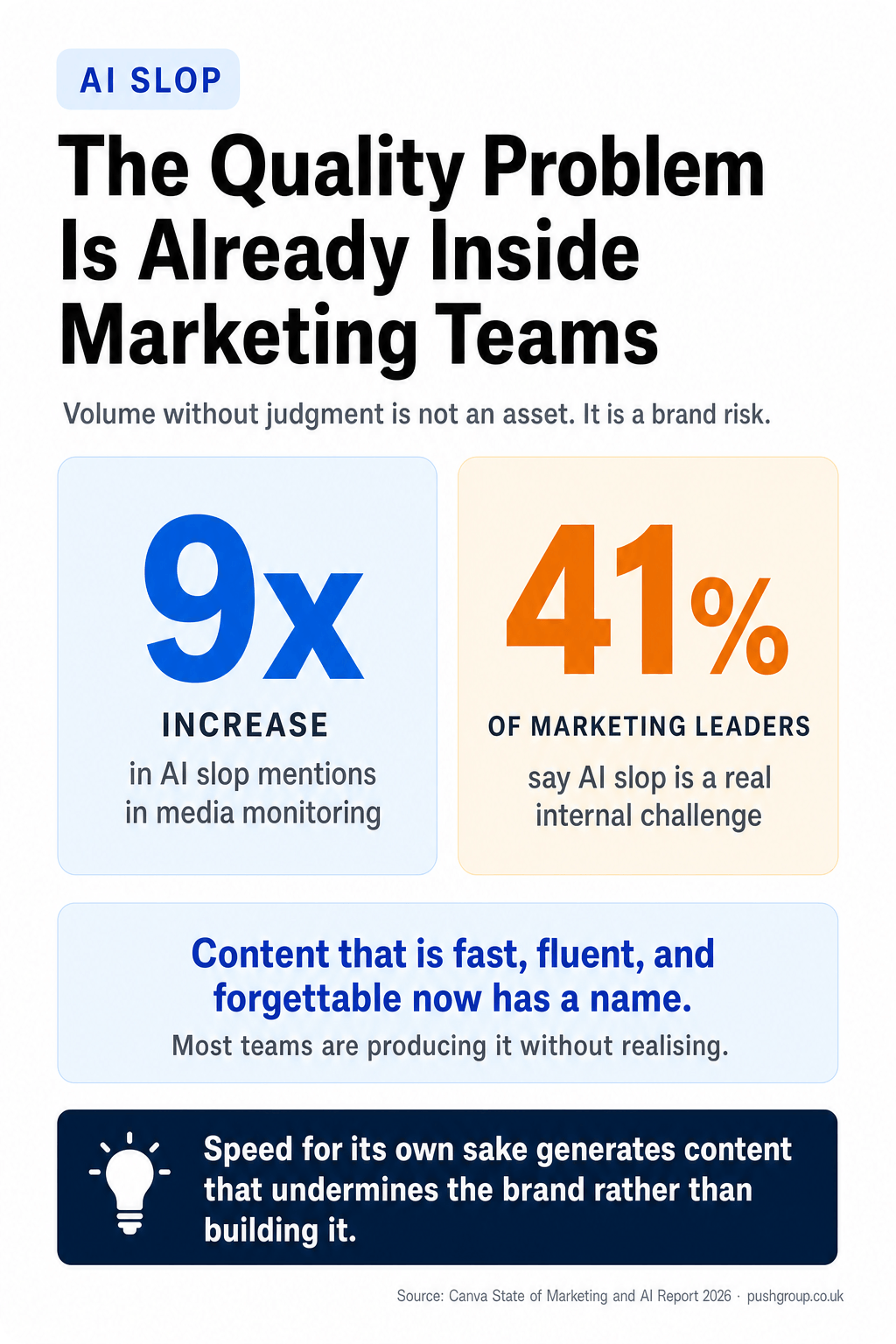
AI has broken that signal. Volume is now the default. Every brand can produce at scale. Which means the brands producing undifferentiated content at scale are not signalling investment. They're signalling the absence of judgment.
41% of marketing leaders say AI slop is becoming a real challenge inside their own organisations. That's the internal version of the same problem. Speed for its own sake generates content that undermines the brand rather than building it.
Distinctiveness is now a scarce resource.
When everything is easy to produce, the things that are hard to produce become more valuable.
A genuine brand voice, built over time, consistently applied, that resonates with a specific audience, is hard. AI can approximate it. It can get close enough to pass a quick read. But it can't generate it from scratch, and it can't maintain it without human direction.
That's what "distinctiveness" means in a post-AI-saturation environment. It's not a creative nice-to-have. It's a competitive asset.
If your brand sounds like every other brand using the same AI tools with the same default settings, you've lost something real. The good news is most brands haven't figured that out yet. The window to act is still open.
What does consumer demand for governance actually mean?
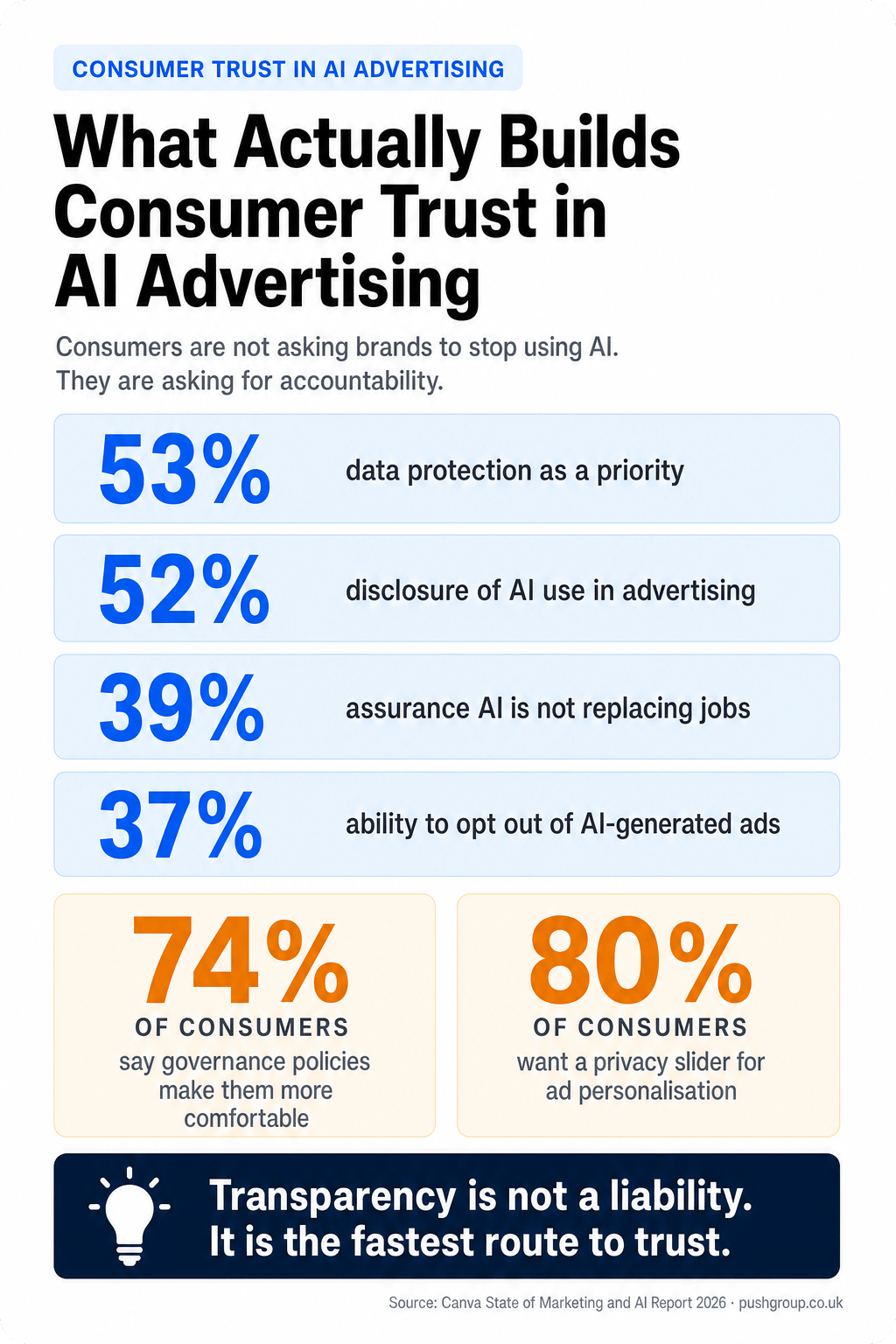
74% of consumers say they'd feel more comfortable with AI in advertising if formal company policies governed its use. 80% say they wish they could control how personal ads get, describing something like a "privacy slider" for advertising.
These are not marginal preferences from a small subset of privacy-conscious consumers. They're majority positions.
Transparency as a competitive advantage, not a compliance task.
Most businesses treat AI disclosure as a risk question. Something to handle carefully to avoid backlash. The data suggests a different approach.
Brands that build visible, clear policies around AI use in their marketing will reach the 74% of consumers who say that governance makes them more comfortable. That's not damage limitation. That's a trust signal that most competitors aren't sending.
The brands winning on this are the ones who've realised that transparency is a media strategy decision, not a legal one.
What practical AI governance looks like for a mid-sized business.
You don't need a 40-page policy document. You need four things.
A clear brief for when AI is used, and what it's used for. A human review layer before any AI-generated creative goes live. A disclosure position you're comfortable defending publicly. And a feedback loop that tells you when AI content is performing differently from human content, and why.
None of that is complicated. Most businesses just haven't done it yet.
For clients working on AI marketing strategy, governance is becoming part of the brief rather than an afterthought. The conversations we're having now are about how to scale AI responsibly, not just how to scale it fast.
What skills matter most in a world of universal AI adoption?
When asked what AI will never fully replicate, 42% of marketing leaders pointed to empathy and emotional intelligence. 41% cited the kind of human imperfection that sparks originality. Another 41% pointed to brand intuition and creative judgment.

Three answers. All of them human. All of them things you get better at through experience, not through prompting.
The roles that are growing, not shrinking.
75% of marketing leaders expect creative roles to grow over the next five years, with greater emphasis on imagination, direction, and judgment.
That's the opposite of what the "AI will replace marketers" narrative predicted. What's actually happening is a revaluation. The production work is moving to AI. The direction work, the judgment work, the work that requires a genuine understanding of an audience, is becoming more central and more valued.
This is good news for experienced marketers. It's challenging news for teams who built their value around output volume.
The AI Business Transformation Statistics we track at Push point in the same direction. The organisations outperforming in AI adoption are not the ones deploying the most tools. They're the ones with the clearest human strategy sitting behind the tools.
What agencies bring that in-house teams find harder to replicate.
An agency working across multiple clients, sectors, and campaign types develops pattern recognition that's difficult to build inside a single organisation. We see where AI is working. We see where it's degrading trust, producing content that's generating impressions but losing brand equity. And we see it faster because we're watching it across a broader set of accounts.
At Push, nine years of working across performance marketing channels, from paid search to paid social to AI search, means we've developed a view of what good judgment looks like in this environment. The AI marketing strategy workshops we run for clients are built around exactly this: not how to use more AI, but how to use it with the intent and governance that makes it actually work.
That's where the agency role has shifted. From maker to director. From producing to deciding what gets produced, to what standard, and why.
The brands that will look back on this period and feel good about it are the ones that treated AI adoption and human judgment as inseparable. Not AI first. Not AI later. Both, deliberately, at the same time.
Frequently Asked Questions
How can I tell if AI-generated content is hurting my brand's trust with consumers?
Watch for declining engagement rates on content produced at scale, particularly on social channels where audience response is immediate. If creative output has increased in volume but click-through rates, comments, and shares have declined, that's the signal. Consumers rarely articulate the problem directly. They just stop engaging.
What's the difference between helpful AI personalisation and invasive AI personalisation?
Helpful personalisation feels contextually relevant. An ad for running shoes appearing after you've searched for a 10k training plan is relevant. An ad for running shoes appearing because an AI predicted you'd start exercising before you've shown any interest feels invasive. The test is whether the consumer's data journey, if made visible, would feel reasonable to them. If the answer is no, the personalisation has crossed the line.
Should we disclose AI use in our advertising?
Yes. 74% of consumers say they feel more comfortable with AI in advertising when formal company policies govern its use, and 52% cite disclosure of AI use as one of the things that builds trust. Disclosure is not a weakness. It's the right position commercially and practically.
What does AI governance look like in practice for a mid-sized marketing team?
Start with four elements: a clear brief for when and how AI is used in the creative process; a human review stage before anything goes live; a public-facing position on AI disclosure that you can defend; and a reporting layer that tracks performance differences between AI and human-produced content. None of this requires external technology. It requires decision-making and documentation.
How do we maintain creative distinctiveness when using AI tools at scale?
Build and enforce a creative standard that AI outputs are measured against, not just a brand style guide, but a set of principles about what your brand does and doesn't say, and what it sounds like. Apply human editorial judgement at the point before publishing, not just at the brief stage. The brands maintaining distinctiveness are the ones treating the AI output as a first draft that requires direction, not a final deliverable.
The 97% adoption number in the Canva report is significant. But the number I keep coming back to is 41%. That's the proportion of marketing leaders saying AI slop is already a real challenge inside their teams. They adopted the tools. Now they're reckoning with what unchecked adoption looks like in practice.
The work now is making the AI output worth the consumer's attention. That's a human job.
If that's a conversation you want to have, speak to the Push team.