I've answered versions of it at webinars, in client meetings, and in conversations with other agency owners who are somewhere on that journey and not quite sure where to go next.
The full conversation is embedded below. But I also wanted to write up the key points here, because some of this is easier to process when you can read it, sit with it, and come back to it.
Watch the full interview first if you want the context. Then read on.
Key Takeaways
- Being AI-led is not about bolting AI tools onto existing processes. It requires rebuilding those processes from the ground up with AI at the centre.
- The technology is not the hard part. Change management is. Getting people to change how they think and work day-to-day is where most agencies struggle.
- A genuine AI operating system needs a data layer. Without normalised, connected data from all your platforms, you are just running prompts, not running an AI agency.
- The build vs buy decision is not binary. Start by replacing the smallest, most expensive software first. Leave the complex platforms until the cost difference genuinely justifies the switch
- If you feel overwhelmed, start with Claude. Pick one time-consuming process. Automate it. That is your foundation.
What does it actually mean to be an AI-led agency?
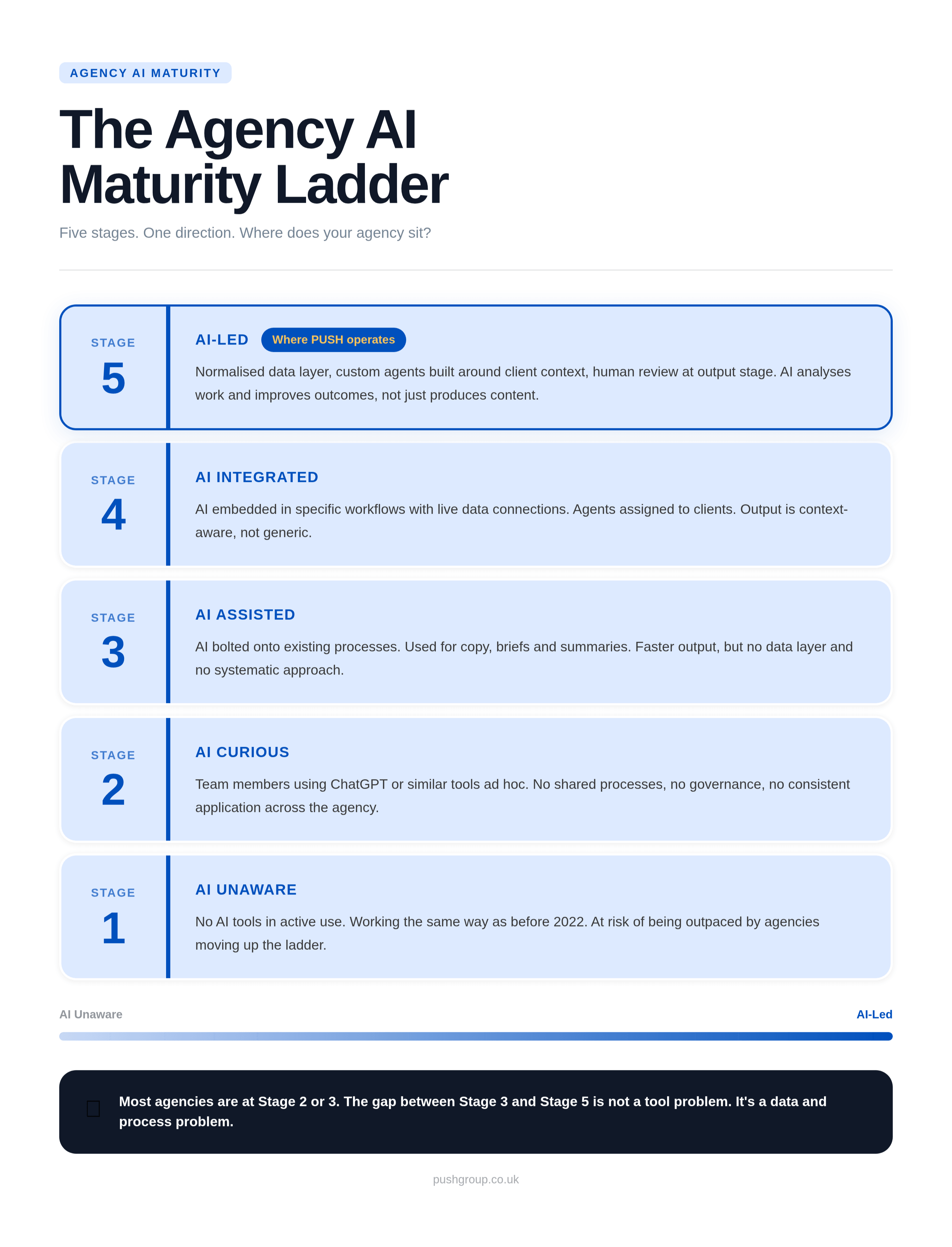
Being an AI-led agency means using AI to analyse the work you are doing and get better output for clients, not just using it to produce things faster. That distinction matters more than most agency owners realise.
A lot of agencies have added AI tools to their workflows. They use an LLM to write copy, generate briefs, or summarise reports. That is useful. But it is not the same thing as being AI-led.
Using AI to analyse work, not just produce it
When Jordan asked me this in the interview, I said something that I think gets to the heart of it: the question is whether you are truly using AI to analyse the work you are doing and get better output for the client.
That means AI needs access to real performance data. It needs to know what campaigns are running, what the results look like, what the client's objectives are, what has been tried before. Without that, you are asking AI to work in a vacuum. It will give you something. It just will not give you the right thing.
The data layer that makes everything else work
At Push, we built our own technology platform called Dial 360, which pulls campaign data from Google, Meta and other channels into BigQuery and then into our own database. We normalised all of that data so we could layer AI on top of it properly. Anomaly detection, performance analysis, budget management, suggestions on what to do next.
That took time to build. But without it, everything else we have done with AI would have been far less effective. The data layer is not the exciting part. It is the part that makes the exciting part work.
What triggered Push's AI pivot in 2023?
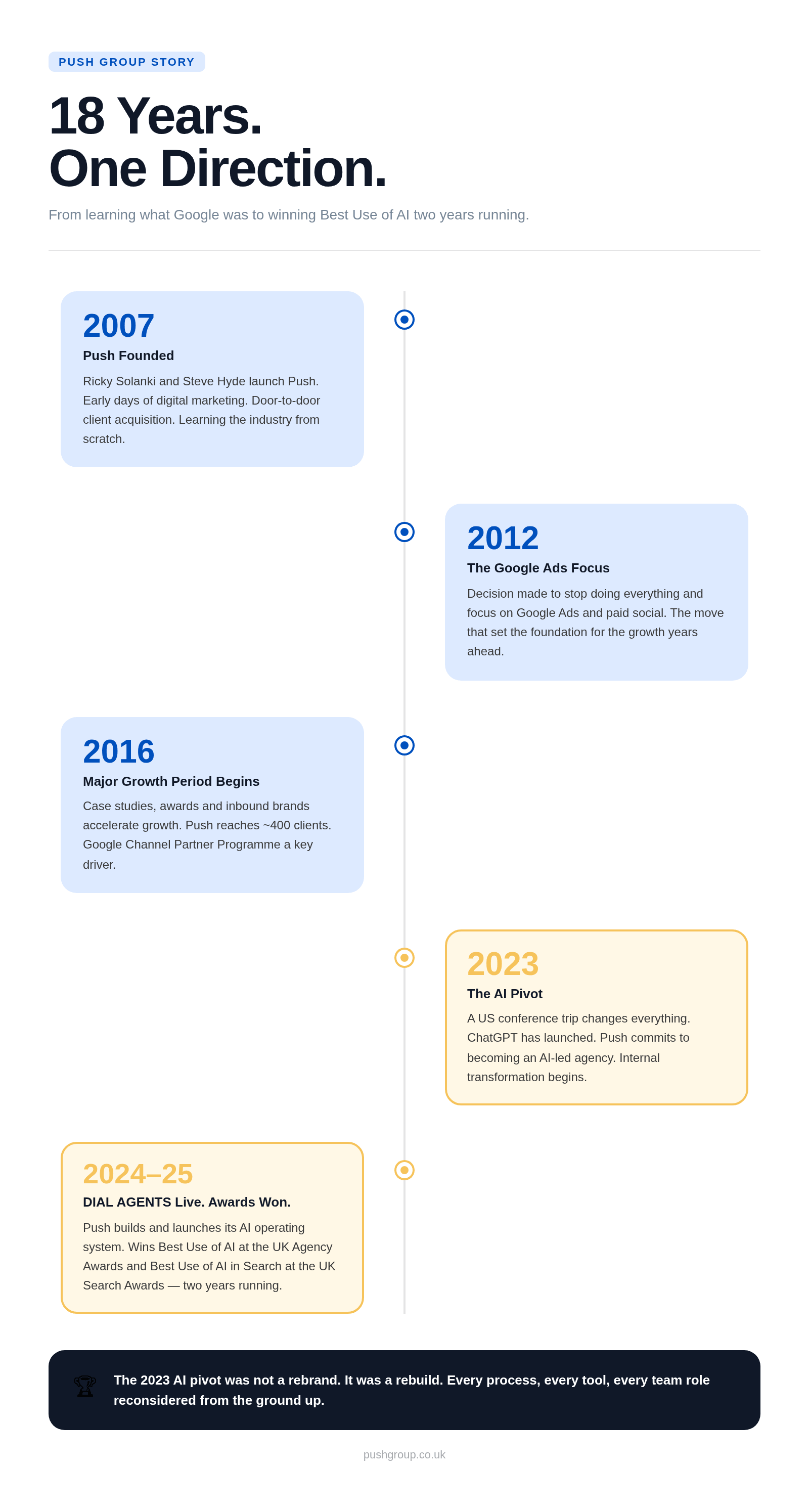
Push's AI transformation began with a conference trip to the United States in 2023. The conference was originally billed as an internet traffic event. By the time we arrived, it had been reframed as an AI conference, because ChatGPT had launched about six months earlier and the industry had shifted almost overnight.
The American conference that changed everything
My co-founder Steve Hyde and I went to that conference already knowing we needed to reposition Push. We had been a Google Ads and paid social agency for over a decade. We were good at it. But we could see the market changing and we knew we needed to move.
What we saw at that conference gave us the answer. American agencies were using AI APIs not just in performance marketing but across email marketing, content production, technology builds and operations. It was further along than anything we had seen in the UK.
We came back from that trip and said: this is it. This is the direction.
As I said to Jordan in the interview:
"That was the catalyst moment where we were like, right, okay, this is the future. We can see really clearly now this is going to change the way all of us operate in the workplace, but also how businesses are going to operate as well."
Coming back with a plan
The first phase was internal. Before we could offer anything AI-related to clients, we needed to get our own house in order. We ran a survey with the team to understand how they felt about AI, what they were using, what they were afraid of. We built an AI responsible use policy. Then we started taking apart our processes one by one and rebuilding them for an AI-first way of working.
The principle was simple: once we had done it for ourselves, we would know exactly what to offer to the businesses we work with.
How did Push manage internal resistance to AI?
Most agency owners I speak to underestimate this part. They focus on the technology and assume the team will follow. The reality is the opposite. The technology is straightforward compared to getting people to change the way they work.
The team survey approach
When we first came back from America and started talking about the AI direction, the initial reaction from the team was fairly predictable. As I told Jordan:
"They've gone off to a conference and come back with another idea. Let's see how far this one goes."
Once they realised we were serious, some people left. Not immediately. But over the following months, some people decided this was not the direction they wanted to go in. They were resistant to change, and if you are resistant to change in a business that is actively rebuilding itself around AI, there comes a point where the fit is gone.
The survey helped because it gave people a voice before the changes happened. It also gave us a clear picture of where the team actually was, not where we assumed they were.
Change management is the hard part, not the technology
I said this plainly in the interview and I still believe it:
"I don't think we need any more advancements in the technology because it's already capable of so much, and no one's using it to the capability that we can use it to."
The technology is there. It has been there for a while. What holds agencies back is not access to the right tool. It is the willingness to actually change how people do things.
Even now, with everything we have built, we still run regular AI training sessions. Recently we ran a three-hour session on our AI operating system because we can still see a spread between our super users and people who are still finding their feet. That is fine. It is a continuous process, not a one-time switch.
We also made sure that everybody, at every level, understands how to build an agent. Not just use one. Build one. Because if you do not understand how it works, you cannot evaluate whether what it produces is right.
What is Dial Agents and how does it work?
Dial Agents is Push's AI operating system. The name comes from DIAL: Digital Innovation Acceleration Lab. It is our framework for taking an idea, forming a hypothesis, testing it, and then launching it as a live process or product.
One place for every client, every data point, every process

Within Dial Agents, every process we have built becomes an agent. A Google Ad Copy Assistant. A creative ideation agent. A campaign strategy builder. These are not separate tools sitting in different tabs. They all live within the same system, assigned to individual clients.
When anyone on the team opens the operating system and selects a client, they get everything in one place. All recent call recordings, so the AI understands current client objectives and challenges. All performance data, pulled in via MCPs connected to Google and Meta. Brand documentation. Tone of voice guidelines. Previous proposals. What has been pitched. What has been approved.
From there, they can ask the system to build a campaign strategy for a new product launch, generate ad copy across multiple channels, or produce a creative brief based on what the performance data says is working. All of it draws on both the client-specific context and Push's own best practice frameworks.
What this looks like in practice
A team member gets a brief from a client. A retail brand is launching a new product and needs campaign assets across paid search and paid social. Instead of starting from scratch, they go into Dial Agents, select the client, and the system already has everything it needs: the brand guidelines, the recent performance data, the objectives from the last call, and the campaign frameworks we have refined over years of running paid media.
The output still goes through human review. Everything does at this stage. But the time it takes to get from brief to first draft has reduced significantly, and the quality is higher because the AI is working with context, not guessing.
Should agencies build their own AI tools or buy them?
This is one of the most common questions I get from agency owners right now. The honest answer is: it depends, and the calculation changes as AI-native tools get cheaper and more capable.
Where the build vs buy calculation actually breaks down
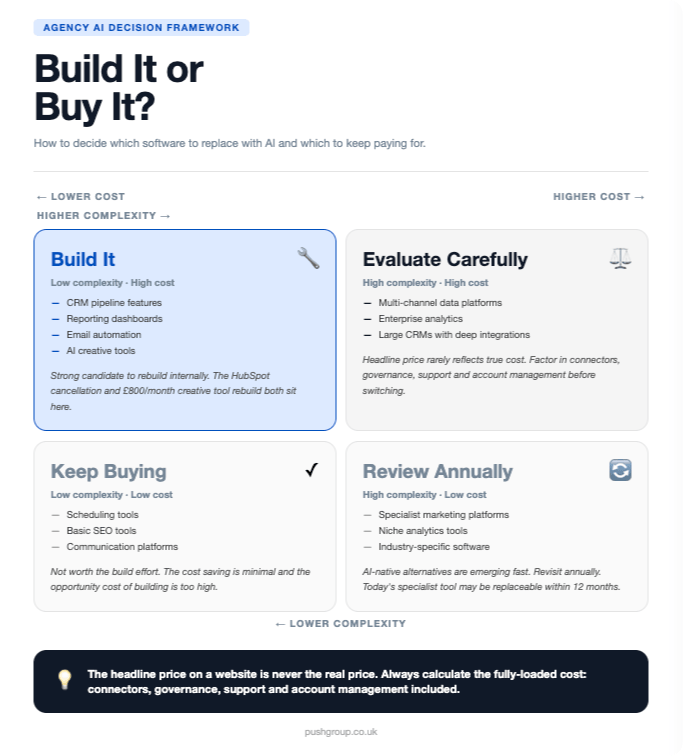
We still use external platforms for some things. Our Dial 360 performance data platform, for example. Every time I have looked at replacing it, I can get about 80% of the functionality from alternatives at what looks like a lower cost. But once you factor in the connectors, the governance layers, the support and account management that comes with a platform at our scale of ad spend, the price difference narrows considerably.
The headline cost on a website and the actual cost of running something properly are rarely the same number.
On the other hand, we cancelled HubSpot. We were mainly using the pipeline feature and built our own version. One of our team members rebuilt an AI creative tool using Claude Code that does everything the £800-a-month subscription was doing, and more, for around £400 in token costs. That kind of win is real and repeatable on the right type of project.
Start small, prove it, then scale
My approach now is to identify the smallest, most expensive pieces of software first and ask whether we can replace them ourselves. Leave the complex platforms until the case is overwhelming. For everything else, start building.
The broader principle I shared with Jordan is one I genuinely believe: agencies that think AI-first from the start, and structure their teams and tools around that premise, will be more efficient and more profitable than those trying to retrofit AI onto a legacy operating model.
Where should an agency owner start if AI feels overwhelming?
Start with Claude. That is my straightforward answer.
Start with Claude, start with one process
Claude has become, for me, the default starting point for agencies wanting to understand and build with AI properly. Go through Claude's own training programme. Understand what an agent is. Understand what a knowledge base is and what it enables. Get the foundational concepts clear before you worry about the technology stack.
Then pick one process in your agency. Something time-consuming. Something where the output is fairly predictable but the effort is disproportionate. Build an agent around it. Test it. See what it produces. Refine it.
That is it. That is where you start.
If you want to go deeper on what this looks like in practice, take a look at how we approach AI marketin for UK businesses. The same thinking applies whether you are an agency owner or a brand trying to figure out where AI fits in your marketing.
Why foundations matter more than the technology stack
The temptation is to go straight for the big problem. Connect all nine of your tools. Build an agent that talks to your CRM, your ad platforms, your project management system and your reporting stack simultaneously.
Do not do that. There is no point building a complex system on top of a team that does not understand the basics. Get everybody to the point where they understand how an agent works, why a knowledge base matters, and how to evaluate AI output critically. Then build.
If you want to go further, our AI training for agency teams programme is built specifically for this stage of the journey. We run it because we went through exactly this ourselves.
The window to get ahead of this is still open. The agencies that understand it now and build properly will have an advantage that is genuinely hard to replicate once the market catches up.
That window will not stay open indefinitely.
Ricky Solanki is co-founder of Push Group, a UK AI marketing agency and two-time winner of Best Use of AI at the UK Agency Awards. Jordan Platten hosts the Agency Giants podcast, a show featuring in-depth conversations with leading agency owners on growth, strategy and the future of the industry.