
SEO, GEO, and AEO are three distinct strategies built for three distinct discovery systems. Understanding the difference, and knowing how to prioritise across them, is now a core requirement for any brand that wants to stay visible.

What Is SEO (Search Engine Optimisation)?
SEO (Search Engine Optimisation) is the practice of improving a website's visibility in traditional search engine results pages (SERPs) to attract organic traffic through clicks.
SEO targets platforms like Google and Bing, where users enter a query and receive a list of ranked links. Success means appearing high enough in those results that users click through to your site.
How SEO Works
SEO works by building visibility across four interconnected areas: keyword targeting, topical authority, backlink acquisition, and technical site health.
Keyword targeting aligns your content with the terms your audience actively searches for. Topical authority is built by publishing comprehensive, interlinked content that signals depth of expertise to search engines.
Backlink acquisition earns links from credible third-party websites, which act as trust signals that improve domain authority. Technical site health ensures your pages are crawlable, fast, mobile-friendly, and marked up with structured data so search engines can index and understand them correctly.
- Keyword targeting - match content to what your audience searches
- Topical authority - interlinked, comprehensive content signals expertise
- Backlinks - third-party links build domain trust
- Technical health - crawlability, speed, mobile, and structured data
What SEO Measures
SEO success is measured across four core indicators: keyword ranking positions, organic click-through rate, domain authority, and organic traffic volume.
Keyword rankings show where your pages sit in search results for target terms. Click-through rate reveals how often users choose your result over competing ones. Domain authority reflects the strength of your backlink profile as a trust signal.
Organic traffic volume is the bottom-line measure of how much search-driven traffic your site receives.
- Keyword rankings - position in search results for target terms
- Organic CTR - how often users click your result over competitors
- Domain authority - backlink profile strength and trust signals
- Organic traffic - total search-driven visits to your site
The Limitation of SEO
Zero-click searches are growing. Google increasingly surfaces direct answers, through featured snippets, Knowledge Panels, and AI Overviews, meaning users may see your content without visiting your site.
SEO optimised purely for ranked links is losing ground to systems that extract and present information directly.
What Is AEO (Answer Engine Optimisation)?
AEO (Answer Engine Optimisation) is the practice of structuring content so it can be extracted and surfaced as a direct answer in featured snippets, AI-generated summaries, and voice search responses.
AEO targets systems that skip the list of links entirely and present a single answer: Google's featured snippets, voice assistants (Alexa, Siri, Google Assistant), and the summary layers within AI search interfaces.
How AEO Works
AEO works by structuring content so that answer engines can extract and present it directly, without requiring a click.
That means leading with short, direct definitions of 40–60 words before elaborating, using formatted layouts like bulleted lists, numbered steps, and tables that are easy to extract cleanly, and marking up question-and-answer content with FAQ schema so search engines can identify it as an extractable answer.
Language should match the natural phrasing of spoken and typed questions rather than targeting head keywords alone.
- Short definitions - lead with a direct 40–60 word answer before elaborating
- Structured formatting - lists, steps, and tables that answer engines extract cleanly
- FAQ schema markup - signals question-and-answer content to search engines
- Conversational language - match how users naturally speak and type questions
What AEO Measures
AEO success is measured across three indicators: featured snippet appearances, voice search inclusion rate, and zero-click impression share. Featured snippet appearances track how often your content is selected as the direct answer at the top of a Google results page.
Voice search inclusion rate measures how frequently your content is read aloud by voice assistants in response to spoken queries. Zero-click impression share captures the broader picture of how often your content is surfaced without requiring the user to click through to your site.
- Featured snippet appearances - how often your content is selected as the direct answer
- Voice search inclusion - how often your content is read aloud by voice assistants
- Zero-click impression share - visibility that does not require a click
The Limitation of AEO
AEO optimises for visibility without clicks. Your brand may deliver the answer and receive no attribution, no visit, and no conversion. It is a brand awareness strategy as much as a traffic strategy, and its value depends heavily on your business model.
What Is GEO (Generative Engine Optimisation)?
GEO (Generative Engine Optimisation) is the practice of building a brand's authority and content footprint so that large language models (LLMs), including ChatGPT, Perplexity, Google AI Mode, and Google Gemini, cite, mention, and recommend it in conversational AI responses.
Where SEO targets a ranking algorithm and AEO targets snippet extraction, GEO targets probabilistic language models that synthesise answers from everything they have indexed and been trained on.
How GEO Works
SEO works by building visibility across four interconnected areas: keyword targeting, topical authority, backlink acquisition, and technical site health. Keyword targeting aligns your content with the terms your audience actively searches for.
Topical authority is built by publishing comprehensive, interlinked content that signals depth of expertise to search engines. Backlink acquisition earns links from credible third-party websites, which act as trust signals that improve domain authority.
Technical site health ensures your pages are crawlable, fast, mobile-friendly, and marked up with structured data so search engines can index and understand them correctly.
- Keywords - match content to what your audience searches
- Topical authority - interlinked, comprehensive content signals expertise
- Backlinks - third-party links build domain trust
- Technical health - crawlability, speed, mobile, and structured data
What GEO Measures
GEO performance is tracked through four key metrics: AI visibility score, citation share, share of voice, and platform-level visibility. AI visibility score measures the percentage of AI-generated responses that mention your brand across tracked prompts.
Citation share captures the proportion of all URLs cited by AI models that point to your domain. Share of voice reflects your brand's proportion of total brand mentions in AI responses across a competitive category.
Platform-level visibility breaks this down further, showing how your brand performs separately on ChatGPT, Perplexity, and Google AI Mode, each of which uses different ranking and citation logic, meaning your performance can vary significantly from one platform to the next.
- AI visibility score - % of AI responses that mention your brand
- Citation share - % of cited URLs that point to your domain
- Share of voice - your brand's proportion of total AI brand mentions in your category
- Platform-level visibility - performance broken down by ChatGPT, Perplexity, Google AI Mode, and others
The Limitation of GEO
GEO results are not deterministic. You cannot buy a position or guarantee a citation the way you can bid on a keyword. You influence the probability that AI models surface your brand by making it a more credible, well-referenced entity in the content ecosystem.
SEO vs GEO vs AEO: Side-by-Side Comparison
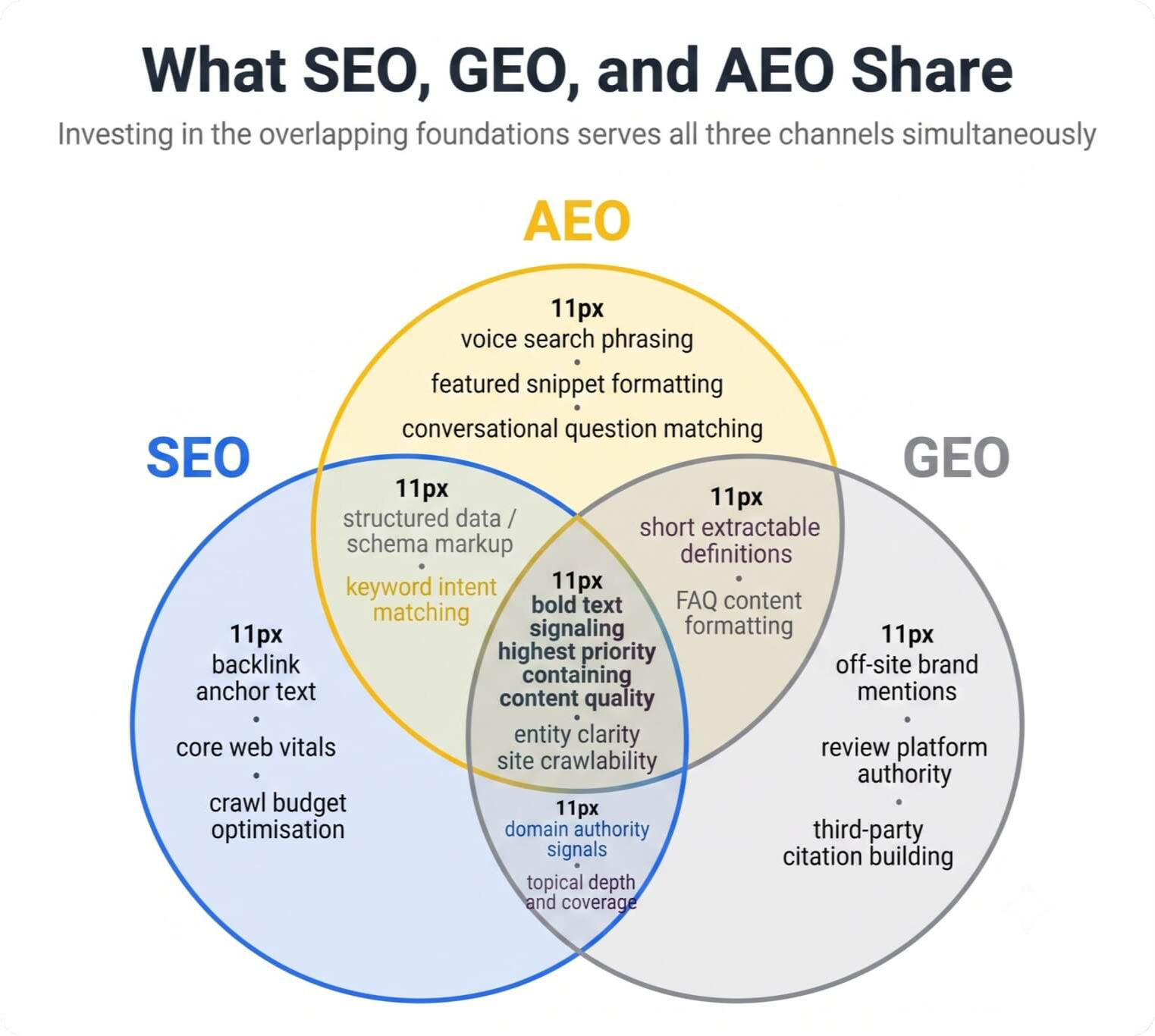
How SEO, GEO, and AEO Overlap
The three strategies are not mutually exclusive. There is significant shared infrastructure:
- Backlinks built for SEO also signal authority to AI models. High-domain-authority links are part of the off-site footprint GEO depends on.
- Content structured for AEO performs better in GEO. Clear definitions, explicit question-answer pairs, and scannable formatting are exactly what language models extract when synthesising answers.
- Technical foundations serve all three. Structured data markup (schema.org), fast page load, crawlability, and mobile optimisation benefit traditional search rankings, snippet eligibility, and AI indexing alike.
How to Balance SEO, GEO, and AEO
SEO, GEO, and AEO are not competing priorities, they share enough common foundations that a well-structured programme can serve all three channels simultaneously, provided each is measured and optimised on its own terms.
Step 1 - Audit where your audience currently searches
Track what share of your category's discovery happens via traditional Google, AI chat interfaces, and voice. Tools like Profound measure AI visibility directly; Google Search Console covers traditional search. Understanding where your category's audience is spending attention tells you where to prioritise.
Step 2 - Build content that satisfies all three
For each piece of content:
- Lead with a direct definition or answer (40–60 words) - satisfies AEO and GEO extraction.
- Develop topical depth below the fold - satisfies SEO's authority signals.
- Include named entities, statistics, and original data - increases citation probability for GEO.
- Use FAQ sections with FAQ schema markup - helps featured snippet eligibility (AEO) and AI-structured answer retrieval (GEO).
Step 3 - Invest in off-site authority for GEO
GEO is the strategy most reliant on factors outside your website. Prioritise:
- Earning coverage in industry publications and news outlets
- Building a presence on review platforms relevant to your category
- Participating in community platforms (Reddit, LinkedIn) where AI models draw signals
- Ensuring your brand is consistently named and described the same way across all sources (entity consistency)
Step 4 - Measure each channel separately
A single analytics dashboard will not capture all three. You need:
- Google Search Console / rank tracker for SEO
- Snippet monitoring tools for AEO
- AI visibility platforms (such as Profound) for GEO, tracking brand mentions, citation share, and share of voice across ChatGPT, Perplexity, Google AI Mode, and other LLM platforms
Step 5 - Iterate based on platform-level signals
GEO performance varies by AI platform. ChatGPT, Perplexity, and Google AI Mode each use different ranking and citation logic. A brand highly visible on Perplexity may be poorly cited on Google AI Mode. Platform-level breakdowns reveal where to focus content and authority-building efforts.
Frequently Asked Questions
What is the difference between SEO and GEO?
SEO (Search Engine Optimisation) targets traditional search engines like Google and Bing, aiming to rank a website's pages as clickable links in search results. GEO (Generative Engine Optimisation) targets large language models like ChatGPT, Perplexity, and Google AI Mode, aiming to make a brand visible as a mentioned or cited source in AI-generated conversational answers.
SEO focuses on keyword rankings and organic traffic; GEO focuses on AI visibility score, citation share, and share of voice in AI responses.
What is the difference between AEO and GEO?
AEO (Answer Engine Optimisation) focuses on getting content extracted as a direct answer in featured snippets and voice search, typically within Google's own interface. GEO (Generative Engine Optimisation) focuses on being cited or recommended by external large language models such as ChatGPT, Perplexity, and Google AI Mode. AEO is primarily an on-page content formatting strategy.
GEO relies more heavily on off-site brand authority, third-party mentions, and the overall entity footprint a brand has built across the web.
Is GEO replacing SEO?
No. GEO does not replace SEO it extends it. Traditional search engines still drive significant traffic, and the technical and content foundations of SEO (backlinks, structured data, topical authority, crawlability) directly support GEO performance. Brands that treat SEO and GEO as competing strategies will underinvest in one.
The most effective approach treats them as complementary layers of the same content and authority-building programme.
How do I measure GEO performance?
GEO performance is measured through AI-specific metrics: AI visibility score (the percentage of AI-generated responses that mention your brand), citation share (the proportion of URLs cited by AI models that point to your domain), and share of voice (your brand's proportion of total brand mentions across a competitive category in AI responses).
Platforms such as Profound track these metrics across ChatGPT, Perplexity, Google AI Mode, Google Gemini, and other LLM platforms.
How long does GEO take to show results?
GEO results are slower to materialise than traditional SEO because they depend on LLMs updating their indices and weighting new content and brand signals. Changes in off-site authority, new earned media coverage, and fresh structured content can take weeks to months to surface as changes in AI visibility scores.
Monitoring AI visibility metrics over a rolling four-week period gives the clearest signal of whether GEO efforts are taking effect.
Which AI platforms does GEO need to target?
The major AI platforms to optimise for are ChatGPT (OpenAI), Perplexity, Google AI Mode, Google AI Overviews, Google Gemini, Microsoft Copilot, Grok (xAI), and Meta AI. Each platform uses different ranking logic and cites different sources. A brand may perform well on Perplexity (which is citation-heavy) but be underrepresented on Google AI Mode.
Platform-level visibility tracking is essential for identifying where the gaps are.
Summary
SEO, GEO, and AEO are three responses to the same problem: search behaviour has fragmented across multiple systems, each with different rules for surfacing content.
- SEO wins ranked links in traditional SERPs through keyword authority and backlinks.
- AEO wins direct answer extraction in snippets and voice search through structured, question-led formatting.
- GEO wins brand mentions and citations in LLM-generated responses through off-site authority, entity clarity, and citation-worthy content.
A modern search strategy needs all three. The content and authority investments required overlap enough that a well-structured programme can serve all channels simultaneously, but only if each channel is measured on its own terms.