
Most UK businesses are over-indexed on paid and underinvested in organic. The paid ads work until you pause the budget. Then the traffic stops. Organic builds something that compounds. And right now, with AI search growing at the rate it is, being found online means more than it has in years.
Key Takeaways
- LLM traffic (chatGPT , Gemini etc) converts at more than double the rate of standard Google organic. Most UK businesses are doing nothing to optimise for it.
- Organic search drives 53% of all website traffic. Paid drives 27%. When you stop paying, one of those disappears.
- HubSpot's 2025 research found SEO outperforms paid search, social advertising and events on lead quality for B2B businesses.
- AI referral traffic grew 357% year on year by June 2025. AI search visits grew a further 42.8% year on year in Q1 2026.
- Semrush predicts AI search traffic will surpass traditional search by 2027 to 2028. That window is open now.
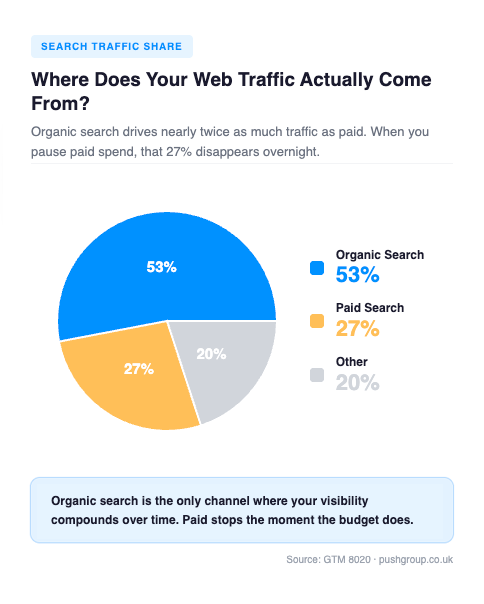
Why does paid advertising stop working the moment you stop paying?
Paid advertising delivers visibility on demand. That's its strength and its ceiling. The moment you pause the budget, the traffic stops. There's no residual value, no compounding return, no asset left behind.
Why paid-only visibility is a permanent treadmill
Most businesses start with paid search because it works quickly. You put money in, you get clicks out. That feedback loop is clean and measurable, and for early-stage growth or seasonal campaigns, it's the right tool.
The trap is treating it as the whole strategy.
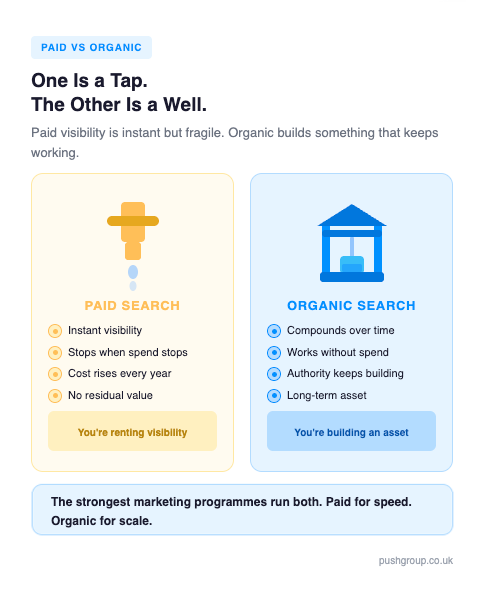
When paid is your primary or only source of search traffic, you're renting your visibility. Every click has a price tag. Every month you need to spend to maintain what you had last month. And as more advertisers compete for the same keywords, that price rises.
Average CPCs on Google Search have increased 12% year on year. In competitive sectors like legal, B2B services and finance, the cost per click runs significantly higher. The businesses paying those rates today will pay more next year.
Turn off a paid campaign and you disappear from the results page within hours. There's no grace period, no residual ranking.
Turn off an SEO programme after two years of consistent work and your content continues driving traffic. Your rankings don't evaporate overnight. The authority you've built in Google's index remains. The pages you've created keep attracting visitors.
That's the structural difference. One is a tap. The other is a well.
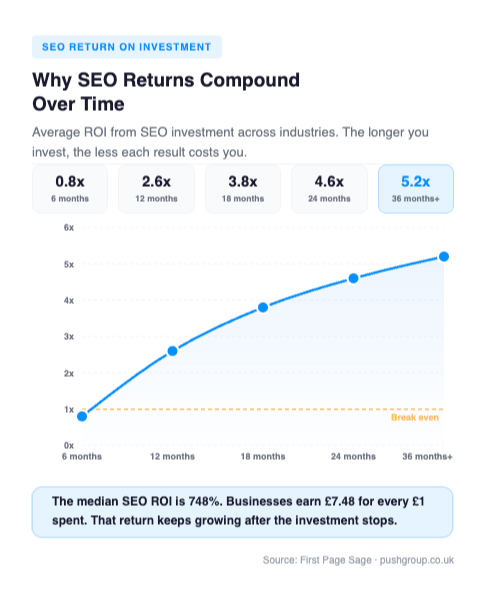
Why is organic search a long-term asset, not just a traffic channel?
Organic search builds something that belongs to you. A page that ranks for a valuable keyword today will keep generating traffic next month, next year, and beyond, without a recurring cost per click attached to every visitor.
What organic search builds that paid never can
The median ROI from SEO investment is 748%, meaning businesses earn £7.48 for every £1 spent, according to First Page Sage industry data. That figure reflects the compounding nature of organic. A well-optimised piece of content doesn't just deliver value in the week it's published. It builds authority over time, attracts links, climbs rankings, and keeps generating traffic long after the initial investment.
With paid, your cost per acquisition is relatively fixed and tied to market competition. With SEO, your cost per acquisition decreases as rankings improve. You're not paying for the same traffic twice.
Why does organic search consistently outperform paid on lead quality?
HubSpot's 2025 research found SEO outperforms paid search, social advertising and events in lead generation effectiveness for B2B businesses. That reflects something practitioners know from experience.
Organic search traffic converts well because it arrives with intent. Someone who typed a specific question into Google and clicked your result is further along the decision-making process than someone who saw an ad while scrolling.
The quality of organic traffic is different. It's not just cheaper. It's better qualified.
Why organic rankings carry a trust signal paid placements don't
Over two-thirds of UK consumers cannot distinguish between paid and organic Google results. But the ones who can trust organic results more. Earning an organic position signals authority, relevance and credibility in a way that a paid placement simply doesn't.
That trust transfers to the brand. A business that consistently appears at the top of organic results for the questions its customers are asking builds a different kind of relationship than one that only shows up when it's paying for the slot.
What does "being found online" actually mean in 2026?
Being found online used to mean ranking on Google. Now it means showing up in AI responses too. Those are related but not the same thing, and most businesses are only doing one of them.
Google search results are still the biggest channel
Organic search still drives 53% of all website traffic. Google processes an estimated 8.5 billion queries daily. For the vast majority of UK businesses, Google remains the single largest source of organic discovery, and that isn't changing overnight.
What is changing is how Google presents results. AI Overviews now appear on roughly 16% of all queries, and when they do, organic CTR drops by 61%. That's not an argument against SEO. It's an argument for doing it properly, including structuring content so it gets cited inside those AI Overviews rather than buried beneath them.
AI search is a new front that is already sending traffic
ChatGPT crossed 1 billion monthly active users in June 2026, the fastest app in history to reach that milestone. Perplexity handled 780 million queries in a single month in 2025. AI search visits grew 42.8% year on year between Q1 2025 and Q1 2026, from 15.6 billion to 27.4 billion.
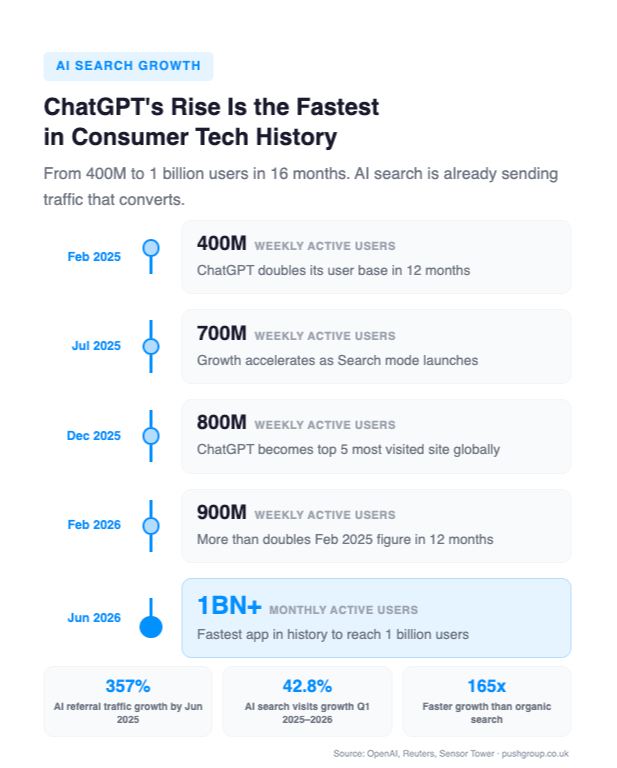
These aren't future projections. This traffic exists now, it's growing rapidly, and it converts.
In our own GA4 data at Push, LLM traffic converts at 2.47% compared to 1.19% for standard Google organic. That's more than double the conversion rate from a channel that most UK businesses are doing nothing to optimise for.
The difference between ranking on Google and being recommended by AI
Ranking on Google and being recommended by ChatGPT aren't the same thing. Research from Profound shows ChatGPT results overlap only 12% with the Google SERP.
The businesses that get cited by ChatGPT, Perplexity and Google AI Overviews aren't necessarily the ones with the highest domain authority. They're the ones whose content is structured to be extractable, authoritative and specific. That's a different discipline, and it's one most businesses haven't started yet.
What is GEO and why does it matter alongside traditional SEO?
Generative Engine Optimisation (GEO) is the practice of structuring content so it gets cited and recommended by AI-powered search systems. It sits alongside traditional SEO, not instead of it.
How ChatGPT, Perplexity and Google AI Overviews decide what to recommend
AI search systems don't rank pages the way Google's traditional algorithm does. They synthesise answers from multiple sources and cite the ones that give them the clearest, most authoritative, most directly usable information.
Research from Princeton University and Georgia Tech, published at KDD 2024, tested nine GEO methods across thousands of content samples. Techniques including adding specific statistics, citing authoritative sources and structuring content with direct answers at the top increased visibility in AI responses by up to 40%.
44% of all AI citations come from the first third of a piece of content. If your content buries the answer, AI systems move on to a source that doesn't.
The conversion data that makes LLM traffic impossible to ignore
The commercial case for GEO isn't theoretical. LLM visitors convert 4.4x better than organic search visitors, according to Semrush data from 2025. Adobe's Q1 2026 analysis across more than a trillion visits found AI referral traffic converts 42% better than non-AI traffic, with AI-referred visitors spending 48% longer on site. In our own data at Push, LLM traffic converts at 2.47% against 1.19% for Google organic.
The pattern is consistent across independent sources. People using AI search tools to research a decision arrive pre-qualified. When your content is what they find, it works harder.
Why strong SEO is still the foundation for AI visibility
GEO doesn't replace SEO. It extends it. 93.67% of Google AI Overview citations come from pages already ranking in Google's top 10. Technical SEO, strong content structure, authoritative backlinks and clean site architecture are still the prerequisites. You can't skip the foundations and expect to appear in AI results.
What GEO adds is a layer of intentional structuring: direct answers at the start of each section, question-based headings that mirror how people query AI assistants, and content depth that gives AI systems something specific and credible to extract.
Traditional SEO still drives approximately 345 times more total traffic than all AI engines combined. The argument isn't that AI search is bigger than Google. It's that it's growing at a rate that makes ignoring it a strategic error, and that the conversion quality makes it disproportionately valuable.
Why has Push invested in a Director of Organic Search?
Push has been in this industry for nearly two decades. We started with websites, moved into SEO and email marketing, then built out paid search when it became a serious channel. Paid grew quickly, and for good reason. It's measurable, scalable and delivers results fast.
But paid and organic aren't in competition. They serve different functions. Paid delivers speed. Organic delivers scale. The businesses that get the balance right run both, seriously.
Hiten joined Push in January 2024. In two and a half years he hasn't just managed an SEO function. He rebuilt it.
He looked at how most agencies still operate organic search, junior teams running checklists, reports taking weeks, content shipping in batches with no real judgement behind it, and designed something different.
AI handles the work that scales: processing large keyword and log datasets, tracking visibility across Google and AI platforms simultaneously, drafting at volume. His team spends their time on the part AI can't do, which is deciding what matters and why. He rebuilt the process from how we sell organic through to how we deliver it. The thinking is the product, not the page count.
That's not a small thing to do in two and a half years.
The results reflect that. Working with a large B2B business, Hiten's team took on one of its core commercial categories in January 2026. By the second-quarter review, five months in:
- Non-brand impressions up 72%
- Organic sessions up 36%
- Top-three keyword rankings up 51%, with 293 new keywords on page one
- Average non-brand position improved from 13.9 to 6.4
- Domain Rating up from 59 to 65
- The most-mentioned brand in its category across ChatGPT, Gemini and Google AI Overviews, ahead of every direct competitor
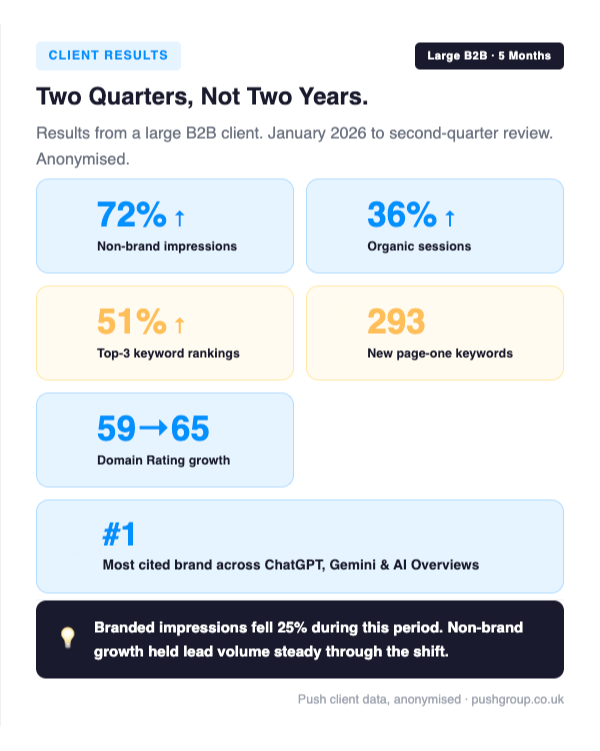
Two quarters, not two years. The context behind those numbers matters as much as the numbers themselves. The client's branded search footprint was already eroding. Branded impressions had fallen by around a quarter and branded rankings were sliding. On that trajectory, lead volume was exposed. It didn't drop. By growing non-brand and AI visibility fast enough, the team replaced the declining branded demand and held lead volume steady through the shift.
That's the kind of work that earns a directorship. Not tenure. Not loyalty. The ability to see where the market is going, build the operation to match it, and deliver results that prove the thinking was right.
Hiten now leads our GEO work alongside traditional SEO, with AI automation embedded throughout the service to make it faster and more efficient without removing the judgement that makes it effective. Promoting him to Director of Organic Search is the right recognition for what he has already built, and the right foundation for what comes next.
How should a UK business think about the balance between paid and organic?
The honest answer is that most UK businesses are over-indexed on paid and underinvested in organic. That's not a criticism. It reflects how digital marketing matured. PPC offered fast, measurable returns. The feedback loops were clean. Organic felt slower and harder to attribute.
But the gap between the two has real consequences over time.
Paid for speed, organic for scale
Paid search is the right tool when you need immediate visibility: a product launch, a seasonal push, a new market entry. It delivers results while organic builds. Used well, the two work together.
Organic is the right investment when you're thinking about where your business needs to be in two years, not two weeks. The pages you build and optimise today compound in value. The paid campaigns you run today stop the moment you stop paying.
The businesses that get this right run both in parallel
The strongest marketing programmes treat paid and organic as complementary. Paid provides coverage and speed in the short term. Organic builds the authority and visibility that reduces dependency on paid spend over time.
A business that runs paid well but neglects organic is permanently exposed to rising CPCs, platform changes and budget pressure. A business that invests in both builds resilience alongside performance.
What to ask your agency about your organic and AI search visibility right now
If you're working with an agency on paid search or paid social, three questions are worth asking today.
First: what does your organic search visibility look like, and is it improving? Second: does your content appear in AI-generated answers on ChatGPT, Perplexity or Google AI Overviews? Third: if your paid budget stopped tomorrow, what traffic would remain?
The answers tell you a lot about how exposed your business actually is.
If you want to understand where your organic and AI search visibility stands right now, our team works with UK businesses on exactly this. Find out more about our AI marketing services and our Generative Engine Optimisation service.
Common questions about organic search, SEO and AI visibility
Q: What is the difference between organic search and paid search?
Organic search refers to unpaid listings that appear in search engine results based on relevance and authority. Paid search refers to advertisements that appear in results when a business bids on specific keywords. Organic results persist and compound over time. Paid results stop the moment the budget is paused.
Q: Why does organic search matter if paid advertising gets results faster?
Paid advertising delivers immediate visibility but requires continuous spend to maintain it. Organic search builds long-term authority that keeps generating traffic without a recurring cost per click. 49% of marketers identify organic search as delivering the best ROI of any marketing channel, precisely because its returns compound over time rather than stopping when spend stops.
Q: What is GEO and how is it different from SEO?
GEO stands for Generative Engine Optimisation. It is the practice of structuring content so it gets cited and recommended by AI-powered search systems like ChatGPT, Perplexity and Google AI Overviews. Traditional SEO focuses on ranking well in standard search engine results. GEO builds on that foundation by adding content structures, direct answers and specific detail that AI systems are more likely to extract and cite.
Q: How much traffic do AI search engines like ChatGPT actually send to websites?
ChatGPT crossed 1 billion monthly active users in June 2026, making it the fastest app in history to reach that milestone. AI search visits grew 42.8% year on year between Q1 2025 and Q1 2026. LLM traffic converts at more than double the rate of standard Google organic traffic, making it a commercially significant channel despite its smaller overall volume compared to traditional search.
Q: How do I know if my business is visible in AI search results?
The most direct method is to search for questions your customers are likely to ask in ChatGPT, Perplexity and Google AI Overviews, and check whether your business, products or content are mentioned or cited. Specialist tools including Profound and SE Ranking's ChatGPT Visibility Tracker allow more systematic monitoring. If your content is not structured to provide direct, standalone answers, it is unlikely to be cited regardless of your Google rankings.