
This article explains what really happens when your AI Max landing pages are GEO-optimised, and why that matters even more as ads move into AI Overviews and AI Mode.
First, a simple framing
AI Max decides who sees your ad and when. Your landing page decides whether AI Max keeps scaling you, or quietly pulls back. GEO does not “hack” AI Max.
What it does is far more useful:
It makes your landing page feel like a natural continuation of the AI’s answer.
That is the key idea to keep in mind.
1. GEO pages are easier for machines to understand
Traditional landing pages are usually built for humans first:
- Big headline
- Benefits
- CTA
GEO-optimised pages are also built for AI systems that interpret intent and context. That means they:
- Clearly explain what you are
- Clearly state who you’re for
- Answer common questions directly
- Use structured sections instead of vague persuasion
Why this matters for AI Max
AI Max does not just send traffic. It learns from what happens after the click.
When your page:
- Matches search intent clearly
- Reduces confusion
- Keeps users engaged
AI Max gains confidence that this advertiser satisfies intent well. That confidence can lead to broader reach, more query expansion, and stronger scaling.
2. AI Max increasingly sends question-based traffic
AI Max is designed to expand beyond obvious “buy now” searches. It increasingly shows ads on searches like:
- “Is this worth it?”
- “What’s the difference between X and Y?”
- “Do I really need this?”
- “How does this work in the UK?”
These are not weak leads. They are often mid-decision users.
A GEO-optimised landing page meets them properly. It:
- Explains context
- Reduces uncertainty
- Answers objections upfront
- Educates before selling
Instead of bouncing, the user thinks, this page actually answers what I was asking. That leads to better engagement, better conversion rates, and a greater chance that AI Max continues expanding rather than throttling.
3. Why this becomes critical when ads appear inside AI Overviews
This is the future state most advertisers still are not preparing for. When ads appear inside AI Overviews or AI Mode, the journey looks more like this:
- AI explains the topic
- AI frames the options
- AI suggests a sponsored result
- The user clicks expecting continuity
If your landing page uses the following, it you create friction.
- Uses completely different language
- Ignores the AI’s framing
- Pushes the sale before providing explanation
But if your page has the following, the ad feels helpful father than intrusive.
- Mirrors the AI’s structure
- Reinforces the same points
- Continues the explanation naturally
Trust increases. Conversion friction drops and in that environment, alignment beats persuasion.
4. The hidden feedback loop most advertisers will miss
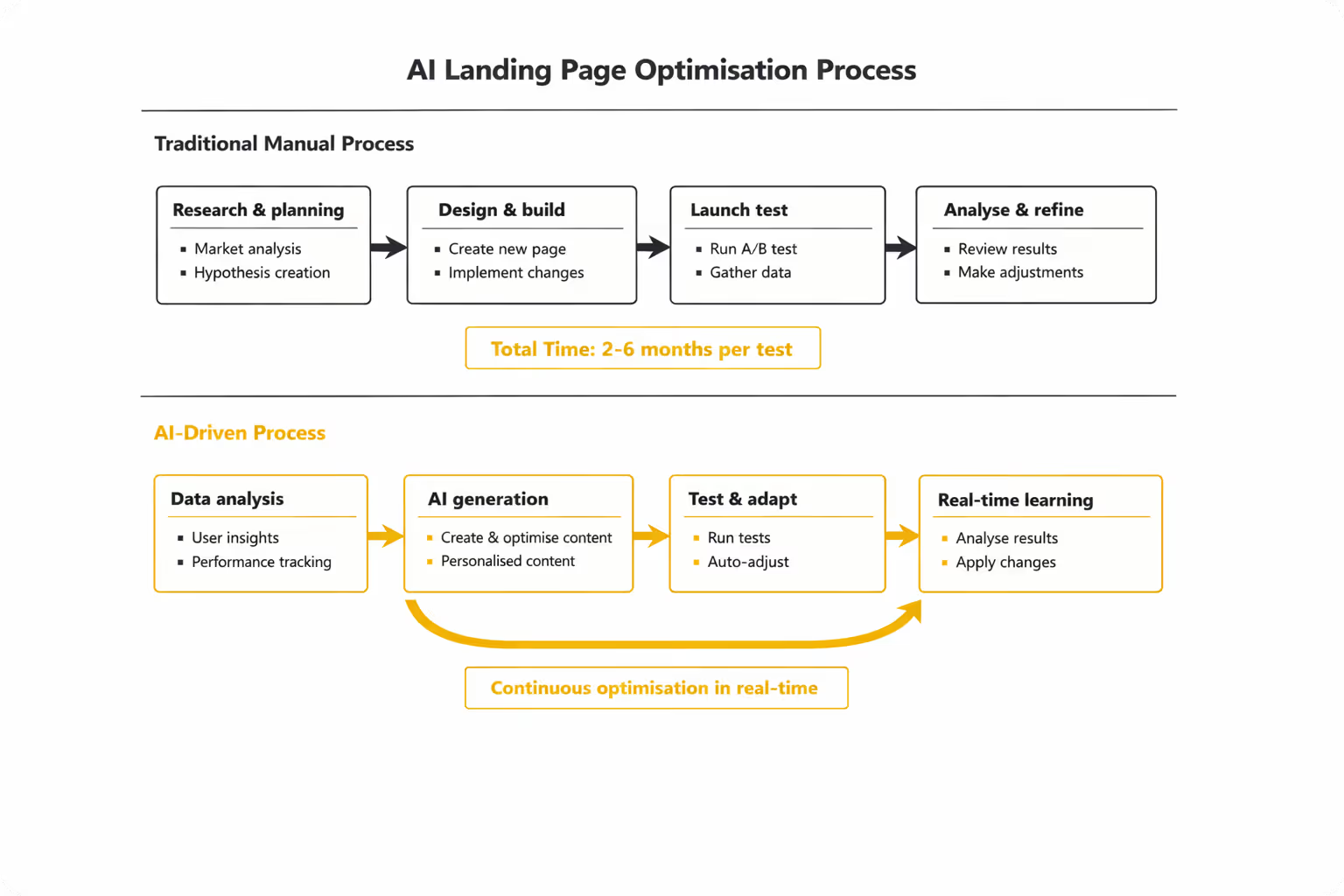
As AI-mediated search matures, Google will not just optimise for "did the ad get clicked?" It will increasingly care about, "Did the ad help complete the user’s answer journey?"
GEO-optimised pages do something powerful:
- They finish the explanation
- They reduce the need to search again
- They feel like part of the same conversation
Over time, that creates a quiet but meaningful advantage. AI systems are more likely to favour advertisers whose pages fit the answer journey.
AI Max is then more likely to allocate more opportunity to those advertisers. Not because there is a special reward system, but because the system learns what works.
5. What kind of impact should you realistically expect?
Let’s keep expectations grounded. Generative Engine Optimisation (GEO) is about driving realistic, not magical, improvements. While GEO-optimised AI Max pages can improve conversion rates from AI-expanded queries and enhance performance stability as reach scales, they will not instantly lower CPCs, force ads into AI Overviews, or replace fundamental campaign elements like bidding, budgets, or creative. Ultimately, GEO should be viewed as a tool for removing friction, not creating shortcuts.
What GEO-optimised AI Max pages can improve
- Conversion rate from AI-expanded queries
- Performance stability as reach scales
- Effectiveness of mid-funnel traffic
- Readiness for AI Overview placements
What GEO will not magically do
- Instantly lower CPCs
- Force ads into AI Overviews
- Replace bidding, budgets, or creative strategy
The better way to think about GEO is this, it removes friction. It does not create shortcuts.
6. The mindset shift that really matters
In the old world, you optimised keywords for machines and pages for humans. In the AI search world, you optimise pages for machines that increasingly interpret quality the way humans do.
That is why GEO-optimised landing pages naturally:
- Work better with AI Max
- Scale more predictably
- Age better as search evolves
Final takeaway
Generative Engine Optimisation (GEO) is the new foundation for success in AI-mediated search, demanding a shift from pages built for human persuasion to those optimised for machines that think like humans.
Alignment is the ultimate currency; by eliminating friction and continuing the AI's answer seamlessly, you activate a powerful feedback loop where AI Max rewards clarity with greater reach and predictable, converting scale.
FAQs
Q: Why are my Google Ads conversion rates dropping since AI overviews launched
A: AI overviews change user behaviour by answering questions directly in search results, meaning users who click through are at different stages of intent than before. Your landing pages may not align with these new user expectations, they're looking for continuation of the AI's answer rather than traditional sales messaging.
The solution is ensuring your pages provide clear, structured information that feels like a natural next step from what the AI already told them.
Q: How does Google AI Overviews affect paid search performance simple explanation
A: AI Overviews answer user questions directly in search results before showing traditional links or ads, which means fewer clicks overall but more qualified clicks from users seeking deeper information. Your ads now compete in an environment where users have already received a preliminary answer, so they're clicking with different expectations, they want continuation and depth, not repetition.
This shifts performance metrics because traffic volume may decrease while intent quality can increase, requiring different optimisation approaches.
Q: ROI impact of AI-driven search on PPC campaigns with data
A: AI-driven search typically reduces overall click volume by 15-40% as users get answers without clicking, but the clicks that do occur often convert better because users are further along in their decision journey. The key metric shift is from volume-based ROI to quality-based ROI, you're paying for fewer but more informed clicks.
Success requires optimising for this new reality by ensuring your landing pages serve users who've already consumed AI-generated context and are looking for the next level of detail.
Q: Why client Google Ads performance is unpredictable in 2026
A: AI-driven search systems are constantly learning and expanding which queries trigger ads, often showing ads on question-based searches that weren't previously targeted, leading to more variable but potentially higher-quality traffic. Performance fluctuates because the system is testing and learning what works, not because campaigns are broken.
The solution is ensuring landing pages can satisfy a broader range of related intents, which helps stabilise performance as AI systems gain confidence in recommending your client's pages.