
UK teams are next. Google said on 28 October 2026 that it plans to bring ads in AI Mode to the United Kingdom in Q4 2026, without giving a date. Adthena captured the first UK sponsored placements the next day.
Key Takeaways
- Google's AI writes the framing in AI Mode. Your feed supplies the product records it frames.
- Existing Search, Shopping and Performance Max campaigns are eligible automatically.
- Clean titles, specific attributes and the six conversational attributes give Google's AI more to match.
- UK AI Mode data is aggregate only. Record a baseline now.
Is Google AI Mode writing your product descriptions?
Partly. In Search Engine Land's test, Google's AI generated the category names and style descriptions, and the product titles matched advertiser feed data.
Advertiser copy stays in play. Adthena's UK captures show ads under a "Sponsored" label, opened by a short AI-written line and followed by product cards or text ads built from your assets, feeds and landing pages.
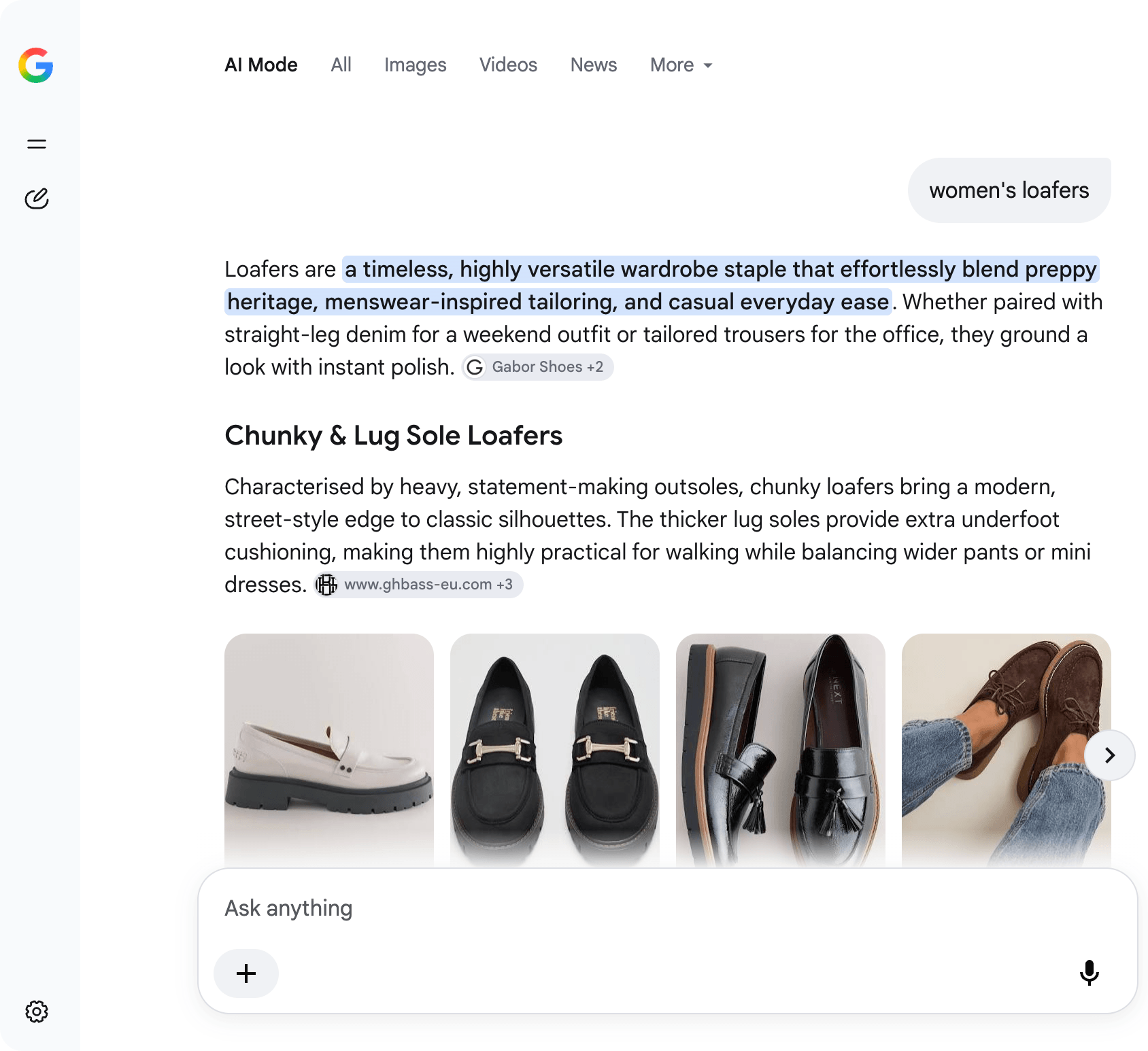
That finding comes from one set of searches, and Google has not published a field-by-field specification.
Why is your product feed the new creative in AI Mode?
Shoppers describe what they want in full sentences, and the feed is the only structured description of your products that Google's AI can match against.
A title like "Women's Lounge Set" gives the AI nothing on fabric, weight or occasion. A brand selling 450-GSM organic French terry, whose feed passes only a brand name, "Lounge Set", a colour and a size, leaves Gemini guessing. It can overlook the listing for a competitor that spells the detail out.
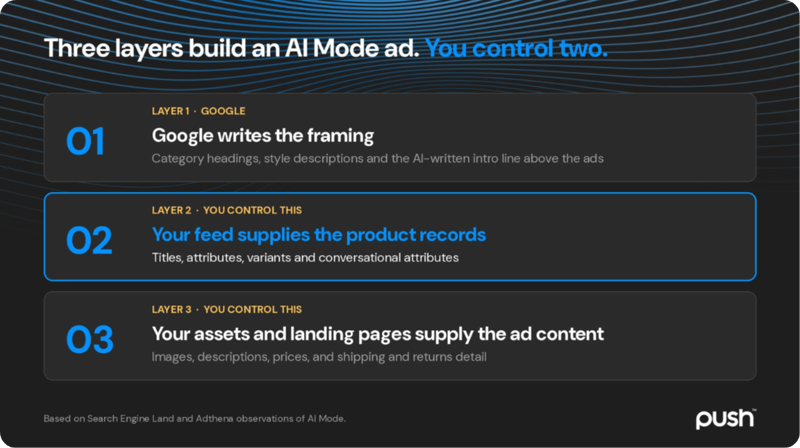
Honcho calls the feed shared infrastructure across Shopping ads, organic search and AI answers. For an ecommerce account manager, feed quality is now the main creative lever you control.
Do I need to change my product feed for Google AI Mode?
Yes. Existing Search, Shopping and Performance Max campaigns are automatically eligible, and you cannot opt out of AI Mode separately from Search. When the UK launch lands, your campaigns serve with whatever your feed says today.
Start with the products that carry your revenue:
- Rewrite titles as clean product names. Search Engine Land advises against keyword-heavy strings.
- Add what shoppers put in prompts: fabric composition, fit, silhouette, occasions and use cases.
- Use dedicated variant attributes for size, scent, firmness and compatibility.
- Supply several high-resolution images, accurate prices, and clear shipping and returns details.
PUSH's guide to choosing a Google Ads agency in the UK lists the questions to ask about asset groups and the balance between Performance Max and Shopping.
Which Merchant Centre attributes matter most for AI Mode?
The standard product data specification still carries the weight. Google describes conversational attributes as optional and designed to complement it, so fix the base first.
Prioritise title and description, written around real features. Add product_highlight and product_detail, which Google says you do not need to repeat in conversational attributes. Fill brand, GTIN and MPN, then colour, size and material for every variant. Keep price, availability and shipping accurate in pounds sterling, matching the landing page.
Write values in the words UK shoppers use: trainers, jumpers, joggers, colour.
Should UK advertisers use Merchant Center conversational attributes?
Conversational attributes are six optional Merchant Center fields that give AI systems product context a standard feed lacks. UK advertisers should use them. Google says they do not affect the approval status of existing products, so the only cost is time.
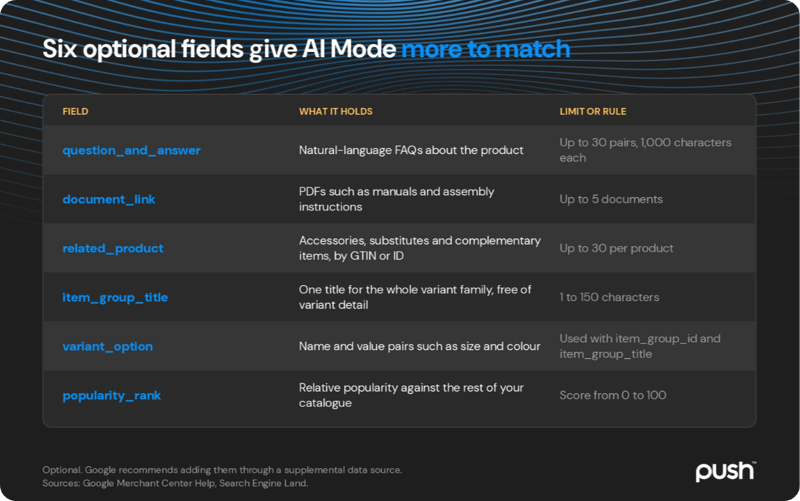
The fields are question_and_answer (up to 30 pairs per product, 1,000 characters each), document_link (up to five PDFs), related_product (up to 30), item_group_title, variant_option and popularity_rank (0 to 100).
Google recommends a supplemental data source, which lets your team edit them without rewriting the primary feed. Its Marketing Live 2026 update said retailers globally can use them.
Start with question_and_answer. Pull the questions from customer service logs and product page FAQs.
How should agencies change their creative workflow for AI Mode?
Treat the feed specification as the creative brief and give it the same review as ad copy.
- Name one feed owner per account, not a split between PPC, SEO and the client's ecommerce team.
- Have copywriters draft question and answer sets, highlights and descriptions. Merchandisers confirm every fact.
- Take phrasing from customer service logs, reviews, on-site search and search terms reports.
- Run commercial prompts in AI Mode every week and record how your products are grouped and described. PUSH tracks around 100 prompts in Profound to monitor AI search visibility.
PUSH is a Google Premier Partner, top 3% in EMEA, and won Best Use of AI in Search at the UK Search Awards 2025. Our AI marketing agency approach applies the same discipline to feed work as to ad copy.
Can UK advertisers measure AI Mode performance yet?
Not directly. Google reports AI Mode results only in aggregate, inside normal campaign and search terms reports. Google Ads does not break AI Mode out as a separate placement, and you cannot target it on its own.
Record a baseline for cost per acquisition, return on ad spend, conversion rate, impression share and new-customer share. Q4 ends on 31 December. Date-stamp every feed change. Check Merchant Center for the AI performance insights report, which Search Engine Land says eligible merchants can use to see share of voice across AI Mode and AI Overviews. Adthena's external tracking shows the prompts a brand appears on and the advertisers alongside.
Gemini will describe your product to a shopper before that shopper reaches your site. The record you submit is the only brief it gets.
Ready to check your feed before the UK launch? Request a free PPC audit from PUSH's PPC team and get a prioritised action plan for your Shopping and Performance Max accounts.