
Headline results
Which Health Insurer connects UK consumers with FCA-regulated health insurance advisers. By Q3 2024, its static Meta ads had stalled at 10 leads a day, with just 1.2% converting to sale. Some enquiries were for travel insurance rather than health cover.
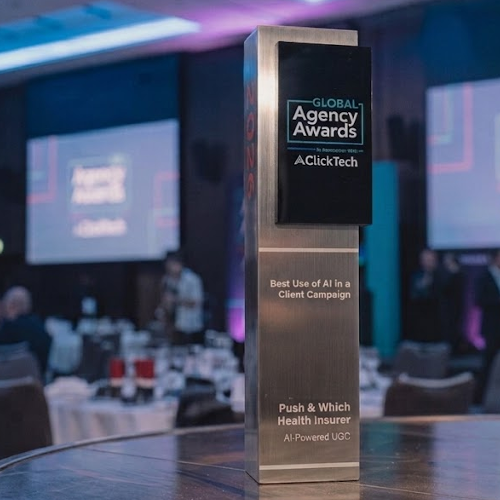
PUSH introduced AI-generated UGC-style videos made with Arcads, a three-campaign Meta structure and a fixed optimisation cycle. Lead-to-sale conversion rose to 14%, while CPA fell by 31% against the pre-campaign baseline. The campaign generated 6,070 leads, 69% above projection, and won Best Use of AI in Client Campaign at the Global Agency Awards 2026.
Static creative was producing the wrong leads, too slowly
Which Health Insurer needed more leads and better enquiries. Its static Meta ads had hit a ceiling on both volume and quality. The brand also operates in regulated finance, so it had to find out whether AI-generated creative could earn consumer trust and pass legal review.
- Irrelevant leads: static ads drew people searching for travel insurance. Lead volume was 300+ a month, but only 1.2% converted to sale.
- Volume ceiling: performance stalled at 10 leads a day. Creative fatigue set in quickly, and static assets were slow to refresh.
- Unsustainable acquisition costs: the existing CPA, combined with a 1.2% lead-to-sale conversion rate, left the model under pressure.
- Trust and compliance: creative had to explain the right insurance product clearly and satisfy legal review.
AI-generated UGC as the creative engine
-
01
AI-generated UGC at speed
Health insurance buyers tend to trust peer recommendations over brand advertising, yet traditional UGC is slow to produce. PUSH used Arcads to create UGC-style video testimonials, with scripts that referred explicitly to private medical insurance and FCA-regulated advisers and were reviewed by legal every time. Avatars matched UK adults aged 30 to 60, and the team produced fourteen videos in week one, in 9:16 for Reels and 1:1 for Feed, with captions for viewers watching without sound.
-
02
A three-campaign Meta structure
Broad targeting, with no interest layering, let Meta find high-intent users through creative signals. Winning videos ran in a Scale campaign using the post-ID method and Advantage+ targeting with 60% budget concentration. AI-generated UGC competed against static images, GIFs and carousels in Creative Testing, while top videos rotated weekly across 12 combinations of three creatives, two ad texts and two headlines in a Dynamic 322 campaign.
-
03
A fixed optimisation and lead-quality cycle
The team reviewed performance every Monday, Wednesday and Friday. CPA exceeding the agreed optimisation threshold or CTR falling below 1.2% triggered a creative refresh. An Arcads video using an adjusted script could go live within 24 hours and reach Scale within 72 hours. Lead-quality controls included Contact State verification, real-time duplicate detection, monitoring for travel insurance enquiries and weekly conversion tracking.
Controlled creative test results
AI-generated UGC video achieved a lower CPA than static images, GIFs and carousels. Its CTR was 1.41%, compared with 0.94% for static images, 1.05% for GIFs and 0.98% for carousels.
Percentage changes are rounded to the nearest whole number. Creative-test comparisons use each named format as the baseline. The separate 31% overall CPA reduction compares campaign performance with the pre-campaign baseline.
"Which Health Insurer needed better-quality leads. Static ads were attracting travel insurance searchers and converting at 1.2%. We built the strategy around AI-generated UGC and refreshed the creative on a fixed cycle. Lead-to-sale conversion rose to 14% and CPA fell by 31% against the pre-campaign baseline. It is great to see the judges recognise that."
 Rohan Moona
Winner: Best Use of AI in Client Campaign
PUSH won Best Use of AI in Client Campaign at the Global Agency Awards 2026 for its work with Which Health Insurer. The judges highlighted the use of AI-generated UGC as the creative engine, calling it an exceptional campaign that showcases end-to-end creativity and genuinely innovative solutions to a complex sector.
PUSH is featured in our guide to the top 9 AI marketing agencies in the UK, which sets out the criteria we judge AI capability against.
Ready to break performance records?
Find out how AI-generated UGC and structured Meta Ads testing could improve lead quality and reduce your acquisition costs.