
What is the AI Diamond?
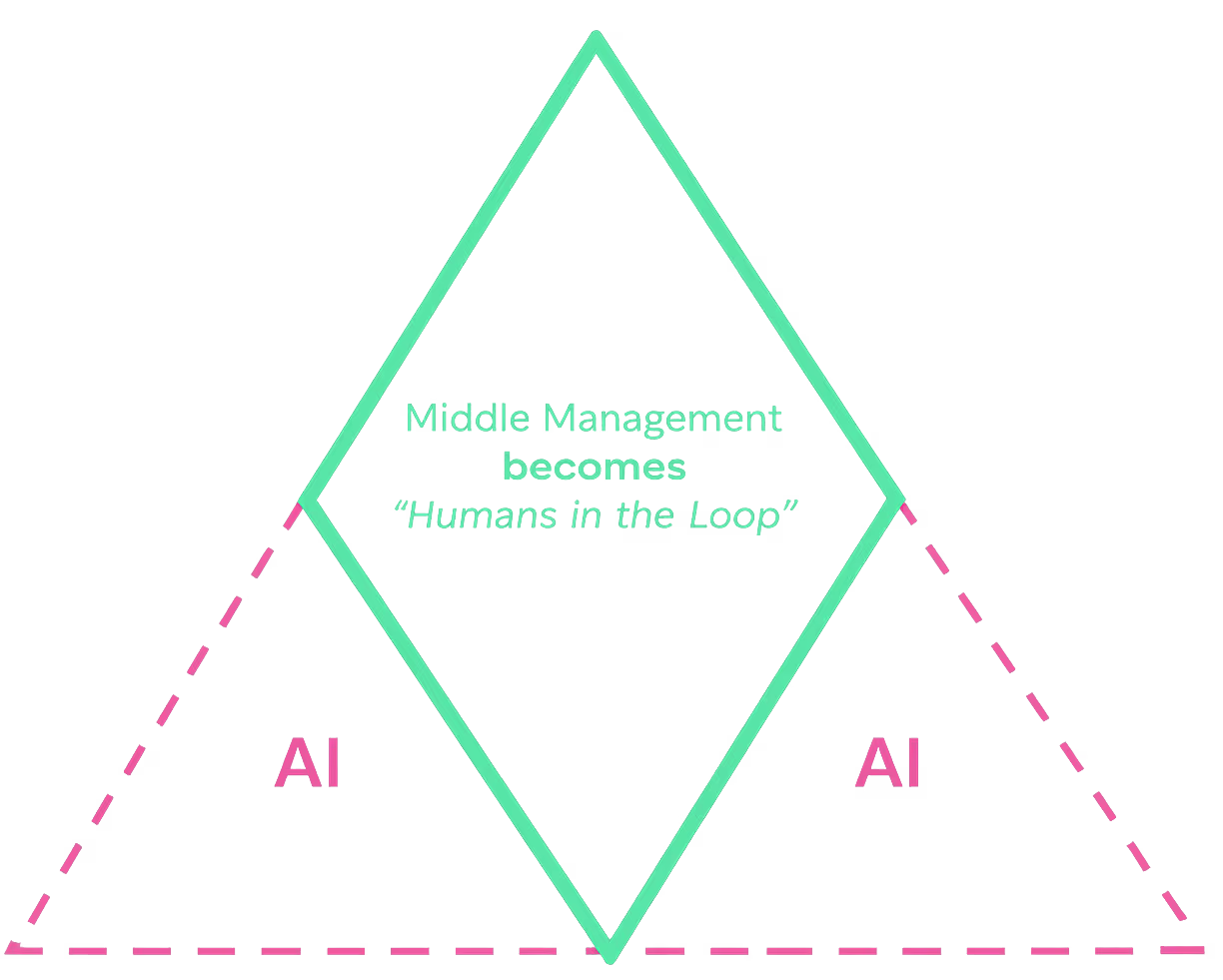
The AI Diamond is a way of describing the structural shift happening inside organisations as artificial intelligence absorbs routine tasks. In a traditional corporate pyramid, the base is wide: large numbers of junior staff doing high-volume, repeatable work. Leadership sits at the top, and middle management holds the layers together.
As AI takes on those routine junior tasks, the base narrows. The pyramid becomes a diamond, widest at the middle management layer, where human judgment, oversight and accountability are now concentrated.
This isn’t a prediction. It’s already happening. At Push, we’ve been AI-first for three years, and the structural shift is visible in our own team and in every organisation we work with.
The shift in real terms
A few of weeks ago I shared a question on LinkedIn. I wasn't theorising. I was describing what I’ve been watching happen in real time at Push, and increasingly with the organisations we partner with.
The response was larger than I expected, and the quality of the debate that followed genuinely helped sharpen my thinking. So I want to expand on it properly here.
In 2020, Push had around 20 graduate-level account executives. Today we have 2. Our strategist layer is bigger, more senior and more entwined with delivery than it’s ever been. That shift didn’t happen through a single decision, it happened gradually, through AI absorbing the repeatable, high-volume tasks that those roles were built around.
The same general pattern is playing out with our clients. It’s not a theory. It’s an operational reality that’s arriving faster than most organisations have planned for.
What the AI Diamond means for each layer
Senior leaders: the pace problem
The most consistent challenge at the top isn’t strategic vision, its tempo. AI implementation doesn’t move at the pace of a quarterly strategy cycle. It moves faster, surfaces unexpected problems, and demands decisions before the data is complete.
The leaders who are adapting well are the ones who’ve accepted that their strategy documents will be outdated before they’re finished. They’re running shorter loops, testing, adjusting, and accepting that ‘good enough and live’ consistently outperforms ‘perfect and pending’.
This is a genuine cultural shift. Organisations built on careful, consensus-driven planning find the pace of AI adoption deeply uncomfortable. That discomfort is a signal, not a reason to slow down.
Middle managers: the hardest pivot
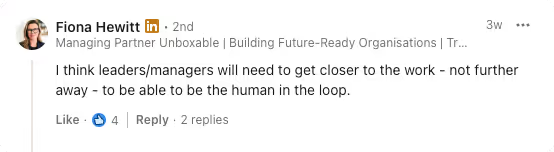
This is where the real leadership story lives. Middle managers in an AI Diamond aren’t managing people in the traditional sense. They’re the human in the loop, the layer of judgment, accountability and context that sits between AI outputs and real business outcomes.
That observation, from the comments on my original post, is exactly right, and it points to something important: the middle manager’s job has become partly editorial, partly operational, and partly investigative.
Doug Dannemiller framed the accountability challenge well. When an AI produces a draft and nobody quite knows how it was built, what sources it drew on, or whether the insight is genuinely sound, the middle manager is being asked to put their professional reputation on something they can’t fully interrogate. That’s a significant burden, and one that requires a deeper operational understanding of the work than many managers currently have.

The implication is clear: middle managers can’t govern what they don’t understand. And they can’t automate a vague idea. The organisations getting this right are the ones investing in their middle layer’s operational depth, not just their people-management skills.
Junior professionals: expertise over execution
The most important thing to say about junior roles is this: AI is replacing the tasks that were historically how junior value was developed, not the underlying expertise itself.
Subject matter expertise, a genuine understanding of what the automation needs to deliver, what good looks like, and where the edge cases are, is now the most critical input in the system. Only the people who’ve done the work know what the automation needs to replicate.
At Push, the junior professionals who remain are operating well above their job titles because of this. The volume of their output has changed; the value of their knowledge hasn’t.

The talent pipeline problem
Mark Hewett and Neil Harrison both raised this in the comments, and it’s the part of the AI Diamond that I don’t have a clean answer to.
If the entry-level roles, the ones that historically developed the next generation of strategists and managers, are being automated away, where do the future strategists come from? You can’t scale a middle layer of experienced operators if you’ve closed the pipeline that produced them.
The honest answer is that most organisations, including Push, are taking the short-term efficiency gains and deferring this problem. That’s a rational response to immediate competitive pressure. But it isn’t a sustainable long-term model.
The organisations that solve this first, finding a way to develop strategic thinking and operational depth in people who’ve never done the junior routine work, will have a significant structural advantage within five to ten years.
Is the Diamond a destination or a phase?
Neil Bennett raised something interesting in the thread: whether the diamond itself is just a transitional shape, and whether organisations will morph into something else as AI matures and network-over-hierarchy becomes more necessary.
I don’t know the answer. What I do know is that the businesses treating the diamond as a permanent destination are probably making a mistake. The ones adapting best are holding their structure loosely, willing to reorganise as the landscape changes, rather than rebuilding the old pyramid with AI bolted on.
"I wonder whether the diamond morphs into other shapes as network over hierarchy becomes more necessary and where the (senior) leader sits eg in the middle?"
Neil Bennett, Veteran RM
The diamond is real. But it may be a waypoint, not an endpoint.
What this means practically
If you’re leading a team or a function right now, here’s what this means in practice:
- Map your junior tasks before you automate them. Know what they actually produce, not just what they’re called. Automating a vague idea produces vague results.
- Invest in your middle layer’s operational depth. They need to understand the work intimately, not just manage the people doing it. The governance role requires it.
- Build a verification culture. AI outputs need human interrogation. Establish clear standards for how AI-generated work is reviewed, attributed and approved before it carries your organisation’s name.
- Keep some version of the entry-level pipeline alive, even if the shape changes. The talent pipeline problem is coming. The organisations that start solving it now will be better positioned in five years.
- Treat the diamond as a live structure, not a fixed org chart. The shape that works today may not be the shape that works in eighteen months. Build in the flexibility to reorganise.
How is your organisation navigating this shift? Are you seeing the same structural changes or something different? I’d genuinely like to know.
If you’d like to understand how AI adoption is reshaping your marketing function specifically, see how Push approaches AI-led transformation. And if you’re ready to assess where your business stands today, our AI marketing audit is the clearest starting point we’ve found.
About Paul Kearney
Paul Kearney is a Director at Push, a UK AI-first digital marketing agency. He has spent the last three years working at the operational intersection of AI and marketing transformation, helping organisations across multiple sectors move from AI interest to real implementation.
Frequently Asked Questions
What is the “AI Diamond” organisation structure?
It describes how companies shift from a traditional pyramid to a diamond shape as AI absorbs routine, repeatable work. The entry-level base narrows while accountability, oversight, and decision-making concentrate more heavily in the middle layer.
How does AI adoption change the role of middle management?
Middle managers move from mainly people-management to being the “human in the loop” who verifies AI outputs and owns governance. Their job becomes more editorial, operational, and investigative—requiring deeper understanding of the work, not just the team.
Why are entry-level jobs shrinking in AI-first teams?
Many junior roles historically focused on high-volume execution tasks, which are among the first to be automated. This doesn’t remove the need for expertise, but it changes how early-career professionals create value—toward domain knowledge and quality control.
What is the “talent pipeline problem” created by AI?
If organisations automate away the roles that used to develop future strategists, they risk running out of experienced operators later. Solving it means creating new pathways to build judgment and operational depth without relying on large amounts of routine work.
What practical steps can leaders take to manage the shift to an AI Diamond?
Start by mapping the real outputs of junior tasks before automating them, then build a verification culture with clear review and approval standards. Invest in middle-layer operational depth and treat the structure as flexible, since the best shape may change as AI matures.