OpenAI has launched product feed campaigns in ChatGPT's Ads Manager. Google is testing Sponsored Shops, a format that groups multiple products from a single retailer into a branded unit inside Shopping results. Both developments point to the same conclusion: the product feed is no longer the layer that sits underneath your advertising.
In these environments, it is the advertising. And that changes what you should be spending your time on.
Key Takeaways
- OpenAI has launched product feed campaigns in ChatGPT Ads Manager, letting retailers generate ads directly from their catalogue via SFTP upload
- A global DTC brand doubled its click-through rate and halved its cost per click after switching from standard ChatGPT ads to feed-based campaigns
- Google is testing Sponsored Shops, a format that groups multiple products from one retailer into a single branded unit inside Shopping results, including store name and seller ratings
- Both platforms now serve your product titles, descriptions and imagery directly to the consumer, with no intermediate creative layer between your data and the person deciding whether to click
- Feed quality is no longer a technical maintenance task. It is the primary competitive variable in ecommerce advertising.
What have OpenAI and Google just announced?
Two separate announcements. Two different platforms. One shared direction.
ChatGPT product feed campaigns: how the beta works
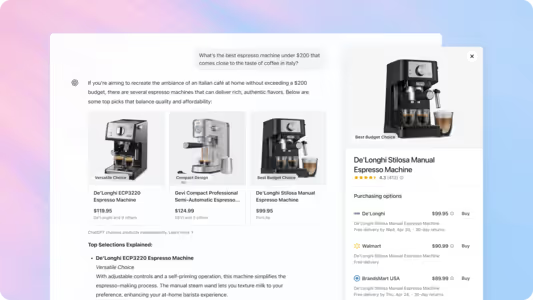
OpenAI's product feed campaigns, now live in beta, let retail advertisers upload a structured product catalogue into OpenAI's Ads Manager via SFTP and run campaigns directly from that data.
The feed requires a minimum of 1,000 products and supports up to 2 million. Once uploaded, advertisers create campaigns by selecting the feed as the campaign type, applying product filters to define eligibility, and setting up an ad template.
Screenshot 1: OpenAI Ads Manager — Product Feed Campaign Setup
Alt text: OpenAI Ads Manager showing Product Feed campaign type selection
Caption: OpenAI Ads Manager beta, showing the Product Feed campaign type. Source: OpenAI Ads Manager.
There is no separate step where you write ad copy. There is no brief to a designer. Your product titles, descriptions and images are pulled directly from the feed and served to users mid-conversation.
ChatGPT matches eligible products to conversations that indicate purchase intent, someone comparing trainers, researching a sofa, asking about skincare, and serves the most relevant product from your catalogue at that moment.
The performance case is already forming. According to OpenAI and reported by Marketing4Ecommerce, a global DTC brand doubled its click-through rate and halved its cost per click after switching from standard ChatGPT ads to feed-based campaigns. Feed-based ads are among the strongest performers in the programme to date.
For UK advertisers specifically: ChatGPT ads went live in the UK on 6 June 2026, confirmed by OpenAI VP of Monetisation Benji Shomair, making the UK OpenAI's first European market.. Access is currently managed and phased, not open self-serve for all. But the direction is clear, and the window to get ahead of the market is open now.
Google Sponsored Shops: what the format looks like in practice
Google's Sponsored Shops format, spotted in Shopping results and reported in April 2026, takes a different approach to the same underlying idea.
Instead of individual product listings competing against each other, Sponsored Shops groups several products from a single retailer into one branded unit. The unit displays the store name, seller ratings and a curated product selection.
Screenshot 2: Google Sponsored Shops, In Shopping Results
Alt text: Google Sponsored Shops ad unit showing multiple products from a single retailer inside Shopping results
Caption: Google Sponsored Shops unit inside Shopping results, showing store name, seller ratings and grouped product tiles. Format currently in testing.
In standard Shopping, you win a placement by having stronger feed data and a higher bid for a specific product. In Sponsored Shops, the competitive unit is the retailer, not the listing.
A competitor with catalogue depth, strong seller ratings and a well-built brand presence holds a structural advantage that bid optimisation alone cannot close. You cannot out-bid a better shop.
Google has also been building toward this. In 2025, Google introduced Merchant Brand Profiles, letting retailers build brand-presence pages in search with lifestyle images, videos and business descriptions. Sponsored Shops looks like the next step in that progression, bringing brand identity directly into the Shopping ad unit itself.
Why does this change how you think about your product feed?

Feed quality has always mattered. But it mattered in a back-office way. Was the data accurate enough to pass validation? Were the required fields populated? Did it clear the minimum bar so the platform would stop flagging errors?
That framing no longer applies.
The feed used to sit behind the advertising. Now it is the advertising.
In standard Google Shopping, the platform reads your feed and builds something on top of it. An individual product listing, a price comparison tile, a sponsored carousel. Your feed data was the input. The output was shaped and filtered by the platform.
In ChatGPT product feed campaigns, your feed data is the ad creative. The title you wrote becomes the headline a user reads mid-conversation. The description you drafted is the supporting copy. The image you uploaded is the visual they judge. No intermediate layer. No creative team adding polish. Just your data, in front of a customer.
In Google Sponsored Shops, your feed data is the storefront. Product imagery, titles, catalogue depth, all presented together as a representation of your brand inside search results.
Both environments expose your data to the consumer directly. And that changes the quality standard.
What "feed quality" actually means when consumers see the raw data
When I look at a product feed for an account managing a large footwear range, the problems tend to cluster in the same places. Titles written to pass validation rather than to communicate value. Descriptions that recycle the product name with minor variations. Size and variant data that is technically correct but inconsistently structured. Images that work well in a standard listing but look thin when displayed at the size a Sponsored Shops unit demands.
Those gaps used to matter only internally, when the platform flagged errors. Now they matter externally, when a customer reads them.
A title that reads "Men's Leather Oxford Shoe Brown 42" passes every validation check Google has. It tells a user almost nothing useful. In a ChatGPT feed ad, served mid-conversation to someone asking about smart shoes for a job interview, that title is your one shot at relevance. In a Sponsored Shops unit, where three or four of your products appear together, that title is part of your brand presentation.
Feed quality is brand quality now.
What does this mean for a large catalogue retailer?
Large catalogue retailers are the primary audience for both formats. OpenAI designed feed campaigns explicitly for catalogues of 1,000 to 2 million products. Google's Sponsored Shops format rewards assortment depth and strong seller signals across multiple product categories.
Why catalogue depth compounds across every new surface
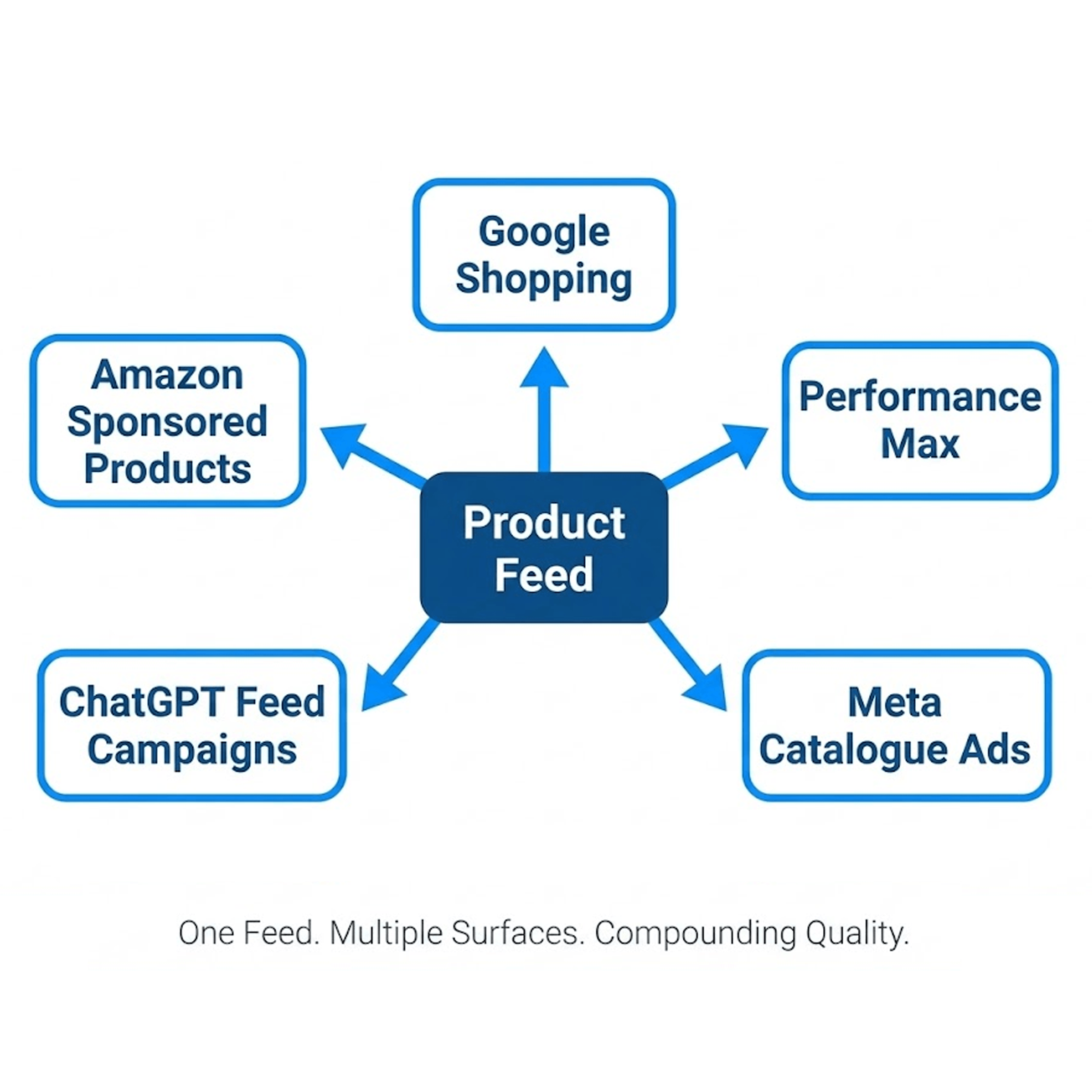
Managing a large footwear range, with men's, women's and children's product lines, seasonal rotations, variant-heavy SKUs across sizes, widths and colours, and an expanding non-footwear category, is a feed management challenge at scale.
The same structured product data flows into Google Shopping, Meta catalogue ads, Performance Max and now ChatGPT feed campaigns. Every surface reads from the same source.
That means feed investment compounds. A title you invest time in improving does not just help one campaign or one platform. It improves performance across every surface that reads your feed. The same is true for imagery, descriptions, category taxonomy and attribute completeness. Quality is not platform-specific. It is a cross-platform asset.
The retailers who have treated their feed as a strategic priority rather than an operational task already hold an advantage that is measurable across multiple channels. That advantage grows with every new surface that routes through the same data.
The consistency problem: one feed, multiple ad environments
The challenge for large catalogues is not just quality, it is consistency. A product title optimised for Google Shopping, front-loaded with category and attribute, structured for keyword matching, does not always translate cleanly into a ChatGPT ad. In a conversational environment, titles read differently.
They need to communicate value and relevance to a person, not just match a keyword pattern.
An image that performs well in a standard Shopping grid tile, clear white background, sharp product shot, may look entirely different in a Sponsored Shops storefront unit where it sits alongside lifestyle imagery and brand-level presentation.
Managing that consistency across a catalogue with tens of thousands of SKUs, seasonal product launches and marketplace expansion is an active strategic task. It is exactly the kind of challenge that sits at the heart of a well-run Google Shopping strategy. It requires a standard, applied systematically, rather than optimisation done ad hoc when performance dips.
What does this mean if your catalogue is smaller?
The honest picture is more nuanced than "big catalogue wins, small catalogue loses."
The 1,000-product minimum and what it actually excludes
OpenAI's 1,000-product minimum for feed campaigns is a genuine threshold. A retailer with 200 or 300 SKUs cannot access this format in its current beta configuration. That is a real constraint.
Google's Sponsored Shops, if it scales broadly, also favours the catalogue depth that smaller retailers cannot match by definition. These are structural realities of both formats.
Standard Google Shopping remains the primary battleground, and smaller sellers compete effectively there. Meta catalogue ads have no equivalent minimum threshold. Amazon's advertising ecosystem continues to reward individual listing quality over catalogue size. The landscape for smaller retailers has not changed overnight.
Why feed quality per product matters more, not less
A 300-product feed with precise titles, complete attributes, strong imagery and clean category taxonomy will outperform a 5,000-product feed with mediocre data on every surface that does not impose a minimum threshold. The ratio of quality to volume matters more when volume is fixed.
Smaller catalogues are also easier to audit and easier to keep consistent. The task of reviewing every product title, improving every description, updating every image to a consistent standard, is a two-week project on a 300-product feed. On a 50,000-product catalogue, it is a six-month programme.
If Sponsored Shops scales, seller ratings and brand signals are also store-level assets that do not require a large catalogue to build. A retailer with strong reviews, a clear brand identity and a well-maintained Merchant Brand Profile is better positioned in a store-level format than a large retailer with weak ratings and inconsistent brand presentation. The format rewards brand clarity, not just breadth.
What should ecommerce brands be doing right now?
Three priorities. All of them are actionable before either format reaches full scale.
Audit your product titles as if they are ad headlines
Pull your feed. Read your top 50 product titles aloud. Not as a data field. As a sentence a customer reads in the middle of a conversation about buying something.
Do they communicate what the product is and why it is worth considering? Or do they describe a product attribute to satisfy a validation requirement?
Every title that reads like the latter is now a gap in your creativity. Fix the worst examples first. Apply the improved standard to new product uploads. The improvement to Google Shopping, Meta catalogue ads and ChatGPT feed campaigns is immediate, across all three surfaces at once.
Get your Google Merchant Brand Profile in order before Sponsored Shops scales
Screenshot 3: Google Merchant Brand Profile — In Search Results
Alt text: Google Merchant Brand Profile displayed in search results showing brand description and product imagery
Caption: A Google Merchant Brand Profile as it appears in search. Retailers can claim and manage their profile via Google Merchant Center under Marketing > Brand.
Google introduced Merchant Brand Profiles in 2025, giving retailers a dedicated space in search to present brand descriptions, lifestyle imagery and product categories. If your Brand Profile is unclaimed or incomplete, fix that now, before Sponsored Shops makes store-level brand presentation a direct ranking input.
Seller ratings matter here too. A Sponsored Shops unit displays store ratings alongside product selection. A retailer with 4.7 stars and 2,000 reviews occupies a fundamentally different position in that unit than one with no rating showing at all.
If you qualify for ChatGPT feed campaigns, the barrier to entry is low
ChatGPT ads are live in the UK as of June 2026. Access is currently managed and phased, not fully open to all UK advertisers through self-serve. The SFTP upload process is documented in OpenAI's Ads Manager. The ad template setup requires selecting an image field, not briefing a creative team.
If your catalogue meets the 1,000-product threshold and you already manage a structured feed for Google or Meta, the incremental cost of testing ChatGPT feed campaigns is low. The learning curve on a channel that is currently under-populated with advertisers is also significant. Early performance data favours the format. The time to test is now, not when every competitor has caught up.
For the broader ecommerce advertising strategy that frames where feed campaigns sit alongside paid search and paid social, our ecommerce paid media work covers how we build that across channels for mid-sized UK brands.
If you want to understand how AI is reshaping how products get discovered, not just advertised, our AI marketing for ecommerce brands overview covers the full picture.
And for the Google Shopping fundamentals that feed quality builds on, our Google Shopping strategy guide is worth reading alongside this.
The product feed used to be something you maintained. You kept it accurate. You fixed the errors. You moved on.
It is now something you compete with. The brands that understand that first are the ones building the right advantage right now.
FAQ
1. What are ChatGPT product feed campaigns and how do they work?
ChatGPT product feed campaigns let retail advertisers upload a structured product catalogue into OpenAI's Ads Manager via SFTP and run ads directly from that data. The platform pulls product titles, descriptions and images from the feed and matches eligible products to user conversations that indicate purchase intent. There is no separate ad copy creation step. The feed data is the ad creative.
2. What is Google Sponsored Shops and how is it different from standard Shopping ads?
Google Sponsored Shops is a Shopping ad format currently in testing that groups multiple products from a single retailer into one branded unit inside search results. Unlike standard Shopping ads, where individual products compete based on feed quality and bid, Sponsored Shops makes the retailer the competitive unit. The format displays the store name, seller ratings and a curated product selection together, rewarding catalogue depth, brand clarity and strong seller signals.
3. How many products do I need to run product feed campaigns in ChatGPT?
OpenAI's current beta requires a minimum of 1,000 products and supports up to 2 million per feed. Retailers below the 1,000-product threshold cannot access the feed campaign format in its current configuration. One feed connection per ad account is permitted during the beta period.
4. How do I optimise my product feed for these new ad formats?
Treat product titles as ad headlines: they need to communicate value to a person, not just pass platform validation. Ensure product descriptions differentiate the item clearly. Use high-quality imagery that holds up across different display contexts. Check that your Google Merchant Brand Profile is claimed and complete. Build and maintain seller ratings through a Google-approved review partner. Apply these standards consistently across your catalogue, not just to top-performing SKUs.
5. Are ChatGPT product feed ads available to UK retailers?
ChatGPT advertising went live in the UK on 6 June 2026, making the UK OpenAI's first European market. Access is currently managed and phased, not fully open to all UK advertisers through self-serve. UK retailers interested in feed campaigns should register interest through OpenAI's Ads Manager or work with an agency partner who has access to the beta programme.