

Key Takeaways
- 64% of shoppers report being likely to use AI for purchases, with younger demographics leading adoption, if your products aren't discoverable in AI conversations, you're invisible to your future customer base
- Product data has become your primary marketing asset, structured, complete catalogue information directly determines AI discoverability
- One Shopify integration now reaches ChatGPT, Perplexity, and Microsoft Copilot, eliminating the need for separate technical integrations
- Attribution complexity has increased 10x, customers discover via AI, research across platforms, then purchase days later
- Early adopters will capture disproportionate value, AI recommendation algorithms reward products that establish engagement patterns first
- Platform dependency is the hidden trade-off, you gain channel access but accept Shopify as your intermediary layer
1. How Are Gen Z Shoppers Actually Using AI in 2025?
Direct answer: 64% of shoppers report being likely to use AI when making purchases, with adoption concentrated among younger demographics, while AI-driven traffic to Shopify stores increased sevenfold since January 2024.
This isn't emerging behaviour. It's mainstream adoption within your future customer base.
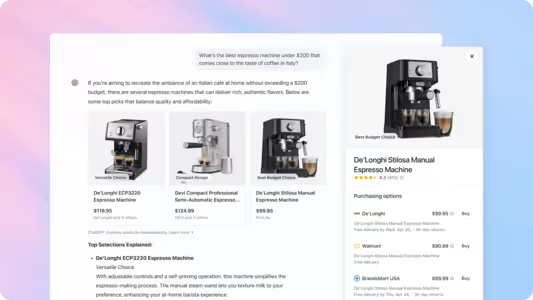
Gen Z isn't typing "best waterproof hiking boots" into Google anymore. They're asking ChatGPT or Perplexity conversational questions like:
- "What hiking boots work for Scottish weather under £150?"
- "Show me sustainable activewear brands that ship to London"
- "Compare these three coffee makers for small kitchens"
They expect curated recommendations with instant purchasing options.
What this means for UK retailers: If your products aren't discoverable in AI conversations, you're invisible to a demographic that will dominate consumer spending within five years.
This isn't about preparing for the future. You're already behind if you haven't optimised for AI discovery.
Push helped brands navigate this change, earning Best Use of AI at the UK Agency Awards 2025 for our work in AI-powered commerce strategy.
2. Why Is Product Data Now Your Most Valuable Marketing Asset?
Direct answer: Product data has shifted from operational infrastructure to primary marketing asset because AI models can only recommend products they can accurately interpret and categorise.
For years, product data meant SKU codes, inventory levels, and basic specifications. Now in 2025, it determines whether you appear in AI-powered shopping conversations.
Shopify's Agentic Storefronts translate your product catalogue into formats AI models can interpret. The system uses signals from millions of merchants to infer categories, extract attributes, and structure information.
The fundamental shift
Your beautifully crafted brand storytelling still matters. But now you need parallel investment in structured data completeness.
Every missing attribute field directly reduces your discoverability. Every incomplete specification makes your product invisible to relevant queries. Every vague categorisation means AI models recommend competitors instead.
For UK merchants specifically
This includes:
- Proper VAT documentation
- UK-specific sizing standards (UK 12 vs. EU 40)
- Brexit-compliant product information
- Accurate shipping zones and delivery timeframes
- Currency formatting (£, not $)
AI models need this structured data to make accurate recommendations to UK shoppers.
Common mistake to avoid: Assuming your existing SEO-optimised descriptions are sufficient. They're not,AI needs structured data fields, not just compelling copy.
3. What Makes Content AI-Readable vs. Human-Readable?
Direct answer: AI-readable content uses semantic structure where key information sits in dedicated fields rather than embedded within narrative copy.
Here's the uncomfortable truth: the product description you spent three hours perfecting might be completely unintelligible to AI models.
The issue isn't writing quality. It's semantic structure.
How AI models interpret product information
When someone asks an AI assistant: "I need a vegan leather handbag under £150 with multiple compartments"
The AI needs to parse:
- Material composition (vegan leather)
- Price range (under £150)
- Structural features (multiple compartments)
- Location relevance (UK pricing, shipping)
If this information is embedded in narrative copy like: "Our beautiful handbag features premium vegan leather construction with thoughtfully designed interior spaces, all at an accessible price point"
The AI can't reliably extract those specific attributes.
What works instead
Structured fields:
- Material: Vegan leather (PU)
- Price: £129.99
- Compartments: 5 (3 interior, 2 exterior)
- Dimensions: 32cm x 28cm x 12cm
- Weight: 680g
Plus narrative copy for human emotional connection.
Key insight: Content strategy now requires dual optimisation, emotional resonance for humans and semantic clarity for machines. You can't choose one or the other.
As a London AI marketing agency, Push helps brands structure content for both audiences without sacrificing brand voice.
4. How Does One Shopify Integration Reach Multiple AI Platforms?
Direct answer: Shopify Agentic Storefronts centralises product syndication across ChatGPT, Perplexity, and Microsoft Copilot through a single admin setup, eliminating separate technical integrations.
Previously, appearing in AI-powered shopping required separate integrations for each platform:
- ChatGPT's shopping features
- Perplexity's Buy with Pro
- Microsoft's Copilot Merchant Program
Each had different:
- Technical requirements
- Data format specifications
- API maintenance needs
- Update schedules
For mid-market retailers, this created an impossible choice: invest scarce technical resources in AI integrations, or miss the channel entirely.
How Shopify solved this
One setup in your Shopify admin syndicates your entire catalogue across multiple AI platforms.
You can:
- Toggle individual platforms on or off from your dashboard
- View attribution flowing back with full channel visibility
- Update product information once, propagate everywhere
- Monitor which AI channels drive the most conversions
Why this matters for UK merchants: You're now competing on product quality and positioning rather than technical resource availability.
A small Brighton boutique has the same AI channel access as a London enterprise retailer.
The catch: You're accepting Shopify as the intermediary layer between your business and these discovery channels. More on this in point eight.
5. Do You Still Own Customer Relationships in AI Commerce?
Direct answer: Yes, merchants remain the merchant of record, customer data stays yours, and you decide whether transactions complete in-chat or redirect to your checkout.
This distinction matters enormously for long-term business value.
If purchases flowed entirely through AI platforms with you as a supplier, you'd lose:
- Direct customer data
- Retention capability
- Pricing power
- Post-purchase relationship
- Email marketing opportunities
- Loyalty program integration
Shopify preserved merchant control. You choose:
- Whether customers buy directly in AI chat interfaces
- Whether they redirect to your hosted checkout
- What post-purchase communications they receive
- How you handle returns, warranty, support
The qualification: "For now"
As AI commerce scales, competitive pressure may shift this dynamic. If competitors offer frictionless in-chat purchasing while you redirect to external checkout, conversion rate differences may force strategic compromises.
The customer experience friction of "leaving the conversation to complete purchase" could become a competitive disadvantage.
UK GDPR consideration
GDPR compliance remains your responsibility. Even though Shopify facilitates the technical integration, you're still the data controller for any customer information collected through these channels.
Ensure your privacy policy, consent mechanisms, and data processing agreements cover AI-mediated transactions.
6. Why Has Attribution Become 10x More Complex?
Direct answer: AI commerce creates multi-platform customer journeys where discovery, research, and purchase happen across disconnected interfaces days apart, making accurate attribution nearly impossible with traditional tools.
Traditional attribution was already challenging:
- Multi-touch journeys across devices
- Delayed conversions
- Cookie deprecation
- Cross-domain tracking limitations
AI commerce makes this exponentially more complex.
Consider this realistic customer journey
Monday morning: Customer asks ChatGPT: "Best espresso machines under £400 for small kitchens"
Your product appears in the AI recommendation. The customer reads the AI summary but doesn't click through.
Tuesday afternoon: Customer asks Perplexity: "Sage Bambino Plus vs Delonghi Dedica reviews"
Your product appears again. The customer watches a YouTube review they found through the AI answer.
Wednesday evening: Customer sees your Instagram ad (retargeting).
Thursday: The customer visits your website directly by typing your brand name into Google.
Friday: Customer completes purchase through standard Shopify checkout.
Attribution question
Which channel gets credit?
- ChatGPT (first discovery)
- Perplexity (research reinforcement)
- YouTube (social proof)
- Instagram (remarketing)
- Google organic (direct navigation)
- None of the above (direct type-in)
The reality: Shopify promises full AI channel attribution flowing into your admin. But the fragmentation challenge remains.
You're operating in an environment where purchase journeys span platforms with fundamentally different tracking capabilities.
Action point for UK merchants
Ensure your analytics infrastructure can handle multi-source attribution before scaling AI channel investment. Otherwise you're optimising blind, potentially over-investing in channels that look ineffective but actually drive significant assisted conversions.
Our SEO Agency in London team helps brands build attribution models that capture the full customer journey across AI and traditional channels.
7. What UK-Specific Features Did Shopify Add?
Direct answer: Shopify extended its automated Tax product to UK and EU merchants in Q3 2024, handling VAT calculations, generating compliant invoices, and tracking regional tax liabilities automatically.
This might seem tactical compared to the strategic shifts above. For UK merchants, it's genuinely transformative.
What changed
Automated VAT handling now includes:
- Real-time VAT calculations for UK and EU
- Automatically generated compliant invoices
- Regional tax liability tracking
- Cross-border compliance management
- Brexit-specific rules and thresholds
Why this matters now
As your products become discoverable to international shoppers through AI platforms, you'll field more queries from EU customers.
AI doesn't respect geographic boundaries. When someone in Paris asks Perplexity for "sustainable skincare UK brands," your products might surface even if you've never deliberately marketed to France.
The infrastructure advantage: Managed Markets combined with automated VAT handling means you can confidently enable these channels without drowning in compliance complexity.
Shopify data shows:
- 83% of Managed Markets adopters increased countries served
- International sales growth averaged over 40% post-adoption
For UK merchants navigating post-Brexit commerce complexity, this removes significant friction.
You can test international AI discovery channels without hiring a tax specialist first.
8. What's the Trade-Off for Platform Convenience?
Direct answer: You gain simplified access to multiple AI discovery channels but accept increased platform dependency where Shopify mediates your relationship with these channels.
Shopify's Agentic Storefronts offer compelling value: access to ChatGPT, Perplexity, and Copilot without building technical integrations in-house.
For SME and mid-market retailers, this is transformative.
The strategic trade-off
You're accepting that Shopify mediates your relationship with AI discovery channels. If:
If:
- Shopify's partnerships change
- Pricing models evolve
- Platform priorities shift
- New AI channels emerge that Shopify doesn't support
Your negotiating leverage is limited. You can't easily maintain direct relationships with these platforms independently.
The nuanced reality
For most UK merchants, this trade-off is pragmatic. Building and maintaining direct integrations with ChatGPT, Perplexity, Copilot, and whatever platforms emerge next quarter is unrealistic without substantial technical resources.
Cost comparison:
- Estimated direct integration: £50K-150K initial build + £2K-5K monthly maintenance
- Shopify Agentic Storefronts: Included in existing Shopify Plus subscription
The economics make the dependency acceptable for most businesses.
Enterprise consideration
Larger retailers with technical teams may want parallel strategies:
- Maintain direct integrations with 1-2 key AI platforms
- Use Shopify for broader channel coverage
This preserves optionality while capturing Shopify's infrastructure benefits.
9. Why Do Early Adopters Capture Disproportionate Value?
Direct answer: AI recommendation systems learn from engagement patterns, creating feedback loops where products that gain early visibility continue reinforcing their position in future recommendations.
This isn't speculation. It's how machine learning systems work.
How AI recommendation algorithms learn
When someone asks ChatGPT: "Best sustainable activewear UK"
The products that surface first gain:
- Visibility
- Click-through data
- Conversion signals
- User engagement metrics
AI models use this data to refine future recommendations. Products with stronger engagement history get prioritised.
The compounding effect: Early visibility → engagement data → algorithm reinforcement → more visibility → more engagement data → stronger algorithm preference.
Late movers face an increasingly steep discoverability curve. Not impossible to overcome, but requiring more investment to achieve equivalent visibility.
The current window
We're in the early adoption phase right now. AI shopping is mainstream enough that investment is justified. But not so saturated that category leaders are entrenched across all verticals.
Typical window duration: Based on typical technology adoption curves, this window usually lasts 12-18 months before competitive dynamics shift and first-mover advantages calcify.
What this means for UK merchants
If AI commerce is strategically relevant to your business (and for most consumer-facing e-commerce, it is), the cost of waiting likely exceeds the cost of early experimentation.
Investment needed:
- Product data audit and optimization: 2-4 weeks
- Agentic Storefronts setup: 1-2 days
- Initial testing and refinement: 4-6 weeks
- Ongoing optimization: 4-8 hours monthly
The barrier is knowledge and process, not budget.
Speak to our team about developing your AI commerce strategy while the early-mover window is still open.
What Happens Next for UK E-Commerce
Shopify's Winter '26 Edition signals a broader shift that extends beyond any single platform.
Commerce infrastructure is fragmenting across:
- Conversational interfaces (ChatGPT, Perplexity, Claude)
- Social platforms (Instagram, TikTok Shop)
- Voice assistants (Alexa, Google Assistant)
- Channels we haven't imagined yet
The companies that thrive won't necessarily have the best products. They'll have the most discoverable products across whichever interfaces consumers prefer.
For UK merchants specifically
This creates both opportunity and pressure.
The opportunity: Delegation, letting platform infrastructure handle technical complexity so you focus on product, brand, and customer experience.
The pressure: Velocity, competitive dynamics reward those who adapt quickly to emerging discovery channels.
The real question
It's not whether to engage with AI commerce. Consumer behaviour has already shifted.
The question is: How do you position your business to capitalise on this change while maintaining strategic flexibility and avoiding over-dependence on any single platform?
That requires:
- Product data infrastructure that works across multiple channels
- Attribution systems that capture fragmented journeys
- Brand positioning that resonates in 50-word AI summaries
- Commercial strategy that balances platform convenience with competitive independence
Push specialises in helping UK brands navigate exactly these transitions.
Our recognition at the UK Search Awards 2025 reflects our ability to translate AI theory into measurable performance for e-commerce clients.
Ready to Future-Proof Your Shopify Strategy?
AI commerce isn't replacing traditional e-commerce. It's adding a new discovery layer that's already mainstream for your next generation of customers.
Gen Z shoppers increasingly use AI tools for holiday shopping, with AI adoption accelerating rapidly.
Push helps UK e-commerce brands develop AI-ready commerce strategies that balance:
- Platform efficiency with strategic independence
- Technical optimisation with brand storytelling
- Short-term channel access with long-term competitive positioning
Contact our team to discuss your specific situation and build an AI commerce roadmap aligned with your business goals.
FAQs: Shopify AI Commerce for UK Merchants
How quickly should UK merchants enable Agentic Storefronts?
Enable it now for testing, but don't scale investment until you've audited product data quality. AI can't recommend products it can't understand, fix data structure first.
Does this work for B2B Shopify stores?
Yes. B2B buyers increasingly use AI for product research. Ensure your catalogue includes technical specifications, bulk pricing, and compatibility information AI models need.
What's the minimum product catalogue size to benefit?
Even 20-50 SKUs benefit if properly optimised. Focus on your top revenue-generating products first, ensure exceptional data quality, then expand.
How do I track which AI channel drives the most value?
Shopify's attribution dashboard shows AI channel performance. But implement enhanced analytics to capture assisted conversions across the full customer journey.
Should I optimise all products equally?
No. Start with your top 20% revenue-generating SKUs. Perfect those, learn what works, then systematically expand optimisation across the catalogue.
What if my competitors adopt this first?
Early adopters gain algorithmic advantage as AI systems learn engagement patterns. The cost of waiting increases weekly as competitors establish position.