
We've already seen it play out across accounts. The ones that acted early are holding steady. The ones that didn't are watching their CPAs drift.
Here's what changed, who it affects, and what to do about it.
Key Takeaways
- Google's Smart Bidding now optimises to your stated target, regardless of budget constraints
- Campaigns 'limited by budget' were over-delivering on efficiency. The budget was filtering out lower-quality auctions. The target-setting had nothing to do with it.
- Affected campaign types: Search, Shopping, Performance Max, Demand Gen and Travel
- Three options available: reset your target to match actual performance, set a commercially calibrated target, or increase budget
- PUSH ran three live tests ahead of the change. Campaigns left untouched saw CPA rise by approximately 18%
What exactly changed on 17 August 2026?
Google's Smart Bidding now optimises toward the target you've set, even when a budget cap limits how many auctions a campaign can enter. Before this update, that wasn't true.
Why budget-limited campaigns were quietly over-delivering
When a campaign's daily budget ran out before entering every available auction, the algorithm cherry-picked. It competed where conversions were most likely and skipped everything else. The result was campaigns delivering CPAs well below their stated targets.
A campaign set to a £10 Target CPA running at £5 wasn't proof of a well-calibrated strategy. It was the budget doing the work.
According to Google's official update published 17 August 2026, that behaviour is gone. The system now optimises toward your stated target regardless of whether the budget creates a natural filter. For campaigns where targets hadn't been revisited in months, the buffer is gone.
Which campaigns are affected?
The update covers five campaign types. Two were already on the updated logic. Three are excluded.
Which campaign types does the August 2026 bidding update affect?
The change applies equally through Search Ads 360 and the Google Ads API.
Performance Max adds a layer to this. Google flags that the update can shift how traffic is distributed across channels inside the campaign. It's not just a CPA question. If your PMax campaigns are budget-limited, understanding how Performance Max handles bidding and channel allocation matters more now than it did before 17 August.
What happens if you do nothing?
Your CPA goes up. Your ROAS comes down. If a campaign has been delivering at £5 CPA against a £10 target and you leave the target unchanged, the algorithm will now enter lower-quality auctions it previously ignored. The actual CPA drifts toward that £10 ceiling.
The drift is gradual, and won't show up as a sudden spike. It shows up as a quiet softening over two or three weeks, and by the time someone flags it, you're already behind.
The accounts most exposed are the ones where targets were set at campaign launch and never touched again. A Target CPA from 18 months ago rarely reflects what the business needs today, or what the algorithm has actually been achieving. This update removes the buffer that masked that gap.
What are your options right now?
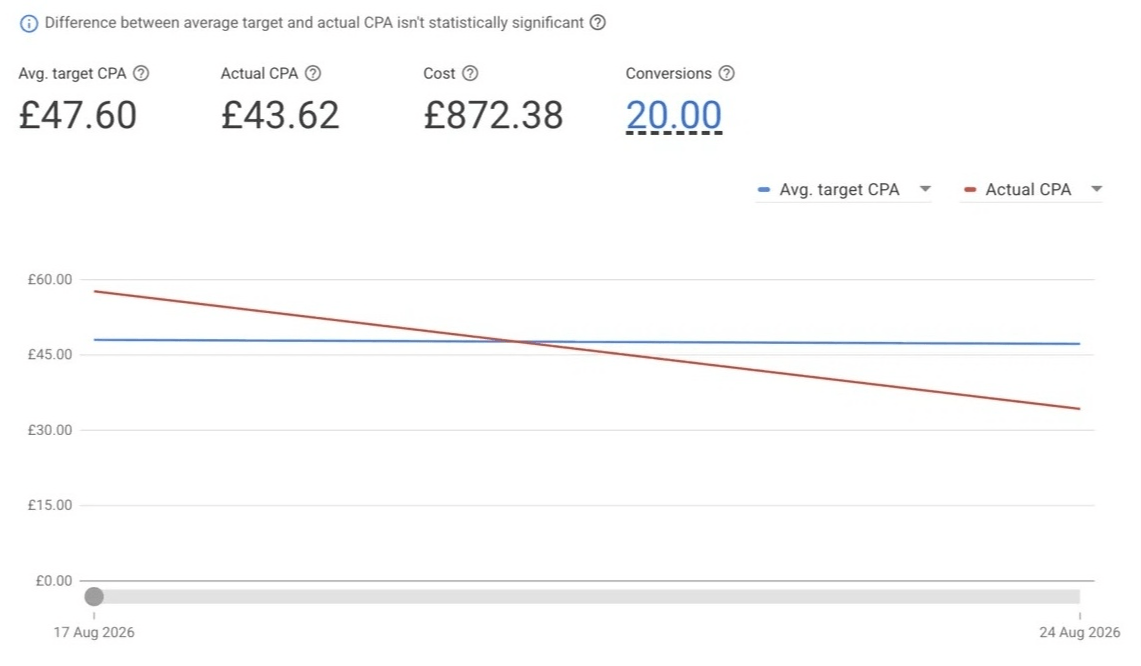
Google released a Bid Target Adjustment Tool with this update. It's in the notifications banner at the top of your Google Ads account, or through Campaigns settings. It shows the gap between your stated target and actual recent performance, and lets you adjust in a few clicks.
What should you do with your Target CPA campaigns after the August 2026 update?
The fourth option removes your floor entirely. Without a target, CPA and ROAS shift with every budget adjustment. It's not the right move for most accounts in this situation.
The right call depends on how far your actual CPA sits from your stated target, and whether the gap is accidental or deliberate.
What did PUSH do, and what did we find?
We ran three different approaches across client accounts in the days around 17 August to get real data before people started asking questions.
How three different approaches performed after 17 August 2026
That 18% gap is the number worth paying attention to. Campaigns on portfolio bid strategies with CPC caps held their CPA flat. Campaigns left on the old simplified setup, without a budget increase or target adjustment, saw costs rise by around 18%.
This update isn't punishing advertisers indiscriminately. It's exposing accounts where nobody has looked at the targets since launch. Every account left unchanged since 17 August is carrying risk it doesn't need to carry.
The early learning phase reset also gave us something we hadn't expected: a clean comparison point. Most advertisers will have muddied before/after data because the change landed mid-flight in live campaigns. Pushing a fresh learning phase the day before gave us a far clearer read on what the update actually did to performance signals.
What does this mean going forward?
Check your budget-limited campaigns today. Open the Bid Target Adjustment Tool. Look at the gap between your stated target and your actual performance, and close it deliberately.
Smart Bidding performs best when targets are reviewed regularly against real performance data. This update removes the buffer that compensated for targets that had never been revisited. That buffer was never part of the strategy. It was just there.
The accounts that come out of this well are the ones that treat it as a proper audit. Review your targets. Understand what the algorithm has actually been optimising toward. Set targets that reflect your current commercial reality and let the system work from there.
If you want a direct view of where your account is exposed, talk to our paid search team.
FAQ
What changed with Google's Target CPA bidding on 17 August 2026?
Google updated Smart Bidding so that campaigns optimise consistently toward the target you've set, regardless of whether a budget cap is limiting campaign reach. Previously, budget-limited campaigns often delivered CPAs well below their stated targets because the algorithm only competed in the highest-quality auctions. That natural filter has been removed.
Which Google Ads campaign types are affected by the August 2026 bidding update?
The update applies to Search, Shopping, Performance Max, Demand Gen and Travel campaigns. App campaigns, Video Reach campaigns and Video View campaigns are excluded. Display and Hotel campaigns already ran on this updated logic before August 2026.
What happens to my CPA if I don't update my Target CPA after this change?
If your campaign has been delivering at a CPA below your stated target, Google's system will now pursue auctions it previously skipped, pushing your actual CPA toward the target ceiling you've set. The drift is gradual. Most advertisers won't notice it immediately, but it compounds over two to four weeks.
How do I find and use the Google Ads Bid Target Adjustment Tool?
The tool is accessible via the notifications banner at the top of your Google Ads account, or through Campaigns settings. It shows the gap between your stated target and your actual recent performance, and allows you to update your target directly from the tool in a few clicks.
What is a portfolio bid strategy with CPC caps, and why did it help in PUSH's tests?
A portfolio bid strategy groups multiple campaigns under a shared bid goal and allows you to apply a Max CPC bid cap, creating a ceiling the algorithm cannot push past. In PUSH's testing around the August 2026 update, campaigns moved to this structure held their CPA flat, while campaigns left on simplified single-campaign bidding saw CPA rise by approximately 18%. The bid cap replicated the protective effect the budget ceiling used to provide by default.