

They weren't. They were in transportation. When commercial aviation took off and car ownership boomed, they had neither the mindset nor the momentum to adapt.
Sixty years on, the pattern hasn't changed. Only the industries have.
We are now in marketing's fifth era, driven by AI, and the companies that treat it as a tool upgrade rather than a structural shift are making the same mistake the railroads made. This post maps how we got here, what each era demanded of marketers, and why the window to act is shorter than most teams realise.
Key Takeaways
- Marketing has entered its fifth era, driven by AI. It changes more than just the tools required.
- The Kondratieff wave model shows that each technology cycle compresses faster than the last. The window to adapt is shorter than most businesses realise.
- Businesses that defined themselves by their existing model, not their customers' evolving needs, paid the price in every previous transition.
- The fifth era demands four genuine shifts: mindset, skills, stack, and measurement.
- Early adopters are already compounding advantages in data quality, creative speed, and AI search visibility. Every month of hesitation widens the gap.
Why Do Innovation Waves Punish Businesses That Wait?
Businesses that wait for certainty before adapting to a new technology wave do not get certainty. They get irrelevance. Levitt's railroad example wasn't just a story about one industry's poor strategic thinking. It was a warning about a recurring pattern: companies define themselves by what they sell rather than why customers buy. When the environment shifts, that definition becomes a trap.
Blockbuster is a more modern version I know well, having been UK Sales Director for Disney in 2002. At its peak, it had 9,000 stores globally and revenues of $6 billion. Netflix, then a DVD-by-mail startup, approached Blockbuster in 2000 offering to sell the company for $50 million. Blockbuster passed. What Blockbuster sold was video rentals. What customers wanted was convenient, affordable access to entertainment. Netflix understood the job. Blockbuster defended the store.
This isn't a problem unique to corporate giants. It happens at every scale. And the next version of it is happening right now, in marketing departments across the UK.
What Does the Kondratieff Cycle Tell Us About Marketing Today?
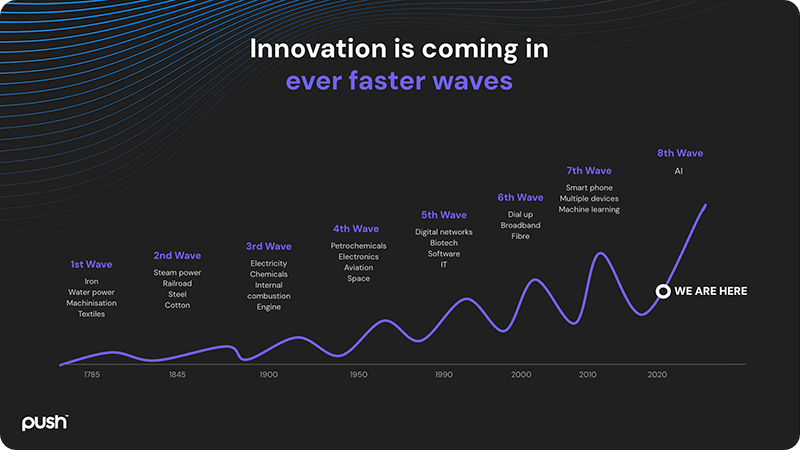
The Kondratieff cycle shows that each major technology wave produces clear winners and clear losers, and the gap between them is determined by how quickly organisations recognise the shift. Russian economist Nikolai Kondratieff identified long-run cycles, "waves," in which clusters of general-purpose technologies reorganise entire economies.
Each wave produces winners among those who build on the new infrastructure, and losers among those who cling to the old one.
The waves he identified have continued well beyond his original observations:
We are here. Wave eight.
What's striking about the last three waves is how quickly they arrived relative to each other. The gap between the steam age and the electricity age was roughly 55 years.
The gap between broadband, smartphones, and AI has been less than two decades. Innovation is compressing, which means the window between "early adopter advantage" and "too late to catch up" is compressing too.
What Changed in Each of the Five Eras of Marketing?
Each era of marketing does not just introduce new channels. It changes what skills are required, what language marketers use, and what "good" looks like. Each transition resets the competitive hierarchy.
The pattern is consistent. Each era demands new thinking, not just new tools. And each era leaves behind the practitioners and businesses that treat it as incremental.
Which UK Businesses Missed the Last Marketing Shift?
These aren't outliers. They are the predictable outcome of organisations that defined themselves by their existing model rather than their customers' evolving needs.
What Does Marketing's Fifth Era Actually Demand From Your Team?
AI-era marketing is not digital marketing with a smarter tool bolted on. It requires four genuine shifts.
Mindset. From campaigns to continuous learning loops. From channel managers to system orchestrators. The marketer's job is no longer to run a campaign. It's to build and govern a system that learns, adapts, and personalises in near real-time.
Skills. The new vocabulary is not decorative. Generative Engine Optimisation (GEO) matters because your clients are now discovering products and services through AI-powered search tools, not just Google. Prompt engineering determines the quality of AI-generated creative and analysis. First-party data strategy determines whether your models learn anything useful at all.
Stack. Siloed point tools are losing ground to integrated AI-augmented platforms where agents can automate testing, personalise journeys, and surface insights without waiting for a human to pull a report.
Measurement. Last-click attribution was already inadequate. In an AI-driven era, the standard shifts to incrementality, causal lift, and always-on experimentation, with decisions made by models informed by clean, consented data.
We've spent nearly two decades at Push working at the intersection of performance marketing and emerging technology. Winning Best Use of AI at the UK Agency Awards 2025 and Best Use of AI in Search at the UK Search Awards 2025 wasn't the result of adopting AI late. It came from treating each new wave as a fundamental operating shift, not a feature update.
What Is the Real Cost of Waiting on AI Marketing?
The cost of waiting is compounding disadvantage. Every month you delay, competitors build cleaner data, faster creative cycles, lower acquisition costs, and stronger positions on AI-infused discovery surfaces.
The Kondratieff waves used to give businesses decades to adjust. The last three gave them years. This one is moving faster still.
Early adopters are already building those advantages. Every month that passes, the gap between the adapters and the hesitators widens. And unlike the railway era, there is no geographic moat to hide behind. A UK business that masters AI-driven marketing competes nationally and internationally from day one.
The railroad companies had warning signs for years before aviation took their market. Blockbuster had Netflix at their door offering to sell. HMV watched iTunes transform an industry and still took a decade to respond. The evidence is always visible in advance. The question is whether you act on it.
Ready to understand where your business sits in the AI marketing transition?
Our team works with UK businesses to build practical AI marketing capability. We focus on execution that compounds, not theory or tool demonstrations.
Talk to the Push team