
Gilcrest Manufacturing has been making precision panel systems since 1946. Its Puracore® cleanroom walling and Puracoustic® acoustic systems serve some of the most demanding buyers in the world: Rolls-Royce, Pfizer, GSK, Dyson and McLaren.
These are not impulse purchases. Search volumes are thin, CPCs are high, and a single wasted click on the wrong enquiry matters. When Push took on the account in August 2025, the brief was simple: build a pipeline, not just traffic.
Gilcrest operates in a niche where the buyers are engineers and specifiers, not casual searchers. Monthly search volumes for the most valuable terms run in the hundreds. Deal values run to six figures. In that environment, a poorly structured account does not just waste budget. It fails to build anything.
The account diagnostic identified three structural problems.
- Capped discovery. Heavy reliance on exact and phrase match limited learning and volume.
- Wrong optimisation signal. Campaigns chased raw form-fills, pulling in off-spec and residential traffic that would never convert.
- Budget diluted. Spend spread too thinly across too many keywords to dominate anything.
Our paid search strategy was built in four moves.
Segment and test. We used Broad match as a deliberate discovery engine, paired with smart bidding and a tight negative keyword list. Its job was to find signal cheaply in a thin, expensive niche.
Isolate match types. Broad, Exact and Phrase ran in separate campaigns with separate budgets. That separation meant we could scale harvest independently of discovery, cutting spend without cutting leads.
Consolidate onto winners. The keyword universe was condensed from around 65 terms to a focused set of proven, high-relevance angles. Better to own impression share on a few than to be invisible across many.
Connect to pipeline via OCT. By feeding CRM stages (Lead, MQL, SQL, Opportunity) back into Google Ads via GCLID upload, we trained the algorithm to value qualified opportunities, not cheap form submissions.
From August 2025 to July 2026, the account did more with less. Spend came down in the second half. Lead volume held and then grew. Quality stayed consistent throughout.
- Monthly leads up +61% from launch to July 2026
- Cost per lead down -51% over the same period
- Average CPC down -14%
- Blended CTR reached 8.3%, peaking near 11%
- MQL rate held at approximately 60% across the year
- CPL fell from a first-half average of £133 to £74 in the second half
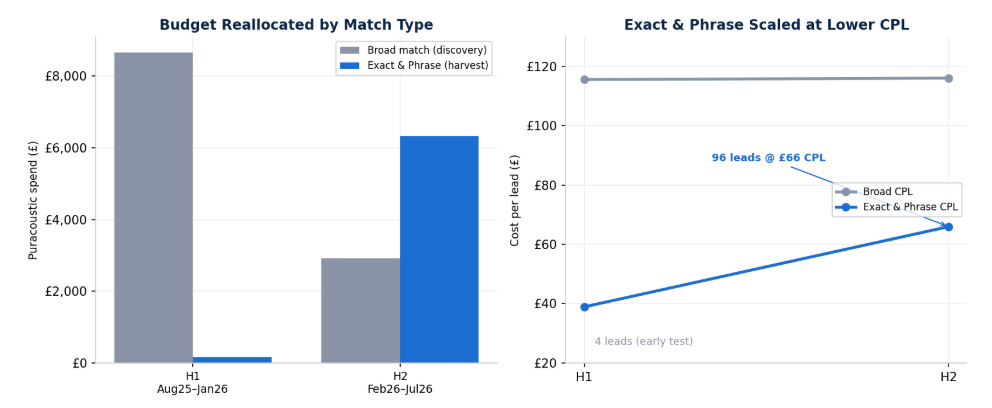
The headline improvement is straightforward. From launch to July 2026, monthly leads rose 61% and cost per lead fell 51%.
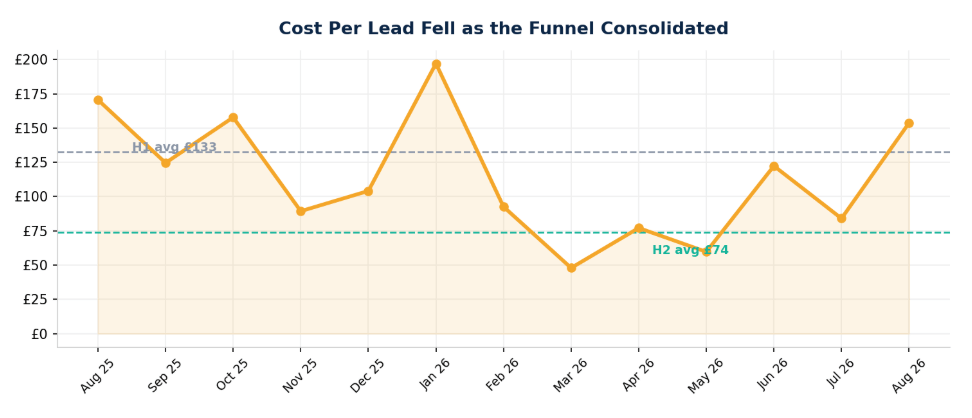
Spend was pulled back deliberately in H2. Lead output held and then climbed. That is the signature of a consolidating funnel.
This was an account where the niche never got easier. Thin search volumes, high CPCs, long buying cycles. What changed was the architecture underneath.
Separating discovery from harvest, connecting bidding to pipeline value, and concentrating spend on proven terms turned a fragile account into a controllable one. Leads grew, cost fell, and quality held at a 60% MQL rate throughout.
The same structure is now the platform for Gilcrest's expansion into new sectors and international markets.